
Top Social Media Sites: The 2026 Social Landscape at a Glance
- The Big Shift: Reach is out; community is in. 1,000 engaged fans are worth more than 10,000 silent followers.
- The AI Factor: AI is a massive co-pilot for content creation, but audiences are actively seeking out “human-generated content” to combat AI fatigue.
- Social Search: Over 60% of product discovery now happens on social platforms rather than traditional search engines.
- Top Dog: Facebook still holds the crown globally for overall users (over 3 billion), but Instagram and YouTube are leading the charge in engagement and cultural relevance.
It is 2026, and the digital landscape feels entirely different than it did just a few years ago. Do you remember when social media was just about posting heavily filtered vacation photos or updating a basic text status? Those days are ancient history. Today, feeds are powered by advanced AI, search engines are taking a backseat to social discovery, and “micro-communities” are the new digital living rooms.
If you are a creator, a business owner, or just someone trying to keep up with where your friends are hanging out, figuring out the Top Social Media Sites right now can feel like trying to drink from a firehose.
You might be wondering where to spend your time. Should you focus on short-form video? Are decentralized networks worth the hype? What even works anymore now that AI content is everywhere?
I get it. The sheer volume of options is overwhelming. But here is the good news: you do not have to be everywhere at once. You just have to be in the right places. In this guide, we are going to break it all down. We will explore exactly what is working this year, dive into the 30 Social Media Platforms Ranked by Users in 2026, and uncover the hidden gems among new social media sites. Grab a cup of coffee, and let’s figure out your digital strategy for the year.
What Do You Mean By Social Media Sites in 2026?
Let’s start with a quick reset. If someone asks, “What do you mean by social media sites?” in 2026, the answer goes way beyond “a place to add friends.”
Today, social media sites are dynamic ecosystems. They are search engines, e-commerce storefronts, customer service hubs, and entertainment networks all rolled into one. They are digital platforms that allow users to create, share, and exchange information, ideas, and multimedia in virtual communities. But more importantly, they are where internet culture is born and where modern commerce thrives.
Types of Social Media
Not all platforms serve the same purpose. Understanding the Types of social media helps you figure out where you belong.
- Social Networks (Facebook, LinkedIn, X/Twitter): Built for connecting with people, sharing updates, and fostering professional or personal relationships.
- Media Sharing Networks (Instagram, TikTok, YouTube, Snapchat): Highly visual platforms centered around photos, short-form videos, and long-form content.
- Discussion Forums (Reddit, Quora): Places where communities gather around niche interests to ask questions, debate, and share deep-dive information.
- Social Commerce Platforms (Pinterest, TikTok Shop): Platforms where the primary user intent heavily overlaps with product discovery, inspiration, and direct purchasing.
- Decentralized/Federated Networks (Mastodon, Bluesky): The new frontier. These operate on independent servers, giving users more control over their data and algorithms.
- Private Messaging/Community Apps (WhatsApp, Telegram, Discord): The rising stars of 2026. Dark social and direct message (DM) groups are where the real, unfiltered conversations happen.
Advantages of Social Media
Why should you care? The Advantages of social media in 2026 are impossible to ignore, whether you are building a personal brand or scaling an enterprise.
- Social SEO and Discovery: Platforms are acting like search engines. If you optimize your content properly, your videos and posts will continue to pull in views and sales months after you post them.
- Direct Audience Connection: You have unfiltered access to your target demographic. Features like polls, AR social filters, and direct messages allow for two-way communication that traditional media cannot match.
- Monetization and Commerce: With integrated shops and the booming creator economy, social platforms are direct revenue drivers. You can literally sell products directly from a live stream.
- Community Building: In an era of AI overload, platforms offer a space to build authentic, loyal communities. Finding your “tribe” has never been easier.
25 Social Media Platforms Ranked by Users in 2026
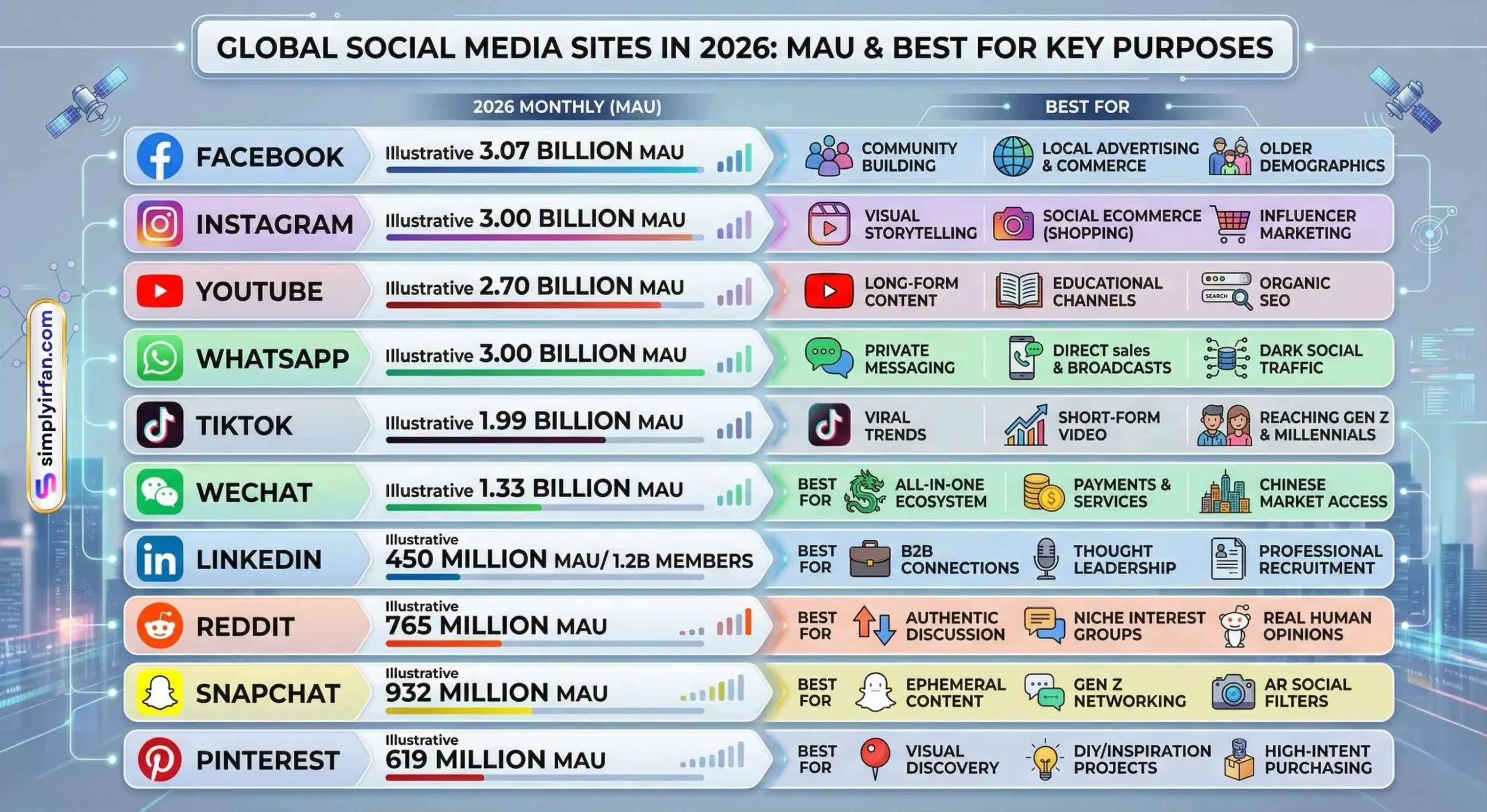
Alright, let’s get into the main event. Where is everyone spending their time? Here are the top 25 Social Media Platforms Ranked by Users in 2026, ranked by a combination of Monthly Active Users (MAU), cultural relevance, and user engagement metrics.
1. Facebook
- 2026 MAU: ~3.07 Billion
- Best For: Community building, localized advertising, and e-commerce.
- The 2026 Reality: You might think Facebook is just for your older relatives, but the stats say otherwise. It remains the undisputed king of sheer numbers. In 2026, Facebook Groups are thriving micro-communities, and Facebook Marketplace is practically a digital economy of its own. Marketers still rank it as a top platform for reliable ROI. It is not the trendiest, but it is the most reliable anchor for any brand.
2. Instagram
- 2026 MAU: ~3.0 Billion
- Best For: Visual storytelling, influencer marketing, and social commerce.
- The 2026 Reality: Instagram is breathing down Facebook’s neck in terms of user numbers, but it destroys Facebook in cultural impact. Reels are dominating the feed, making up the bulk of user engagement. In 2026, Instagram is essentially the new digital mall. If you are selling a lifestyle, a physical product, or a personal brand, this is your primary storefront. The DM feature has also evolved into a massive customer service and sales tool.
3. WhatsApp
- 2026 MAU: ~3.0 Billion
- Best For: Direct messaging, international communication, and private community broadcasts.
- The 2026 Reality: WhatsApp is no longer just a texting app. With the explosion of WhatsApp Channels in recent years, brands and creators are using it for direct-to-consumer broadcasts. It is the definition of “dark social” the place where links are shared privately among friends, driving massive, untrackable traffic.
4. YouTube
- 2026 MAU: ~2.7 Billion
- Best For: Long-form education, entertainment, and native SEO.
- The 2026 Reality: YouTube is the ultimate search engine. In 2026, the strategy is all about combining “Searchable Shorts” for discovery with “Story-Building Longs” for deep connection. Users trust YouTube more than almost any other platform for long-term learning and product reviews. If you want to build enduring authority, YouTube is non-negotiable.
5. TikTok
- 2026 MAU: ~1.99 Billion
- Best For: Viral marketing, short-form video, and reaching Gen Z/Millennials.
- The 2026 Reality: TikTok completely rewired how algorithms work, shifting the focus from the “social graph” (who you follow) to the “interest graph” (what you like). In 2026, users spend a staggering 97 minutes a day on the app. TikTok Shop has turned the platform into a massive e-commerce engine. It is not just about dancing anymore; it is where people go to learn how to cook, fix a sink, or decide what book to read next.
6. WeChat
- 2026 MAU: ~1.33 Billion
- Best For: Reaching the Chinese market, all-in-one digital living.
- The 2026 Reality: WeChat is an “everything app.” If you live in China or are marketing to the Chinese demographic, WeChat is indispensable. It handles messaging, social feeds, mobile payments, and mini-programs (apps within the app). It is a closed ecosystem that dominates daily life in its primary market.
7. LinkedIn
- 2026 MAU: ~1.2 Billion Members (approx. 450M MAU)
- Best For: Professional networking, B2B marketing, and thought leadership.
- The 2026 Reality: LinkedIn had a massive glow-up over the last few years. It is no longer just an online resume. It is a thriving content platform where professionals share vulnerable stories, deep industry insights, and long-form articles. With organic reach still surprisingly high in 2026, it is the absolute best place for B2B brands and founders to build their voice.
8. Telegram
- 2026 MAU: ~1.0 Billion
- Best For: Secure messaging, large-scale broadcasts, and cryptocurrency communities.
- The 2026 Reality: Telegram found its niche among tech enthusiasts, crypto traders, and users demanding privacy. Its Channel feature allows creators to broadcast to millions instantly. It operates largely outside the traditional algorithmic feed, making it a powerful tool for direct audience retention.
9. Snapchat
- 2026 MAU: ~932 Million
- Best For: Direct engagement with Gen Z, AR social filters, and ephemeral content.
- The 2026 Reality: Snap has quietly maintained a massive, highly engaged user base, particularly among teens and young adults. While they may scroll TikTok for entertainment, they use Snapchat to talk to their actual friends. Snap’s AR technology remains industry-leading, allowing brands to create immersive try-on experiences.
10. Reddit
- 2026 MAU: ~765 Million
- Best For: Community insights, highly specific niches, and authentic text-based discussion.
- The 2026 Reality: Reddit has exploded in mainstream relevance. Why? Because when people are tired of AI-generated fluff on Google, they add “Reddit” to the end of their search queries to find real human opinions. In 2026, it is a goldmine for market research. Brands that try to overtly advertise here get destroyed, but those that participate authentically win huge loyalty.
11. Douyin
- 2026 MAU: ~728 Million
- Best For: Short-form video and e-commerce in China.
- The 2026 Reality: TikTok’s sister app in China. It is years ahead of Western platforms in terms of live commerce. Creators seamlessly sell products during highly produced live streams, a trend that is rapidly trickling over to the rest of the world.
12. Kuaishou
- 2026 MAU: ~715 Million
- Best For: Live commerce, rural Chinese demographics.
- The 2026 Reality: Douyin’s biggest rival. Kuaishou leans heavily into live streaming and e-commerce, but historically captures a slightly more rural, deeply loyal user base compared to Douyin’s urban skew.
13. Pinterest
- 2026 MAU: ~619 Million
- Best For: Visual discovery, mood-boarding, and high-intent shopping.
- The 2026 Reality: Pinterest is the ultimate “future-planning” app. Users do not go there to see what their friends are doing; they go there to plan their weddings, renovate their kitchens, or update their wardrobes. In 2026, 96% of top searches are unbranded, meaning new businesses have a massive opportunity to be discovered. The audience is female-dominated and skews heavily towards luxury and high-intent purchasing.
14. Weibo
- 2026 MAU: ~588 Million
- Best For: Trend-driven content and celebrity news in China.
- The 2026 Reality: Often compared to X (Twitter), Weibo is the pulse of Chinese pop culture, trending topics, and real-time news.
15. X (formerly Twitter)
- 2026 MAU: ~557 Million
- Best For: Real-time news, political discourse, and tech/crypto conversations.
- The 2026 Reality: X remains the global town square for breaking news and industry conversations, despite a chaotic few years of rebranding and algorithm shifts. It is highly text-based, male-dominated, and relies heavily on outrage, humor, and rapid-fire commentary. It is indispensable for journalists and specific niches, but harder for traditional brand marketing.
16. QQ
- 2026 MAU: ~554 Million
- Best For: Desktop messaging, gaming integrations, youth in China.
- The 2026 Reality: A legacy Tencent property that remains sticky among younger users in China due to its deep integration with gaming ecosystems.
17. Threads
- 2026 MAU: ~400 Million
- Best For: Conversational, casual text-posting connected to the Instagram ecosystem.
- The 2026 Reality: Meta’s answer to X. Threads leveraged Instagram’s massive user base to scale incredibly fast. By 2026, it has matured from a chaotic launch into a stable platform for text-based creator content, brand banter, and community dialogue. It is less news-focused than X and leans more heavily into lifestyle, pop culture, and creator engagement.
18. Quora
- 2026 MAU: ~400 Million
- Best For: Q&A, long-tail SEO, and educational authority.
- The 2026 Reality: Quora remains a strong SEO player. If you can provide detailed, expert answers to specific niche questions, your content will index highly on search engines, driving passive traffic for years.
19. RedNote (Xiaohongshu)
- 2026 MAU: ~350 Million
- Best For: Lifestyle reviews, travel, and product recommendations in China.
- The 2026 Reality: Often described as a mix of Instagram and Pinterest. It is deeply trusted by young, affluent Chinese women for authentic product reviews and aesthetic lifestyle inspiration.
20. Discord
- 2026 MAU: ~259 Million
- Best For: Private, topic-based communities, gaming, and web3.
- The 2026 Reality: What started as an audio-chat app for gamers is now the premier platform for community management. Brands, podcasters, and creators use Discord servers to build highly engaged, VIP-feeling spaces away from the noise of public algorithmic feeds.
21. Twitch
- 2026 MAU: ~240 Million
- Best For: Live streaming, gaming, and real-time interaction.
- The 2026 Reality: The undisputed king of live-streamed entertainment in the West. Twitch demands incredibly high creator stamina. It is unparalleled for building intense, parasocial relationships between streamers and their chat.
22. Tumblr
- 2026 MAU: ~95 Million
- Best For: Fandoms, creative self-expression, and alternative internet culture.
- The 2026 Reality: Tumblr refuses to die. It remains a haven for dedicated fandoms, artists, and users who prefer a chronologically sorted, ad-light experience away from the polished aesthetic of Instagram.
23. Bluesky
- 2026 MAU: ~40 Million
- Best For: Decentralized text networking, tech enthusiasts, and fleeing X users.
- The 2026 Reality: A massive trend in 2026 is the flight to decentralized platforms. Bluesky gained major traction by offering an experience similar to early Twitter but built on an open protocol (the AT Protocol). Users love it because they control their own algorithms and moderation settings.
24. Mastodon
- 2026 MAU: ~1-5 Million (Fluctuates based on federation instances)
- Best For: Open-source purists and decentralized, chronological feeds.
- The 2026 Reality: The original decentralized alternative. It has a steeper learning curve because users have to join specific servers (“instances”), but it fosters fiercely loyal, ad-free micro-communities.
25. Substack Notes / Substack
- 2026 MAU: (User base highly fragmented across newsletters)
- Best For: Long-form writing, direct monetization, and intellectual discourse.
- The 2026 Reality: Substack successfully bridged the gap between email newsletters and social feeds with “Notes.” It is the premier platform for writers and journalists to monetize their audience directly without relying on ad revenue or algorithms.
Exploring New Social Media Sites and 2026 Trends
Understanding the platforms is only half the battle. To actually succeed, you need to understand the behavioral shifts happening underneath them. The era of posting a glossy photo with a generic caption and expecting it to go viral is over. Let’s look at the definitive trends shaping the digital world in 2026.
1. The Era of “AI Slop” vs. Human Authenticity
Let’s talk about the elephant in the room: Generative AI. Over the last few years, tools became so good and so accessible that the internet was flooded with cheap, auto-generated content. Marketers call this “AI slop.” Feeds became crowded with overly polished, synthetic images and robotic text.
As a result, user behavior aggressively pivoted. In 2026, human-generated content is the number one priority for users. They are craving mistakes, raw iPhone footage, behind-the-scenes vlogs, and authentic storytelling.
- Actionable Insight: Use AI as your co-pilot, not your creator. Let AI outline your content calendar, analyze your metrics, or generate first drafts. But when it comes time to hit post, ensure the voice, the face, and the story are unapologetically human.
2. Social SEO: Platforms are the New Search Engines
If a Gen Z user wants to know how to fix a leaky faucet or find the best sushi in town, they do not go to Google. They go to TikTok or YouTube Shorts. They want to see the solution, not read a recipe blog with 14 pop-up ads.
In 2026, social platforms are surfacing answers, not just content.
- Actionable Insight: Stop relying purely on trending audio. Start treating your social posts like search results. Build videos with clear, problem-solving hooks (e.g., “3 Things to Check Before Buying a Used Car”). Use native SEO by putting keywords in your titles, captions, and on-screen text.
3. The Shift to “Dark Social” and Micro-Communities
People are tired of performing for an audience of millions. They are retreating into private spaces. The real engagement, the deep conversations, the conversions, the link sharing, is happening in DMs, WhatsApp groups, Discord servers, and exclusive subreddits.
- Actionable Insight: Focus on building a VIP experience. Instead of trying to go viral to reach a million strangers, figure out how to get 500 people into a private community where you can offer them exclusive value. Prompt users to DM you for a link rather than putting it in your bio.
4. The Rise of “Social Telenovelas”
Attention spans are short, but people love a good story. A massive trend imported from Asian markets into the US and Europe in 2026 is the “Social Telenovela” short, serialized, highly dramatic multi-part videos. Think of them as 60-second soap operas that just happen to feature a product placement.
- Actionable Insight: Embrace storytelling. Create a series instead of one-off posts. End videos on a cliffhanger. Make it purposefully imperfect to drive comments and debate.
Platform Comparison: Where Should You Start?
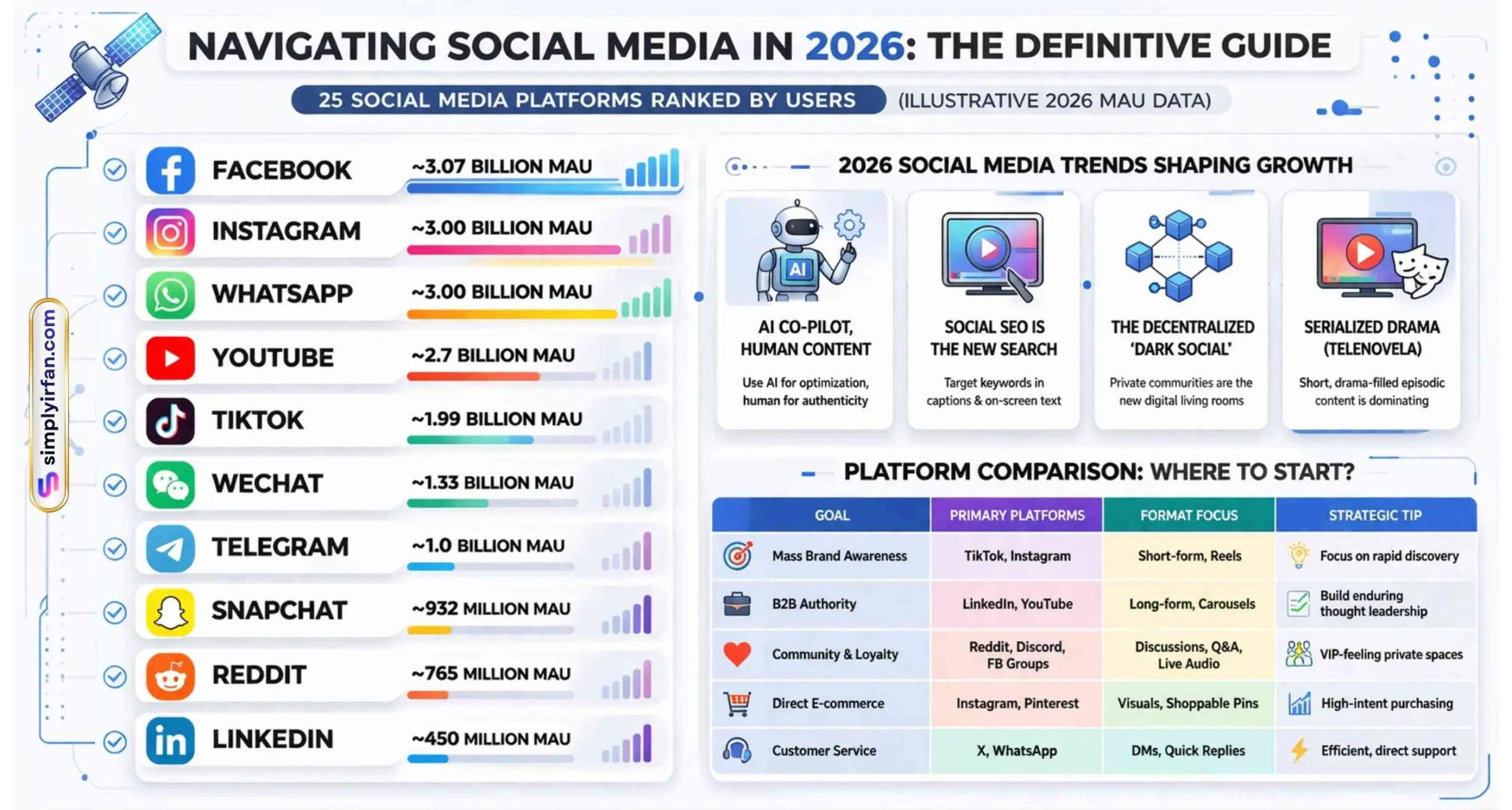
If you are overwhelmed, here is a quick cheat sheet on where to invest your energy based on your goals in 2026:
| Your Goal | Primary Platform | Format Focus |
| Mass Brand Awareness | TikTok, Instagram | Short-form video, Reels, Trends |
| B2B Authority & Leads | LinkedIn, YouTube | Long-form video, Carousel text posts |
| Community & Loyalty | Reddit, Discord, FB Groups | Text discussions, Q&A, Live audio |
| Direct E-commerce | Instagram, Pinterest | High-quality visuals, Shoppable pins |
| Customer Service | X (Twitter), WhatsApp | Direct messaging, Quick replies |
Frequently Asked Questions (FAQ)
1. What are the best new social media sites to join in 2026?
If you are looking for new or rapidly evolving spaces, Bluesky and Threads are the top contenders for text-based networking. Bluesky offers a decentralized, customizable experience, while Threads provides seamless integration with the Instagram ecosystem. Substack Notes is also excellent for writers seeking a smart, algorithm-light community.
2. Which platform is best for small businesses?
It depends heavily on your niche. However, Instagram remains the most versatile. It offers strong visual tools, e-commerce integration (Instagram Shopping), and massive local discovery potential. If your business solves specific problems (like plumbing or finance), YouTube Shorts and TikTok are incredible for Social SEO discovery.
3. Is Facebook dead in 2026?
Absolutely not. While it may lack the cultural “cool factor” among Gen Z, Facebook still boasts over 3 billion monthly active users. It remains incredibly dominant for local community building (Facebook Groups), localized advertising, and peer-to-peer selling (Facebook Marketplace).
4. How is AI changing social media in 2026?
AI is a double-edged sword. On the backend, it powers hyper-personalized algorithms and provides creators with incredible editing and analytics tools. On the front end, an overload of “AI slop” has made users skeptical. The current trend heavily favors authentic, “human-first” content to cut through the synthetic noise.
5. What is the most used social media by age in 2026?
- Gen Z (16-24): TikTok heavily dominates their screen time, followed closely by Instagram and Snapchat for messaging.
- Millennials (25-40): Instagram and YouTube are the primary hubs, with LinkedIn growing significantly for professional networking.
- Gen X & Boomers (41+): Facebook and YouTube remain the absolute staples for news, community, and entertainment.
6. What do you mean by decentralized social media?
Decentralized networks, like Mastodon or Bluesky, do not run on a single company’s servers (like Meta or Google). Instead, they run on independent servers created by users or organizations. This gives users ownership over their data, freedom from corporate algorithms, and custom moderation choices.
Conclusion: Finding Your Space in the 2026 Landscape
The days of trying to be everywhere at once are over. The best social media sites for you are simply the ones where your specific audience hangs out and where you enjoy creating.
In 2026, the internet is loud, fast, and crowded. The only way to win is to stop shouting into the void and start speaking directly to the people who matter. Focus on Social SEO so people can find you when they are searching. Lean into authentic, human-centric storytelling to combat AI fatigue. And most importantly, move your most loyal followers off the algorithmic feed and into direct, micro-communities.
The digital world has changed, but the core rule of human connection has not: provide value, be authentic, and listen to your community.
What is your primary social media platform going to be this year? Drop a comment below or share this guide with a friend who is trying to figure out their 2026 digital strategy!
Also Read