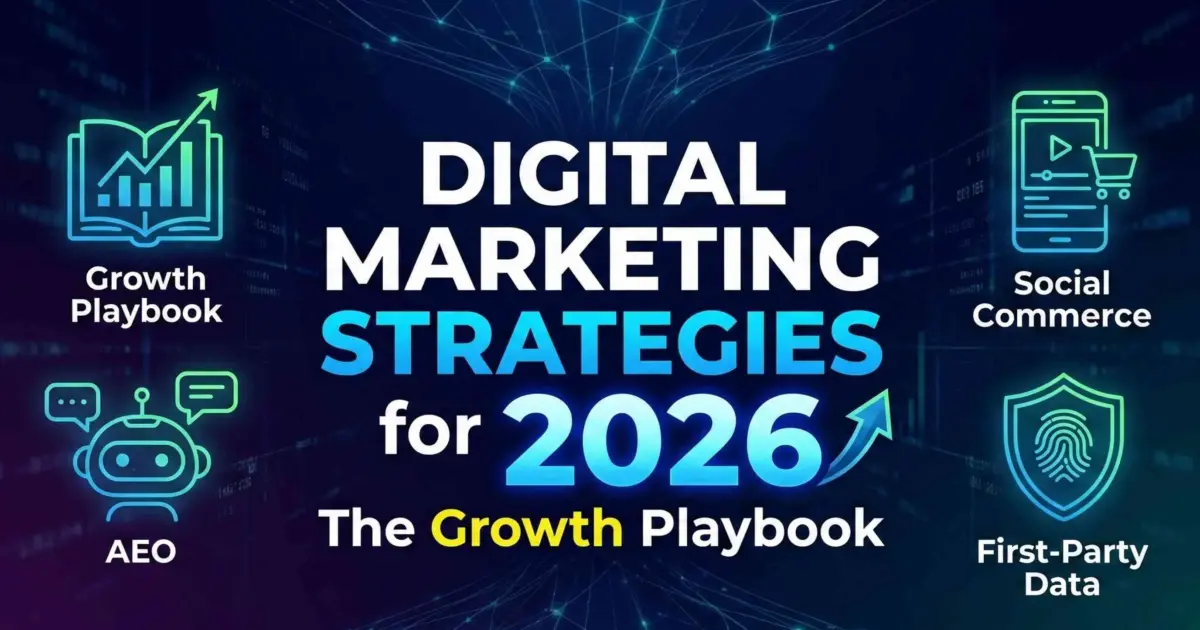
In 2026, the game has shifted from “gaming the algorithm” to earning the click. The big winners are focusing on Answer Engine Optimization (AEO) to capture AI-generated summaries, leaning into creator-led social commerce, and protecting their growth with first-party data. If you aren’t humanizing your brand through video and high-intent storytelling, you’re invisible.
The New Frontier: Why 2026 Feels Different
Remember when we used to obsess over being “blue link #1” on Google? That world is fading. As we move through 2026, we’ve entered the era of the Answer Engine. Between Google’s AI Overviews and assistants like Gemini or ChatGPT, users often get exactly what they need without ever clicking a website.
It sounds scary, but for the savvy business owner, it’s a massive opportunity. The core of all successful digital marketing strategies this year is no longer about volume; it’s about intent and authority. We are moving from “Search Engine Optimization” to “Generative Engine Optimization” (GEO).
Think about it: when you ask your phone, “What are the best digital marketing strategies for a small e-commerce brand?” you don’t want a list of ten websites. You want a clear, step-by-step answer. To win in 2026, your business needs to be the source that the AI trusts enough to cite.
1. Master the Shift from SEO to Answer Engine Optimization (AEO)
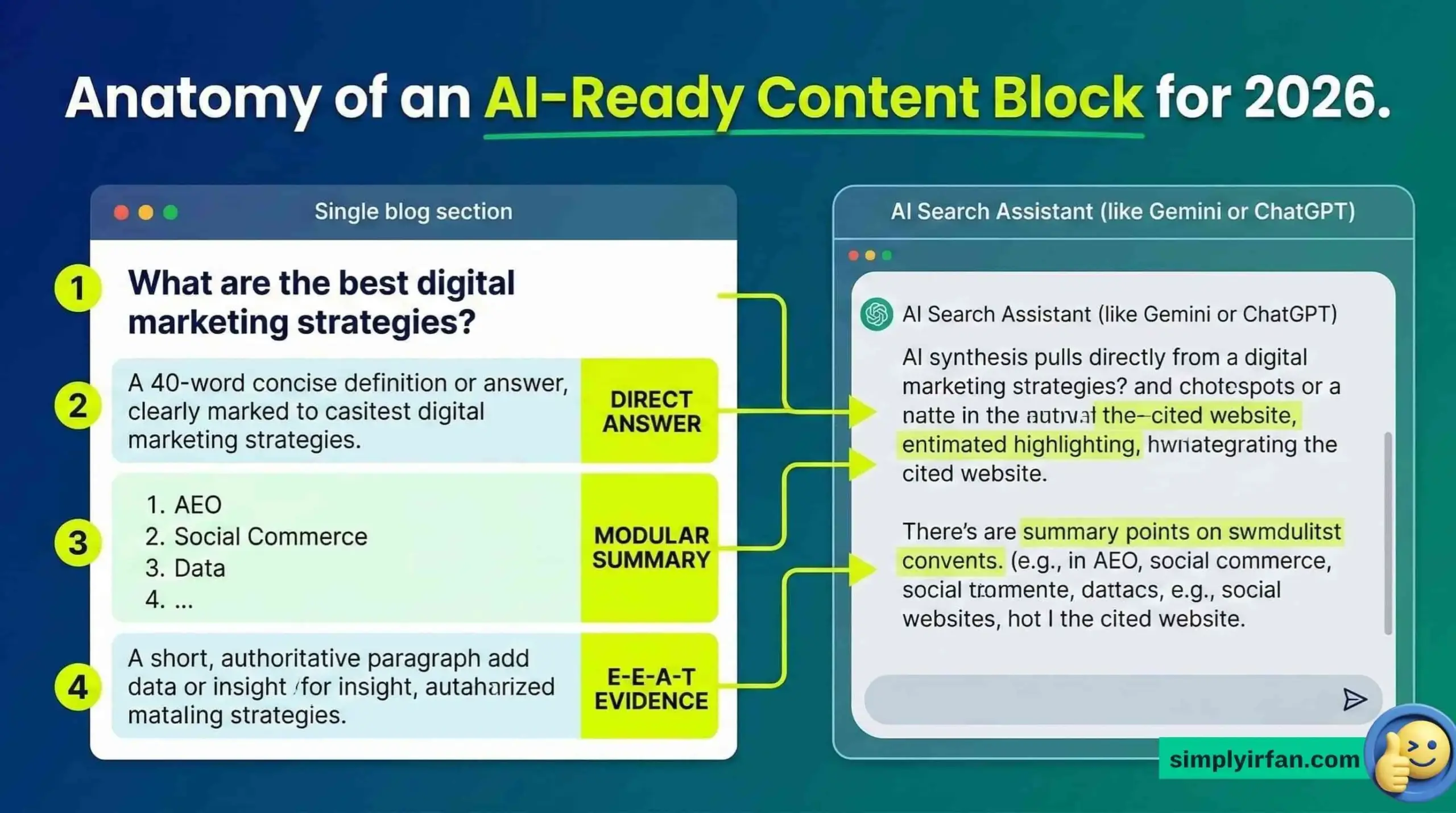
Search has evolved. We used to write for robots; now we write for “models.” AEO is the practice of optimizing your content so that AI models can easily digest, synthesize, and credit your information.
The “Snippet-First” Framework To rank in AI summaries, you have to stop “burying the lede.” In 2026, the most effective content follows an inverted pyramid. Give the direct answer in the first 50 words, then expand. AI crawlers love structured, “modular” content. If your blog post is just one giant wall of text, the AI will skip it. Use bulleted summaries and clear, question-based headings.
Example 1: The AI-Optimized Blog Post
- User Intent: The user is searching for “how to choose a CRM for small business.”
- The Content: You publish a blog post titled “The 5 Best CRMs for Small Business in 2026.”
- AEO Execution: Instead of a flowery introduction, the post starts with a clear, bold definition: “A small business CRM is software that helps manage customer relationships. The best choice for 2026 is [Brand A] for its ease of use, [Brand B] for affordability, or [Brand C] for robust features.”
- The Result: Google’s AI Overview instantly scrapes this direct definition and credits your blog with a citation.
The Authority Factor
Google’s E-E-A-T (Experience, Expertise, Authoritativeness, and Trustworthiness) is now the primary filter. In a sea of “AI slop” generic, low-quality AI-generated articles human-led, data-backed insights are gold. Use original case studies and proprietary data. If you can say, “We tested this on 500 accounts and here is what happened,” you have a moat that no generic AI can cross.
2. Social Commerce and the Rise of “Search Everywhere”
For the younger demographic in 2026, TikTok, Instagram, and even YouTube are the new Google. Social media platforms have essentially become visual search engines. If you aren’t optimizing your social captions with keywords and local tags, you are missing out on high-intent traffic.
Example 2: The Social Search Journey
- User Intent: A user in Atlanta is looking for “eco-friendly cleaning services.”
- The Content: Instead of searching Google, they open TikTok and search.
- Execution: Your Atlanta-based cleaning company has a short, engaging video showing a “satisfying clean” using green products. The caption is optimized: “Best eco-friendly cleaning service in #Atlanta. Book your green clean today! #ATLsmallbusiness.”
- The Result: Your video appears in the top results, and the user taps the link in your bio to book immediately.
Creator-Led Growth Traditional “influencer marketing” has matured into Creator-Led Commerce. People don’t want to see a polished celebrity holding a product; they want to see a niche expert explain why a product actually solves a problem. Short-form video remains the king, but in 2026, we’re seeing a massive comeback in “Long-form Short-form”—videos that are 2-3 minutes long but fast-paced and packed with utility.
The “On-Platform” Conversion
The most successful digital marketing strategies involve shortening the distance between discovery and purchase. With the integration of “Buy Now” buttons inside social feeds and AI-powered chat commerce (like WhatsApp marketing), forcing a customer to click a link to your website is often a point of friction you can’t afford.
In 2026, forcing a customer to click a link to an external website is a point of friction you can no longer afford. The most successful digital marketing strategies capture the impulse purchase directly within the discovery feed.
The infographic below visually diagrams this “On-Platform” conversion journey, showing how discovery, intent, and purchase are seamlessly integrated.
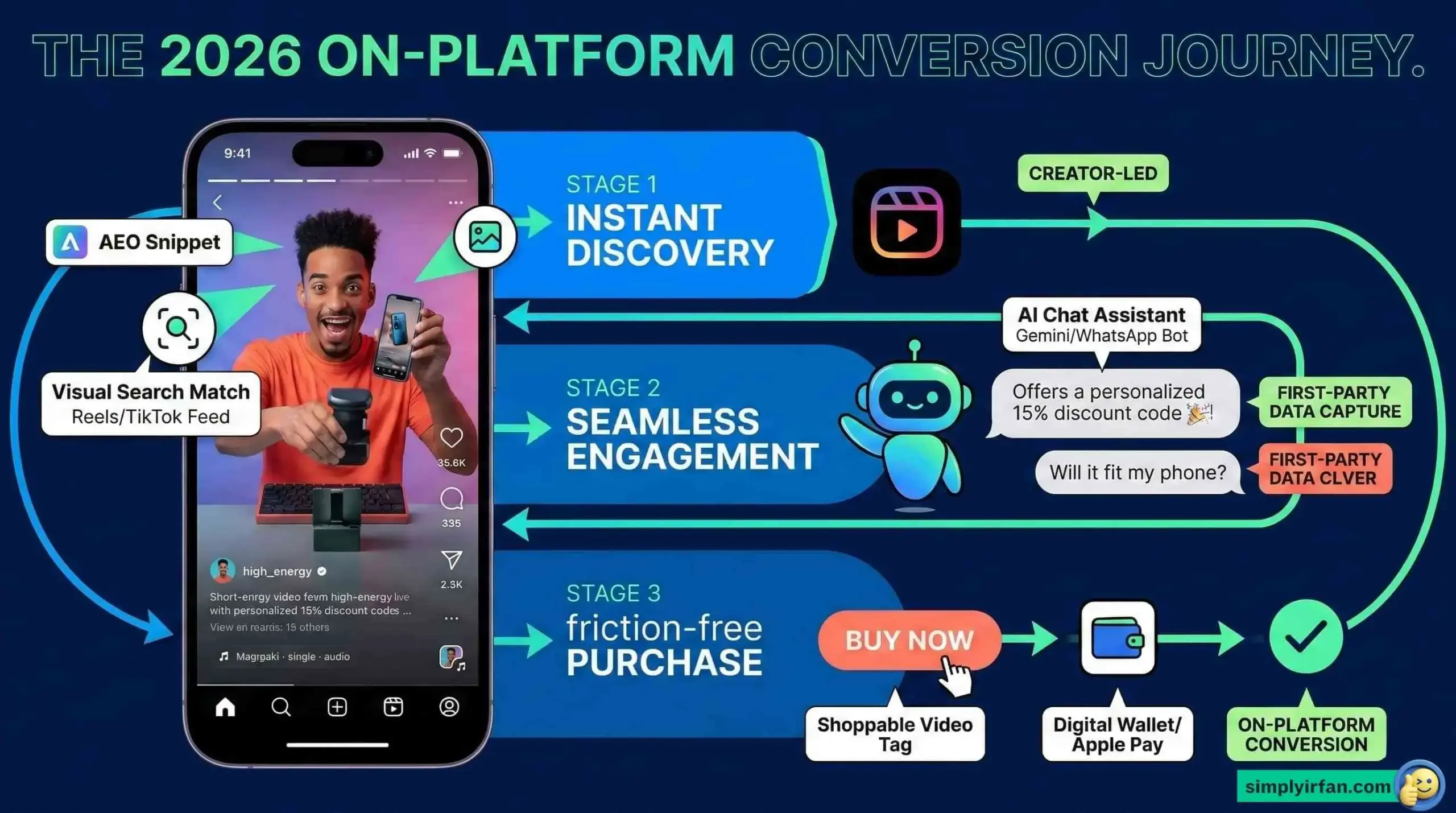
Breakdown of the 2026 On-Platform Conversion
- 1. INSTANT DISCOVERY: A user scrolls through a social feed. Instead of generalized keywords, the experience is driven by highly specific searches (labeled ‘Visual Search Match’) or an instant AI answer (labeled ‘AEO Snippet’) presented directly above the video. The content must be ‘Creator-Led’ and high-energy to capture attention immediately.
- 2. SEAMLESS ENGAGEMENT: The video itself is now an interactive storefront (the white boundary). Users can tap or use an integrated AI chat (like Gemini or a brand bot, labeled ‘AI Chat Assistant’) to ask questions without leaving the feed. The bot can immediately offer a personalized 15% discount (labeled ‘FIRST-PARTY DATA CAPTURE’). This engagement is conversational and builds trust.
- 3. friction-free PURCHASE: When the user decides to buy, there are zero clicks to an external site. A permanent ‘Shoppable Video Tag’ (the red ‘BUY NOW’ button) is baked into the video interface. One tap activates the mobile device’s native payment system (labeled ‘Digital Wallet/Apple Pay’). The transaction is completed instantly, confirming the sale right there in the app.
3. Building a Privacy-First Data Fortress
The “Cookie-pocalypse” is over, and the dust has settled. We live in a world where third-party tracking is largely a memory. This makes first-party data—the information users give you directly—the most valuable currency in your marketing stack.
The Value Exchange How do you get people to give you their data in 2026? You offer massive value. This isn’t just a “10% off” coupon anymore. It’s interactive tools, ROI calculators, personalized AI-driven reports, or exclusive community access. When a user creates an account or signs up for your newsletter, they are giving you a direct line of communication that no algorithm can take away.
Example 3: Zero-Party Data Capture
- The Business: A financial advisory firm.
- The Tactic: A free, interactive “Retirement Readiness Calculator.”
- Execution: Users answer 10 questions about their goals and current savings. To get their detailed, personalized report, they must enter their email.
- The Result: The user gets high-value insight. The business gets qualified leads (first-party data) and knows exactly how to segment them for personalized follow-up (e.g., “People with <$50k saved” vs. “People with >$500k saved”).
Systemic Empathy in Marketing AI is great at processing data, but it’s terrible at feeling. As the digital world becomes more automated, the “human touch” becomes a premium feature. Use your data to be helpful, not creepy. Use it to remember a customer’s preferences and anticipate their needs. This “systemic empathy” builds a brand loyalty that is immune to price wars.
Summary of Core 2026 Tactics
- AI Summary Optimization: Use “Modular Content” and direct answers to capture AI Overviews.
- Visual Search: Optimize video captions and thumbnails for “Social Search” discovery.
- First-Party Data: Focus on email and SMS lists to bypass unpredictable algorithms.
- Hyper-Personalization: Use AI to tailor experiences based on direct user interactions, not third-party tracking.
Frequently Asked Questions (FAQ)
What is the most important digital marketing strategy for 2026?
The most critical strategy is Answer Engine Optimization (AEO). Because more users are getting answers directly from AI assistants, your content must be structured to be easily “extractable” by AI models to ensure your brand is cited as the primary source.
Is traditional SEO dead in 2026?
No, but it has changed. Traditional SEO now supports AEO. While ranking in the “blue links” still drives traffic, the focus has shifted toward becoming a “trusted entity” in Google’s Knowledge Vault. High-quality backlinks and technical site health are still the foundation.
How does social commerce affect small businesses?
Social commerce levels the playing field. Small businesses can use “shoppable” video content and creator partnerships to sell directly to customers without needing a massive advertising budget or a complex e-commerce site.
Why is first-party data so important now?
With the removal of third-party cookies and stricter privacy laws, you can no longer rely on platforms to “find” your audience for you. Collecting your own data through newsletters and apps ensures you can reach your customers regardless of algorithm changes.
How can I make my content more “AI-friendly”?
Use clear, semantic HTML, implement FAQ Schema, and include a concise summary of your main points at the top of every page. AI models prefer factual, data-driven content over vague, flowery prose.
Conclusion: The Path Forward
Navigating the digital marketing strategies of 2026 doesn’t require a PhD in computer science. It requires a return to the basics: being genuinely useful to your audience. Whether you are optimizing for a voice search on a smart watch or a visual search on a social feed, the goal is the same to provide the best possible answer to the user’s problem.
The future belongs to the brands that can balance the efficiency of AI with the soul of human connection. Start by auditing your current content for “AI-friendliness” and begin building your own database of loyal customers today.