
Facebook has been part of the internet for more than two decades, yet it remains an important platform for connecting with friends, discovering content, joining communities, and promoting businesses. Its audience spans different age groups, countries, interests, and backgrounds, making it relevant to marketers, content creators, publishers, and small businesses.
But who actually uses Facebook today? Which countries have the largest audiences? What age groups make up its audience, and how can businesses use these insights to reach the right people?
Understanding Facebook demographics can help you make better decisions about content, advertising, and audience engagement. Instead of treating Facebook users as one large group, demographic data helps reveal differences in age, geography, and potential advertising reach.
In this guide, we cover 27 essential Facebook demographics statistics and facts, including global audience estimates, country-level figures, age and gender patterns, advertising reach, and practical tips for using the data.
Important note: Social media statistics change over time. The global and country-level advertising audience figures cited below are primarily from DataReportal’s analysis of Meta advertising tools for January 2025. They are not the same as Facebook’s total monthly active users. The article distinguishes these measurements so you can interpret them correctly.
What Are Facebook Demographics?
Facebook demographics describe the characteristics of people who use Facebook or can potentially be reached through its advertising platform.
Common demographic categories include:
- Age: The age ranges represented in Facebook’s audience.
- Gender: The gender categories reported in audience and advertising tools.
- Location: Countries and regions where Facebook can reach people.
- Audience size: Estimates of people who can potentially be reached through advertising.
- Interests and behavior: Information advertisers may use to define audiences, subject to Meta’s targeting policies and available features.
These measurements serve different purposes. An advertising audience estimate does not necessarily tell you how many people actively use Facebook every month, how frequently they log in, or how much time they spend on the platform.
For marketers, demographic data is most useful when combined with campaign performance, customer research, and a clear understanding of the intended audience.
27 Essential Facebook Demographics Statistics and Facts
1. Facebook advertising could reach 2.28 billion people in January 2025
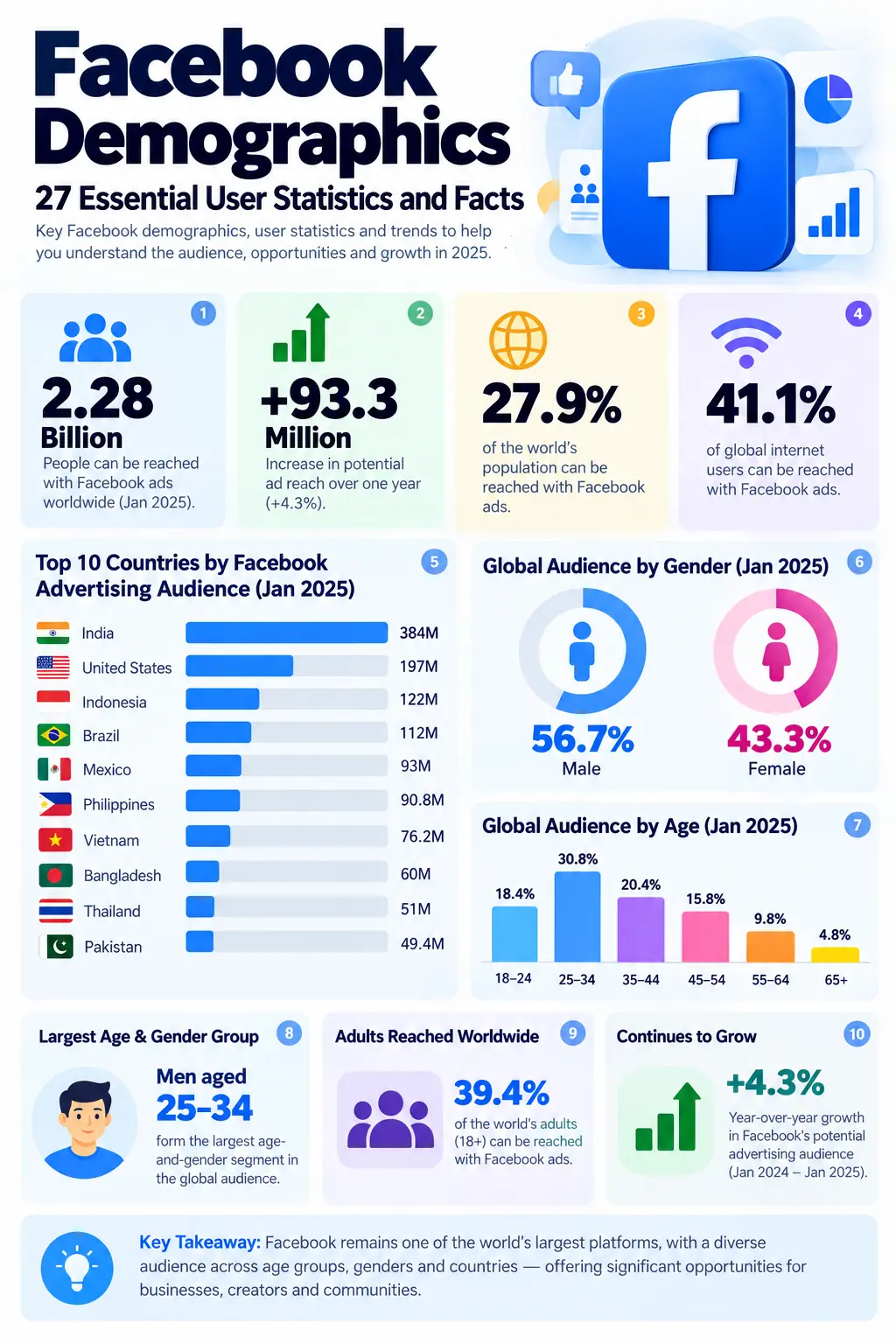
DataReportal reported that Meta’s advertising tools indicated a potential Facebook advertising audience of approximately 2.28 billion people worldwide in January 2025.
This demonstrates the platform’s enormous potential reach. However, it should not be interpreted as an exact count of unique, monthly active Facebook users. Advertising estimates and active-user measurements use different methodologies.
2. Facebook’s reported advertising reach increased by 93.3 million in one year
Between January 2024 and January 2025, Facebook’s potential advertising reach increased by approximately 93.3 million, according to DataReportal’s analysis of Meta’s advertising tools.
This represented reported growth in the audience advertisers could potentially reach, not necessarily 93.3 million newly registered or newly active users.
The distinction matters when comparing platform growth over time.
3. Facebook’s potential advertising reach grew by 4.3% year over year
DataReportal reported a 4.3% increase in Facebook’s potential advertising audience between January 2024 and January 2025.
Although Facebook is an established social network, its advertising audience continued to expand during that period.
Businesses should still evaluate their own target markets rather than assuming that global growth will translate into better campaign results in every country or demographic group.
4. Facebook advertising reach represented 27.9% of the world’s population
Based on its January 2025 advertising audience estimate and United Nations population data, DataReportal calculated that Facebook advertising could reach approximately 27.9% of the global population.
This is a broad population comparison. Facebook’s minimum age requirements and differences in internet access mean that the percentage among people eligible to use the platform can be higher.
It is also a measure of potential ad reach, not proof that every person counted actively uses Facebook.
5. Facebook advertising could reach 39.4% of adults worldwide
DataReportal estimated that Facebook’s advertising audience represented approximately 39.4% of the global population aged 18 and above in January 2025.
This gives advertisers another perspective on the platform’s potential reach among adults.
The figure does not mean that 39.4% of all adults log in daily or monthly. It describes the relationship between the estimated advertising audience and the adult population.
6. Facebook advertising reached 41.1% of internet users worldwide
DataReportal’s analysis indicated that Facebook’s potential advertising audience was equivalent to approximately 41.1% of the world’s internet users at the beginning of 2025.
This suggests that Facebook remained a significant channel for reaching online audiences.
However, the opportunity varies considerably by country. Internet adoption, platform availability, local preferences, and audience characteristics all influence how useful Facebook may be for a particular campaign.
7. India had the world’s largest Facebook advertising audience
In January 2025, India had an estimated 384 million people in Facebook’s advertising audience, according to Meta data analyzed by DataReportal.
India’s large population and substantial online audience make it an important market for advertisers, publishers, creators, and businesses.
For organizations targeting India, the national figure is only a starting point. Campaign planning should also consider language, region, age, interests, purchasing behavior, and the actual results of previous campaigns.
8. The United States had approximately 197 million people in Facebook’s advertising audience
The United States ranked second among the countries listed in DataReportal’s January 2025 Facebook advertising audience figures, with approximately 197 million people.
The US remains an important market for companies that want to reach consumers, communities, and businesses through Facebook.
A large potential audience does not guarantee affordable advertising. Costs and performance depend on competition, campaign objectives, creative quality, audience selection, and other factors.
9. Indonesia had approximately 122 million people in Facebook’s advertising audience
Indonesia ranked among the largest Facebook advertising markets, with an estimated audience of 122 million in January 2025.
This makes the country relevant for brands and publishers targeting Southeast Asia.
As with other markets, advertisers should consider local languages, cultural context, mobile experiences, and audience behavior instead of simply translating content intended for another country.
10. Brazil had approximately 112 million people in Facebook’s advertising audience
DataReportal reported an estimated Facebook advertising audience of 112 million in Brazil in January 2025.
Brazil is an important market for social media marketing in Latin America. Businesses targeting Brazilian audiences should pay attention to Portuguese-language content, local interests, and regional differences.
The most useful demographic strategy is one that connects broad audience estimates with the needs and behavior of the people a business actually wants to reach.
11. Mexico had approximately 93 million people in Facebook’s advertising audience
Mexico had an estimated Facebook advertising audience of 93 million people in January 2025.
This places Mexico among the platform’s largest advertising markets.
Businesses looking to reach Mexican consumers should evaluate language, location, purchasing preferences, and the suitability of their products or services for the local market.
12. The Philippines had approximately 90.8 million people in Facebook’s advertising audience
DataReportal’s January 2025 figures put the Facebook advertising audience in the Philippines at approximately 90.8 million.
The country represents another major market for digital publishers and advertisers.
For brands, understanding how people in the Philippines use social platforms is more valuable than relying on audience size alone. Campaigns should be tested against relevant engagement and conversion data.
13. Vietnam had approximately 76.2 million people in Facebook’s advertising audience
Vietnam’s estimated Facebook advertising audience reached approximately 76.2 million people in January 2025.
This figure highlights Facebook’s potential reach in another Southeast Asian market.
Businesses should consider local language, audience interests, mobile usability, and the competitive environment before allocating a significant share of their marketing budget to a single platform.
14. Bangladesh had approximately 60 million people in Facebook’s advertising audience
DataReportal reported an estimated Facebook advertising audience of 60 million in Bangladesh in January 2025.
For publishers and businesses targeting Bangladesh, this offers a useful starting point for evaluating the platform’s potential role in a wider digital strategy.
Actual reach and engagement will depend on the intended audience, campaign setup, and the availability of relevant content or services.
15. Thailand had approximately 51 million people in Facebook’s advertising audience
Thailand had an estimated Facebook advertising audience of 51 million people in January 2025.
The figure places Thailand among the countries with substantial potential Facebook reach.
For businesses operating in Thailand, local language, audience preferences, and campaign objectives should guide content planning and advertising decisions.
16. Pakistan had approximately 49.4 million people in Facebook’s advertising audience
DataReportal’s January 2025 figures showed an estimated Facebook advertising audience of 49.4 million in Pakistan.
This makes Facebook a potentially useful channel for organizations seeking to reach people in the country.
As with all audience estimates, the figure should not be treated as an exact count of active users or unique individuals who regularly use the platform.
17. Facebook’s reported advertising audience was 56.7% male globally
DataReportal’s analysis of Meta’s advertising tools for January 2025 indicated that the global Facebook advertising audience was approximately 56.7% male.
This is a description of the gender categories available in Meta’s advertising data, not a complete representation of every Facebook user’s gender identity.
Advertisers should not assume that a campaign needs to target men simply because men account for a larger share of the reported global advertising audience. The right audience depends on the product, service, and campaign objective.
18. Women represented 43.3% of Facebook’s reported advertising audience
The same January 2025 analysis indicated that women accounted for approximately 43.3% of Facebook’s global advertising audience.
The worldwide pattern does not apply equally to every country. DataReportal reported substantial geographical differences, with women representing larger shares of the potential advertising audience in some regions than others.
Businesses should therefore review audience data for the specific countries and age groups they want to reach rather than relying exclusively on global averages.
19. People aged 25–34 were a particularly important Facebook audience
DataReportal’s analysis placed Facebook’s average audience age somewhere in the 25–34-year-old range in January 2025, based on the available advertising audience data.
The age group is relevant to many advertisers because it includes adults at different stages of their working lives, relationships, and purchasing journeys.
Nevertheless, age alone is not a reliable predictor of individual interests or buying decisions. A business should use actual customer data and campaign results to understand which age groups respond best.
20. Men aged 25–34 formed Facebook’s largest reported age-and-gender group
According to DataReportal’s analysis of Meta’s advertising tools, men aged 25–34 represented the largest age-and-gender segment in the global Facebook advertising audience in January 2025.
This is useful context for marketers, but it should not be treated as a universal targeting recommendation.
A business selling products for parents, retirees, students, or another specific audience may achieve better results by focusing on that audience rather than the largest global segment.
21. Adults aged 35–44 remain part of Facebook’s substantial audience
Facebook’s audience is not limited to younger adults. DataReportal’s age breakdown includes substantial representation among adults aged 35–44, as well as older age groups.
For marketers, this is a reminder not to dismiss Facebook when targeting established professionals, families, homeowners, or customers with different life experiences.
The appropriate age range depends on the business and should be validated using campaign analytics.
22. Facebook has an audience among people aged 45 and older
DataReportal’s January 2025 audience breakdown included people aged 45–54, 55–64, and 65 and older.
This shows why it is misleading to describe Facebook as a platform used only by younger generations.
Businesses serving older adults or multigenerational households may find Facebook useful, provided their audience research supports that choice.
Content should remain readable, accessible, and relevant regardless of the age group being targeted.
23. Facebook’s age and gender patterns differ by region
Global averages hide important local differences. DataReportal’s analysis found that the gender distribution of Facebook’s advertising audience varied across regions.
For example, its January 2025 data indicated that women accounted for a larger share of the reported audience in Eastern Europe and Northern America than in Southern Asia.
These differences reflect the available advertising audience data and should not be interpreted as universal statements about people’s social media preferences.
If you advertise internationally, review each target country’s audience data separately.
24. Facebook’s advertising audience is not the same as its monthly active users
This is one of the most important facts to understand when reading Facebook statistics.
Advertising reach and monthly active users are different measurements.
Advertising tools estimate how many people advertisers may be able to reach under certain conditions. Monthly active users are a separate platform metric based on Meta’s reporting methodology.
The two figures should not be substituted for each other. For a current company-reported monthly active-user figure, consult Meta’s latest earnings releases and annual reports rather than assuming that an advertising estimate represents total active users.
Official source: Meta Investor Relations.
25. Facebook’s audience size does not tell you how engaged users are
A large potential audience does not automatically produce likes, comments, shares, clicks, or sales.
Engagement depends on the relevance of the content, the audience, the format, the distribution system, and many other factors.
A page with a smaller but highly relevant audience may generate more meaningful interactions than a page with a much larger but less interested audience.
If you manage a Facebook Page, measure results against your goals instead of using follower count as your only indicator of success.
For help with publishing, see our guide to Facebook Page posts.
26. Privacy settings affect how people use Facebook
Facebook users share different types of information, from public posts and Page interactions to content intended only for friends.
Understanding privacy settings helps people control who can see their posts, profile information, and other activity.
Users should review their audience selectors, profile visibility, tagging settings, and available account security controls. They should also be careful about suspicious links, impersonation attempts, and requests for personal information.
Read our guide to Facebook privacy mistakes to avoid for practical advice on protecting your account and personal information.
27. Facebook remains useful for communities, content sharing, and personal expression
Demographic statistics tell only part of the story. People use Facebook to keep in touch with friends, participate in groups, discover local businesses, follow public figures, share photos, and discuss subjects they care about.
The platform’s features also let people personalize parts of their experience, including creating an avatar, publishing posts, and sharing content with different audiences.
If you want to explore these features, our complete Facebook usage guide explains how to get started. You can also learn how to create an Avatar on Facebook or make a Facebook post shareable.
These everyday uses help explain why Facebook’s role cannot be understood through audience size alone.
Facebook Demographics by Country: A Quick Comparison
The following table summarizes the January 2025 advertising audience estimates cited earlier.
| Country | Estimated Facebook advertising audience |
|---|---|
| India | 384 million |
| United States | 197 million |
| Indonesia | 122 million |
| Brazil | 112 million |
| Mexico | 93 million |
| Philippines | 90.8 million |
| Vietnam | 76.2 million |
| Bangladesh | 60 million |
| Thailand | 51 million |
| Pakistan | 49.4 million |
Source: DataReportal’s Facebook statistics.
These estimates provide a useful comparison of potential advertising reach. They should not be interpreted as a definitive ranking of monthly active users, daily users, or engagement levels.
How Businesses Can Use Facebook Demographics
Demographic statistics are most useful when they inform a specific decision. Here are practical ways businesses can use them.
Identify your target audience
Start with the people most likely to benefit from your product or service. Consider their location, age range, needs, interests, and purchasing behavior.
Use global demographic statistics to understand the broad market, then narrow your research to the relevant countries and audience segments.
Choose content that fits the audience
Different audiences may respond to different formats. Some may prefer short videos, while others engage more with useful links, community discussions, product demonstrations, or detailed explanations.
Test content formats instead of assuming that one approach will work for every demographic group.
Improve Facebook advertising campaigns
Use audience estimates as a starting point, not a final targeting decision.
Test relevant audiences and compare results using metrics that match your objective, such as qualified visits, leads, purchases, or cost per conversion. Follow Meta’s current advertising policies and restrictions.
Avoid demographic stereotypes
Age, gender, and location can help describe an audience, but they do not explain every individual’s preferences.
Do not assume that all people in an age group behave alike. Use real customer feedback, research, and campaign results to refine your decisions.
Review results regularly
Audience tools, platform features, and advertising estimates change over time. Revisit your assumptions periodically and update your strategy when the data supports a change.
Frequently Asked Questions About Facebook Demographics
How many people use Facebook worldwide?
The answer depends on the measurement and reporting date. Meta reports monthly active users separately from advertising audience estimates. DataReportal estimated that Facebook’s advertising audience reached approximately 2.28 billion people in January 2025. For the latest monthly active-user figure, consult Meta’s most recent official financial reporting.
Which country has the most Facebook users?
India had the largest reported Facebook advertising audience in DataReportal’s January 2025 analysis, at approximately 384 million. This figure refers to potential advertising reach, not an exact count of monthly active users.
Which age group is largest on Facebook?
DataReportal’s analysis of Meta’s advertising tools placed the average Facebook audience age in the 25–34 range in January 2025. Its data also identified men aged 25–34 as the largest age-and-gender group in the reported global advertising audience.
Are there more men or women on Facebook?
In DataReportal’s January 2025 analysis, men represented approximately 56.7% of Facebook’s global advertising audience and women 43.3%. The distribution differs across countries and regions, and the figures reflect the gender categories available in Meta’s advertising tools.
Why are Facebook demographics important for marketers?
Demographic information helps marketers understand potential audience size and identify groups worth researching or testing. Combined with campaign performance and customer insights, it can help businesses improve content planning, audience selection, and advertising decisions.
Where can I find updated Facebook statistics?
Start with DataReportal’s Facebook statistics for advertising audience estimates and demographic analysis. For Meta-reported monthly active users and company metrics, consult Meta Investor Relations.
Final Thoughts
Facebook demographics offer a useful snapshot of the people advertisers may be able to reach, but the numbers need context.
India, the United States, Indonesia, Brazil, and other large markets represent substantial potential audiences. The platform also reaches adults across multiple age groups, and its demographic patterns differ from one region to another.
For businesses, the best strategy is not to target the largest audience automatically. It is to identify the people who matter to the business, create content that serves their needs, and measure whether those efforts produce meaningful results.
Use demographic statistics as a starting point, verify the reporting date and methodology, and combine the figures with your own audience research. That approach will give you a more reliable understanding of Facebook than any single user-count statistic can provide.