
TL;DR: The 2026 Digital Marketing Blueprint
The world of digital marketing has evolved. Shouting the loudest no longer works; building the deepest trust does. If you want to cut through the noise this year, here is your snapshot:
- AEO over SEO: Answer Engine Optimization (AEO) is the new standard. Optimize your content to directly answer questions so AI models (like Gemini and SearchGPT) cite your brand.
- Zero-Party Data is King: With third-party cookies effectively dead, you must build owned channels. Focus heavily on email lists, SMS, and private communities.
- Short-Form Video for Discovery: Vertical video (Reels, Shorts, TikTok) is the primary search engine for Gen Z and Alpha. It is your ultimate top-of-funnel discovery tool.
- Systemic Empathy: Use AI for data analysis and backend automation, but keep a radically human, unpolished voice for your customer-facing content.
I was on a call recently with a local business owner named Mark. He looked exhausted. He had just burned through $10,000 in Facebook ads over two months, and he had exactly three sales to show for it.
He told me, “I’m doing everything the blogs say. I have the tracking pixels, I’m targeting the right age groups, and my ad copy is professionally written. Why is my digital marketing completely failing?”
When I looked at his campaigns, the problem was painfully obvious. Mark was running a 2020 playbook in 2026. He was broadcasting generic sales pitches to an audience that was already drowning in a sea of automated, AI-generated noise. He was asking for a marriage proposal before he even introduced himself.
If you are feeling that same frustration, take a deep breath. You aren’t alone. The internet has fundamentally shifted over the last couple of years, and the old “hacks” simply do not work anymore. Consumers are tired of being treated like data points. They have developed a serious case of “Ad Blindness,” scrolling right past anything that looks too polished or sales-heavy.
Today, effective digital marketing strategies require a completely different approach. It’s no longer about tricking an algorithm into showing your post to a million people. It is about combining the incredible efficiency of artificial intelligence with raw, relatable, human empathy.
If you want to stop wasting money on clicks that don’t convert and start building a loyal customer base, we need to throw out the old rules. Let’s walk through the exact strategies that are actually driving revenue right now.
1. The Shift from Traffic to Trust: Why Data is Your New Currency
For years, marketers relied on tech giants like Facebook and Google to do their heavy lifting. We happily let them track users across the web with third-party cookies, and in exchange, they let us serve highly targeted ads. It was easy, cheap, and effective.
But privacy laws have changed, and those third-party cookies are gone. The era of tracking a user across ten different websites to serve them a pair of shoes they looked at once is over.
Because of this, the cost of running traditional paid ads has skyrocketed. To survive, you have to stop renting your audience from social media platforms and start owning your data. This brings us to the most crucial shift in modern marketing: capturing Zero-Party Data.
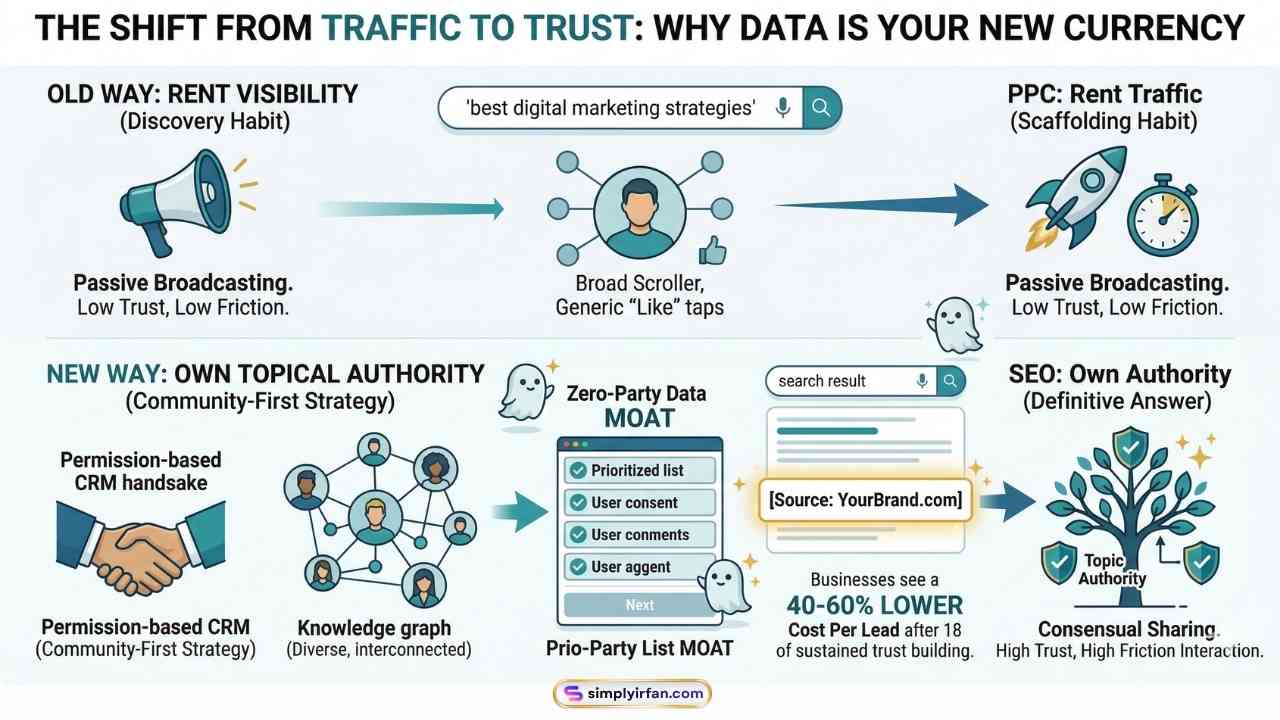
Zero-Party Data is information that a customer intentionally and proactively shares with a brand. Unlike first-party data (which tracks behavior, like what pages they visited), zero-party data is explicitly given through preferences, quizzes, surveys, and conversational pop-ups.
Think about a standard website pop-up. Usually, it says something like, “Join our newsletter for 10% off!” That is boring, low-friction, and ignores the user’s actual needs.
Instead, imagine landing on a skincare website and seeing a short, interactive quiz: “Find the perfect routine for your exact skin type.” You happily type in your email, select that you have dry skin, and mention you live in a cold climate.
You just handed that brand incredibly valuable zero-party data. Now, their email automation isn’t just blasting generic sales. They are sending you specific recommendations for winter moisturizers. That is how you build a high-converting digital marketing funnel today.
The 2026 Data Comparison
| Strategy Focus | Third-Party Data (The Old Way) | Zero-Party Data (The 2026 Way) |
| How it’s Collected | Secretly tracked via cookies/pixels | Voluntarily given via quizzes/forms |
| Accuracy Level | Guessed based on browsing habits | 100% accurate (direct from user) |
| User Sentiment | Feels creepy and invasive | Feels helpful and personalized |
| Marketing Use Case | Broad, generic retargeting ads | Hyper-personalized email automation |
| Long-Term Value | Low (expires quickly) | Extremely High (owned asset) |
Actionable Insight: Spend this week reviewing how you capture emails on your site. If you are just using a generic “Subscribe” box, you are leaving money on the table. Create a simple, 3-question assessment related to your industry and use that as your lead magnet.
2. Mastering “Answer Engine Optimization (AEO) and Semantic Search
Let’s talk about search engines. When was the last time you typed a broken keyword phrase like “best shoes running cheap” into Google? You probably don’t do that anymore. You probably ask your phone a full question, like, “What are the best running shoes for flat feet under $100?”
With the integration of AI models into our daily lives, search has become conversational. People are using ChatGPT, Gemini, and AI overviews to get direct answers, bypassing traditional websites entirely. This means traditional SEO optimization is no longer enough. You need AEO.
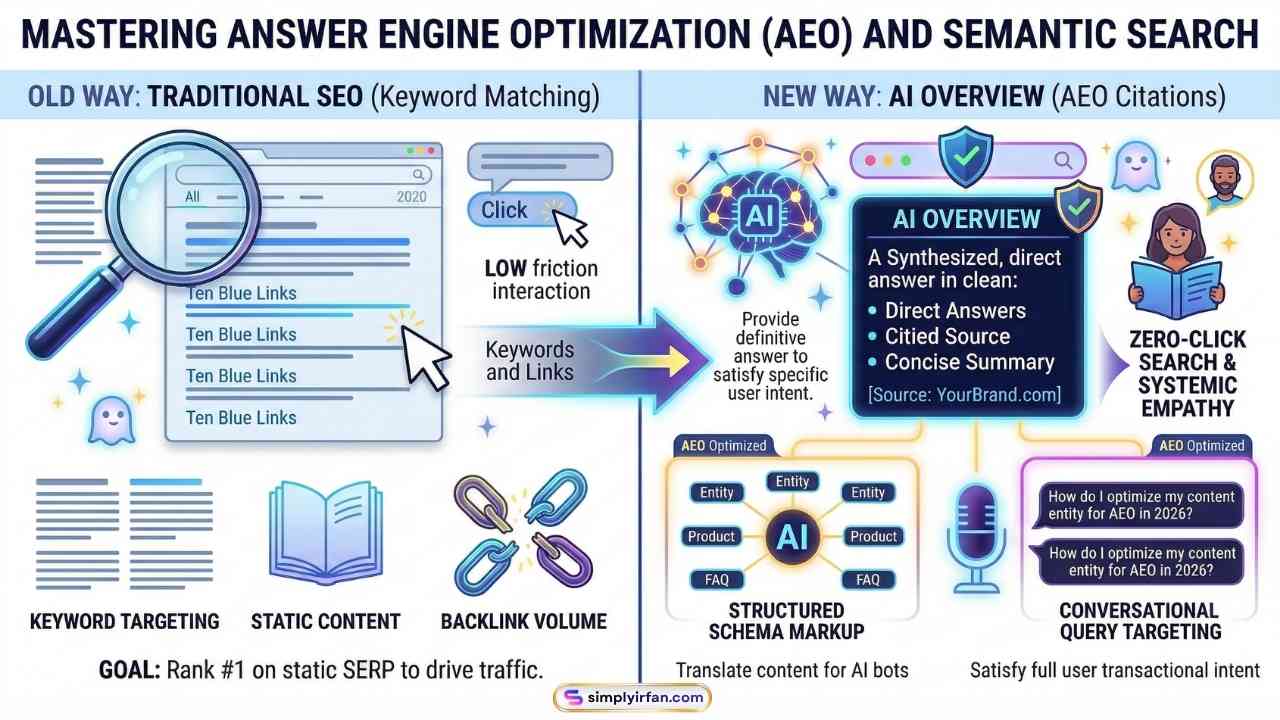
Answer Engine Optimization (AEO) is the practice of formatting and structuring your website’s content so that Artificial Intelligence models can easily understand, extract, and cite your information as the definitive answer to a user’s question.
In 2026, over 65% of informational searches result in a “zero-click” experience. The user asks a question, reads the AI-generated summary at the top of the screen, and leaves. Your goal is no longer just getting the click; your goal is to be the source that the AI cites in that summary.
How do you do that? By structuring your content brilliantly. AI models love clear definitions, bullet points, and clean formatting.
- Target Long-Tail Questions: Use tools to find out exactly what questions your customers are asking. Create content that directly answers the “Who, What, When, Where, and Why.”
- The BLUF Method: Use the “Bottom Line Up Front” technique. Answer the primary question clearly and concisely in the first paragraph of your blog post. Save the lengthy backstory for later.
- Use Schema Markup: This is code you add to your website that translates your content into a language search engines understand perfectly. It tells the AI, “This is a product,” or “This is an FAQ.”
Statistic to Remember: Websites that structure their content with clear H2/H3 question headers and immediate paragraph answers see a 40% higher inclusion rate in AI-generated search overviews.
3. The Omnichannel Video Strategy: Being Everywhere at Once
If you want to grow an audience today, you simply cannot ignore short-form video. It is the undisputed king of content marketing.
Platforms like TikTok, YouTube Shorts, and Instagram Reels are no longer just social networks; they are massive discovery engines. Gen Z and Alpha actually use TikTok as their primary search engine when looking for local restaurants, product reviews, or quick tutorials.
But here is the trap most businesses fall into: they think short-form video means they have to point at floating text and do trending dances. Please, don’t do that. Your audience wants education and entertainment, not cringe.
A successful short-form video strategy relies on the “Hook, Retain, Reward” framework.
- The Hook (0-3 Seconds): You have three seconds to stop the scroll. Do not start your video by saying, “Hi guys, welcome back to my channel.” Start with a bold claim, a surprising fact, or the exact problem you are solving. (e.g., “Here is why your Facebook ads are burning your money.”)
- The Retention (3-30 Seconds): Deliver the value quickly. Use quick cuts, change your camera angle slightly, and use on-screen captions. Keep the pacing tight so the user doesn’t lose interest.
- The Reward (The End): Give them a clear, single call-to-action. Tell them exactly what to do next, whether that is reading the caption, saving the video, or clicking the link in your bio.
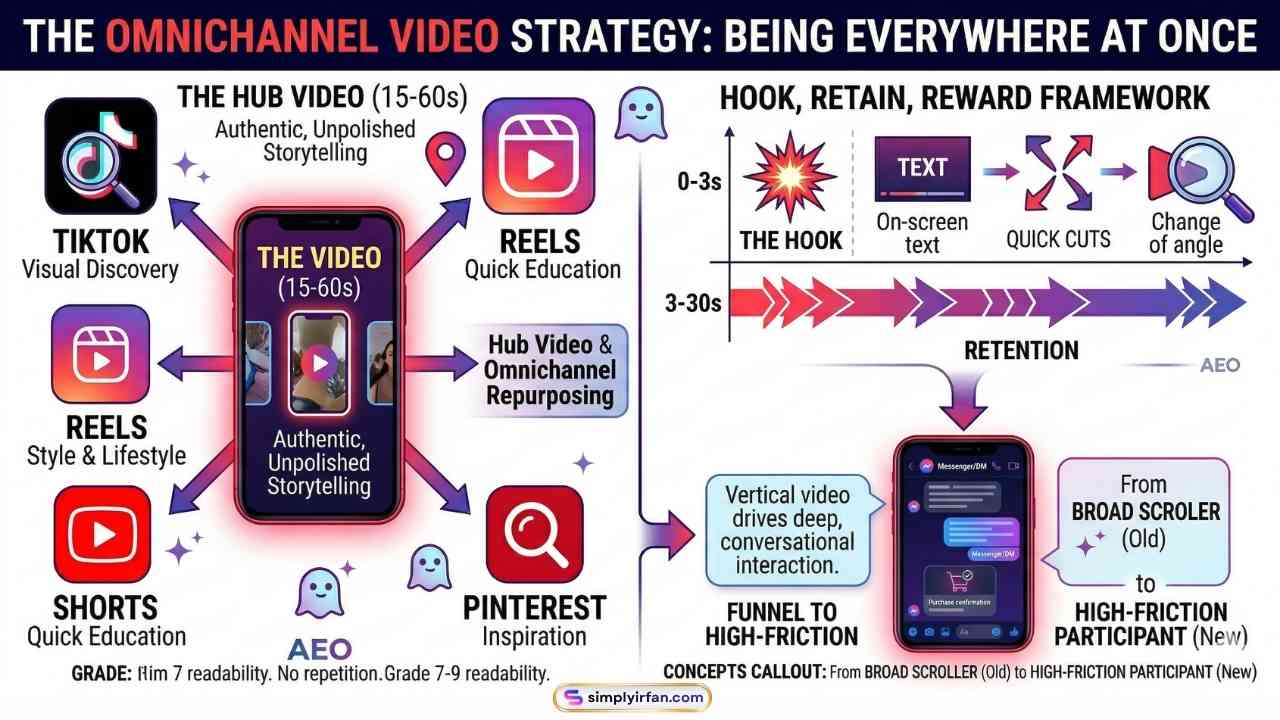
To make this sustainable, you need an omnichannel approach. You shouldn’t be creating different videos for every platform. Create one high-quality, vertical video answering a common customer question, and distribute it across YouTube Shorts, Reels, TikTok, and even Pinterest. You are casting a wide net to pull people into your zero-party data funnel.
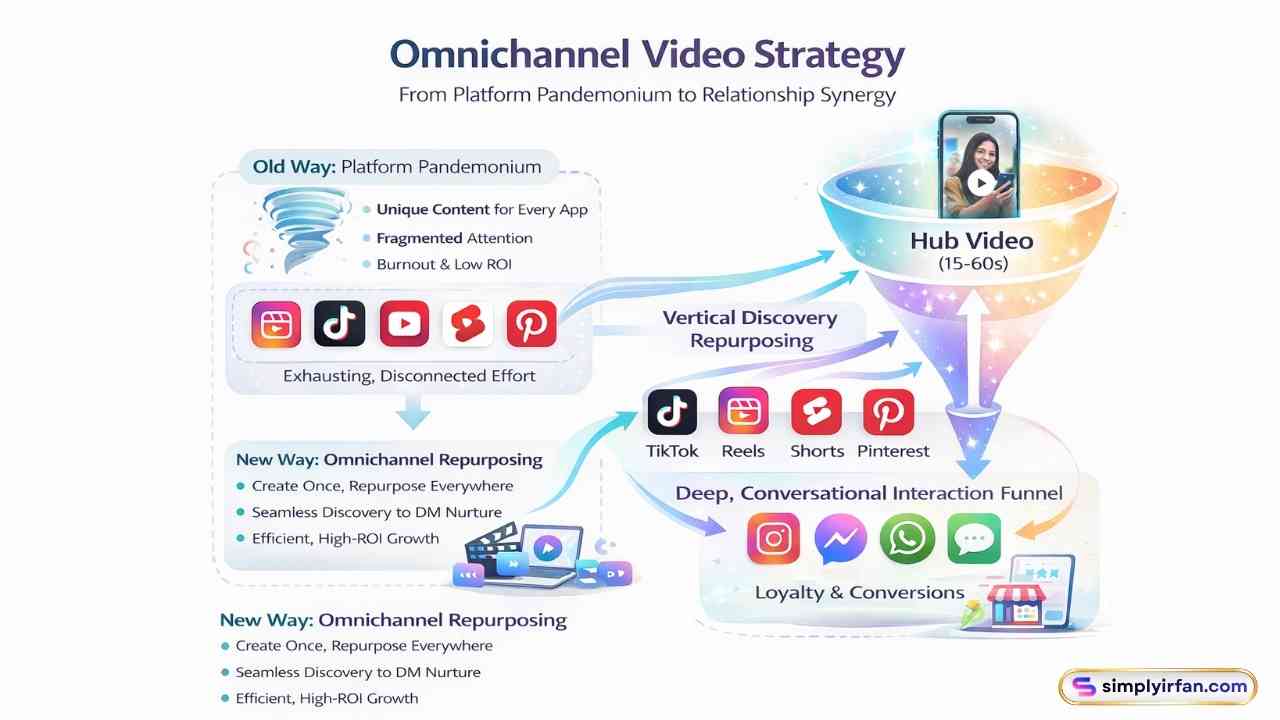
Actionable Insight: Grab your phone right now and write down the three most common questions your customers ask you. Tomorrow, hit record and answer them in under 60 seconds each. Don’t over-edit. Just be helpful. Post them everywhere.
4. Systemic Empathy: Blending AI Automation with Human Connection
The biggest irony of digital marketing right now is that as AI gets smarter and more capable of writing our content, consumers are actively craving real human connection.
We are suffering from AI fatigue. We can spot a ChatGPT-written email from a mile away because it usually sounds like a robot trying to sell us timeshares.
This is where the concept of Systemic Empathy comes in. It is the ultimate differentiator for modern brands.
Systemic Empathy is the strategic framework where a business uses AI and automation to handle repetitive backend tasks (like data sorting, ad bidding, and scheduling), while fiercely protecting the human, authentic voice in all frontend, customer-facing content.
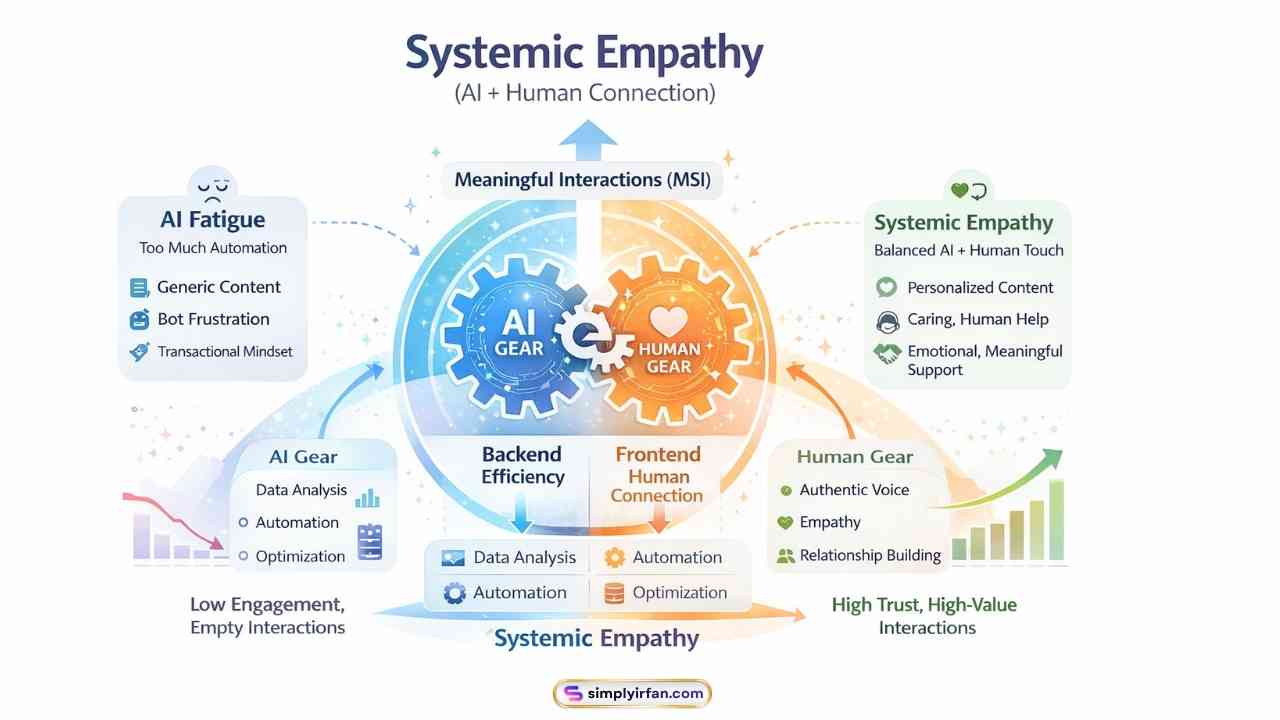
You should absolutely use AI to analyze your analytics. You should use it to build predictive models that tell you when a customer is most likely to buy. You can even use it to brainstorm ideas for your next email campaign.
But a human must hold the pen.
When you write an email to your list, write it as if you are emailing a smart friend. Share a quick story about a mistake you made that week. Use plain language. Tell a joke. Let your brand be a little unpolished.
People do not buy from logos; they buy from people. When a customer replies to your automated welcome email, have a real human reply back with specific context. Doing things that “don’t scale”—like sending a personalized 10-second video message to a new high-ticket client—will generate more loyalty than a thousand automated drip campaigns.
By using AI to free up your time, you can afford to invest heavily in the human touch where it matters most. That is how you win in 2026.
Frequently Asked Questions (FAQ)
What is the most effective digital marketing strategy right now?
The most effective strategy is building an owned audience through zero-party data. By using high-value lead magnets (like interactive quizzes) to capture emails and SMS numbers, you bypass unpredictable social media algorithms and build a direct, highly personalized line to your customers.
How is AEO different from traditional SEO?
Traditional SEO focuses on getting a user to click a link to your website by targeting specific keywords. Answer Engine Optimization (AEO) focuses on structuring your content with direct, concise answers so that AI models (like Gemini) cite your brand as the authoritative source directly within the search results.
Do I have to use video for social media marketing?
Yes. While text and images still have a place, short-form vertical video (Reels, Shorts, TikTok) is currently the primary algorithmic driver for organic reach and brand discovery. It is essential for top-of-funnel awareness.
How much should a small business spend on digital marketing?
While it varies by industry, a common benchmark is dedicating 7-10% of gross revenue to marketing. However, in 2026, it is highly recommended to shift budget away from purely paid ads and invest more heavily in content creation, CRM software, and community management.
Is email marketing still relevant in 2026?
Absolutely. Because organic social media reach has plummeted and paid ads are expensive, email marketing remains one of the highest ROI channels available. It is an “owned asset” that allows for deep personalization and predictable revenue generation.
Stop Broadcasting, Start Connecting
The landscape of digital marketing strategies has fundamentally changed, but the psychology of the buyer hasn’t. People still want to feel understood, they still want their problems solved, and they still want to trust the businesses they buy from.
The brands that will fail this year are the ones that treat their audience like an algorithm to be hacked. They will keep pumping out generic, AI-written fluff, wondering why their sales are flatlining.
The brands that will thrive are the ones that adapt. They will optimize for Answer Engines to build authority. They will use short-form video to educate rather than sell. They will aggressively collect zero-party data to personalize the customer journey. And most importantly, they will use AI to handle the busywork so they can get back to being radically human.
You don’t need to implement all of this overnight. Pick one thing. Tomorrow, look at your website’s primary lead magnet. Is it a boring “subscribe” button, or is it an interactive value exchange? Start there. Fix your funnel, find your human voice, and watch your business grow.
If you are ready to map out your specific 2026 growth plan, where do you feel your current strategy is leaking the most potential? Is it at the top of the funnel with awareness, or at the bottom with conversions?
Also Check: