
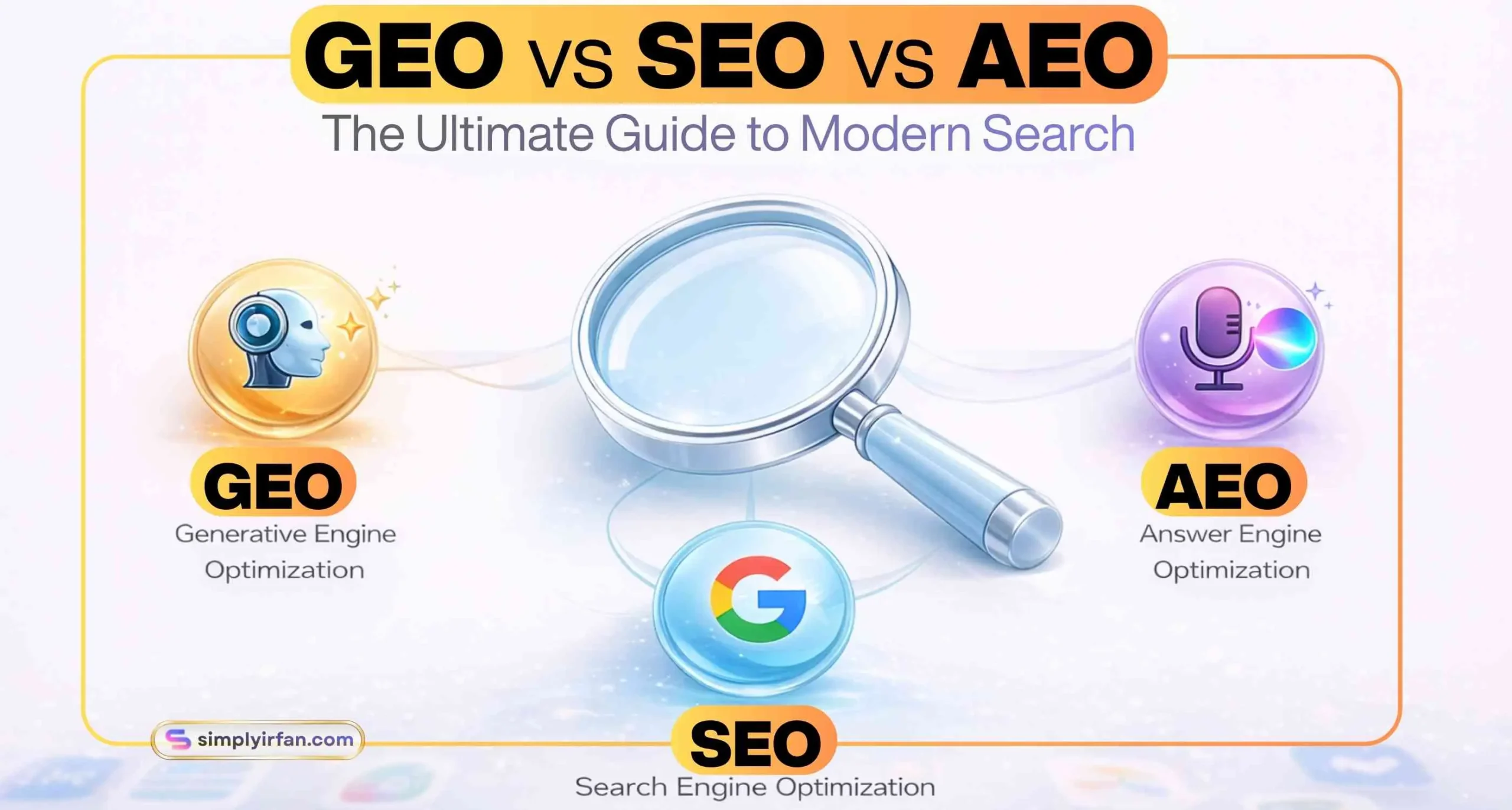

SEO vs GEO vs AEO: The Quick Cheat Sheet
- SEO (Search Engine Optimization): Ranking in traditional blue links on Google.
- GEO (Generative Engine Optimization): Optimizing for AI-driven summaries like Google’s AI Overviews and Perplexity.
- AEO (Answer Engine Optimization): Focusing on providing the single, direct answer for voice assistants and chatbots.
- The Strategy: You need all three. SEO builds the foundation, GEO earns you citations in AI responses, and AEO makes you the definitive source for quick queries.
Imagine it’s 2010. You want to find the best pizza in New York. You type “best pizza NYC” into a search bar, click the third blue link, and read a blog post. Simple, right?
Now, fast forward to today. You’re driving, and you ask your car, “Where’s the best thin-crust pizza near me that’s open now?” Or, you ask a chatbot to “Plan a three-day pizza tour of Brooklyn.”
The way we find information hasn’t just changed; it has mutated. We’ve moved from keywords to conversations. If you’re a business owner or a marketer, the old playbook of just “doing SEO” is like bringing a knife to a laser-tag fight.
We are now dealing with a world of GEO vs SEO vs AEO. If these acronyms sound like alphabet soup, don’t worry. We’re going to break them down like we’re grabbing a coffee and chatting about the future of the internet.
The Big Three: Understanding the Evolution
To understand where we are going, we have to look at the three pillars of modern visibility.
SEO is the grandfather. It’s about structure, keywords, and backlinks. It’s about making sure Google’s bots can crawl your site and decide you’re more relevant than the guy next door. The goal is the “Blue Link.”
GEO (Generative Engine Optimization) is the new kid on the block. With the rise of GEO AI and tools like Perplexity, Gemini, and SearchGPT, the “search result” is often a paragraph of generated text. GEO is the art of getting those AI models to mention you as their source.
AEO (Answer Engine Optimization) is the specialist. It’s a subset of SEO that focuses on being the “instant answer.” Think of Alexa, Siri, or the “Featured Snippet” at the top of Google. It’s about being the most concise, authoritative answer to a specific question.
Recommended: SEO Secrets
The Comparison: At a Glance
| Feature | SEO | GEO | AEO |
| Primary Goal | Rank in Top 10 Search Results | Get cited in AI-generated summaries | Become the single “Featured Answer” |
| User Intent | Browsing / Researching | Synthesis / Comparison | Quick Fact-Checking / Voice Search |
| Format | Long-form content, Blogs | Structured data, Citations, Reviews | FAQ, Bullet points, Schemas |
| Success Metric | Click-Through Rate (CTR) | Brand Mentions & Citations | Zero-click impressions |
Let’s be real. The way we hunt for information on the internet has completely shape-shifted over the last few years. We used to type clunky, robotic phrases into a search bar and dig through ten pages of blue links just to find a simple answer.
Now? We chat with AI. Highly specific questions get directed to smart speakers while we wash the dishes, all with an expectation of instant, summarized brilliance.
Because user behavior has mutated so drastically, our digital marketing playbooks have to evolve right alongside it. If you want to dominate your niche in 2026, you can’t just rely on the old-school tactics. You need to understand the distinct battlegrounds of SEO, GEO, and AEO.
To help you visualize exactly where to allocate your time, budget, and energy, let’s break down the core differences across ten critical categories.
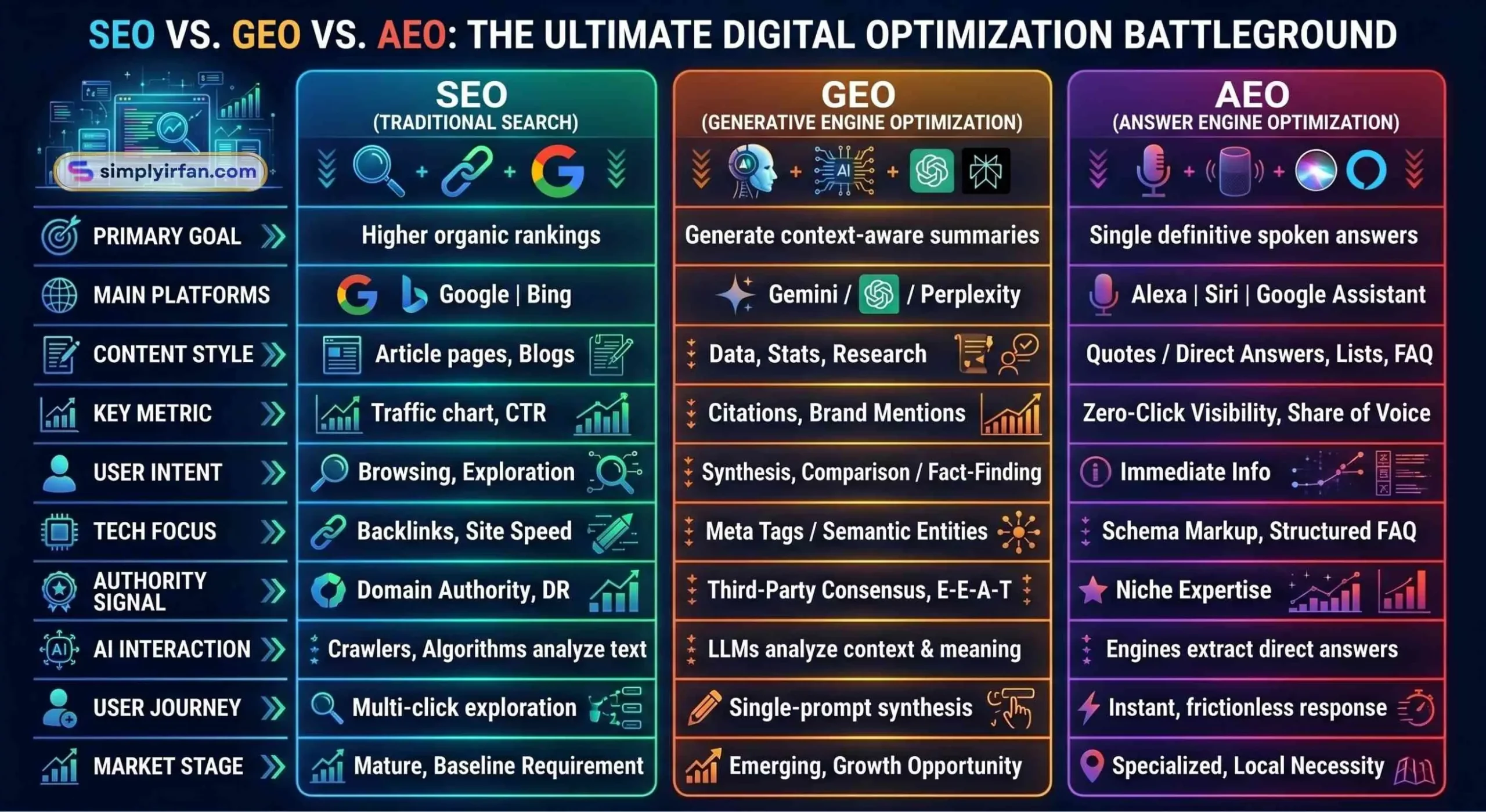
The 10-Point Breakdown: SEO vs. GEO vs. AEO
| # | Comparison Factor | Traditional SEO | Generative GEO | Answer Engine AEO |
| 1 | The Ultimate Objective | Claiming a top spot in standard search engine results. | Earning a citation or mention in an AI-generated summary. | Becoming the single, definitive answer for voice or text queries. |
| 2 | Primary Platforms | Google Classic, Bing, Yahoo. | ChatGPT, Gemini, Perplexity, Google AI Overviews. | Siri, Alexa, Google Assistant, Featured Snippets. |
| 3 | Ideal Content Style | Long-form articles, explore in depth guides, and heavy text. | Original research, fresh statistics, and unique expert quotes. | Bite-sized, concise paragraphs (40–60 words) and listicles. |
| 4 | Measuring Success | Website traffic, organic clicks, and keyword rankings. | Brand mentions, citation frequency, and AI inclusion. | Voice search wins and zero-click visibility. |
| 5 | The User’s Mindset | Exploring options, browsing, and casual reading. | Synthesizing heavy topics or comparing multiple products. | Desperate for a quick, accurate fact on the go. |
| 6 | Technical Priorities | Backlink profiles, site speed, and meta tags. | Semantic relationships, entity mapping, and vector search. | Flawless Schema markup and strict FAQ structuring. |
| 7 | Trust Signals | Domain Rating (DR) and on-page keyword density. | Cross-platform consensus and verified third-party data. | Hyper-specific niche expertise and E-E-A-T guidelines. |
| 8 | How the Algorithm “Reads” | Crawlers index text strings and follow hyperlinks. | Large Language Models (LLMs) analyze context and meaning. | Systems extract the most direct, formatted response available. |
| 9 | The Customer Journey | A multi-step process of clicking, reading, and bouncing. | A single prompt followed by a highly synthesized answer. | An instant, frictionless delivery of information. |
| 10 | Current Market Stage | A fully mature, highly saturated baseline requirement. | The current digital gold rush for tech-savvy brands. | A highly specialized necessity for local and mobile businesses. |
Going Deeper: Why These Differences Matter
Let’s look under the hood. Why do these ten points actually change the way you write and publish content? Here is the strategic reality of the modern web.
1. The Metric Shift: Clicks vs. Clout
For a decade, we were trained to obsess over traffic graphs. If a user didn’t physically land on your URL, your campaign was considered a failure. GEO flips this entirely on its head.
Today, a massive win looks like an AI model natively recommending your brand in its output. Even if the user doesn’t click a link, your brand is positioned as the ultimate authority. You are building digital clout, which eventually translates to direct searches for your company.
2. The Absolute Death of Fluff
Remember those old recipe blogs? You had to read a 1,000-word story about a food blogger’s childhood vacation just to find out how much salt to put in the soup.
AEO has completely killed that format. If a user asks a smart device how to fix a leaky pipe, the engine doesn’t want a history of plumbing. It wants a bulleted list of steps. If you want to win in AEO, you have to adopt an “answer-first” writing style. Give away the gold immediately, and save the dig into it for later.
Also Read: How SEO Services for Small Business Work in 2026
3. Semantic Webs and Context Mapping
Traditional SEO relied heavily on exact-match keywords. If you wanted to sell hiking boots, you made sure the phrase “best hiking boots” was pasted all over your page.
GEO and LLMs don’t care about keyword frequency; they care about concepts. When an AI scans your page about hiking gear, it expects to see related entities like “ankle support,” “waterproofing,” “vibram soles,” and “blister prevention.” It evaluates whether you genuinely understand the ecosystem of the topic.
4. Off-Page Reputation is Everything
Here is a wild truth about the generative era: you can no longer just call yourself an expert on your own website and expect the algorithm to believe you.
When AI tools formulate answers, they scrape the entire web to find a consensus. They look at Reddit threads, news articles, LinkedIn posts, and customer reviews. If your on-page claims don’t match your off-page reputation, GEO models will simply ignore you and cite a competitor instead.
5. Embracing the Zero-Click Reality
This is the hardest pill for traditional marketers to swallow. With AEO, your goal is often to provide an answer so perfectly that the user never actually has to visit your website.
While that sounds like a nightmare for your analytics dashboard, it builds immense brand loyalty. When you consistently show up as the frictionless, instant answer to your customer’s problems, you become their go-to resource when they are finally ready to pull out their credit card.
How to Bring It All Together
You don’t need to pick just one of these strategies. In fact, doing so would be a massive mistake. The best digital brands weave all three together seamlessly.
- Build your foundation with SEO. Create a comprehensive library of resources that drives high-intent, exploratory traffic to your site.
- Future-proof with GEO. Publish original data, conduct surveys, and build cross-platform authority so AI models are forced to cite you as an industry standard.
- Capture the micro-moments with AEO. Format your content cleanly with FAQs and direct answers to win over mobile users and voice assistants.
When you stop writing for search engine crawlers and start optimizing for human curiosity, you win across the board.
Why GEO is Changing Everything (The Rise of GEO vs SEO vs AEO vs AIO)
You might have heard of AIO (AI Overviews). This is Google’s way of bringing GEO into their traditional search results. When you see a big colorful box at the top of your search result summarizing five different websites—that’s AIO.
The shift to GEO meaning a focus on “Generative” rather than just “Search” is massive. Recent statistics show that nearly 40% of Gen Z users prefer searching on TikTok or Instagram over Google, and those who stay on search engines are increasingly relying on AI summaries.
In fact, data from 2025 studies suggests that AI Overviews appear for over 80% of informational queries. This means if you aren’t optimizing for GEO, your traditional SEO efforts might be hidden behind an AI wall.
How to Win at GEO (Generative Engine Optimization)
GEO isn’t about tricking an algorithm; it’s about being useful to a machine that is trying to summarize the world.
- Citations are King: AI models love sources. If multiple high-authority sites link to you or mention your data, the AI sees you as a “fact.”
- Statistics and Original Research: AI loves numbers. When you publish a report saying “85% of users prefer X,” you are highly likely to be cited in a GEO summary.
- The “Niche Authority” Factor: Unlike SEO, where big sites often dominate, GEO often picks the most relevant niche expert.
Related: 40 Game-Changing SEO Benefits in 2026 for Your Business Growth
AEO: Winning the Conversation
If GEO is the summary, AEO is the punchline. Answer Engine Optimization is what happens when a user asks a direct question.
Think about the benefits of social media marketing. A traditional SEO post might be 2,000 words on the history of Facebook. An AEO-optimized response would have a clear heading: “What are the 3 main benefits of social media marketing?” followed by a bulleted list:
- Increased brand awareness.
- Direct customer engagement.
- Higher conversion rates through targeted ads.
By being direct, you “win” the voice search. You become the voice that speaks out of a smart speaker.
The Technical Side: LLMO and Beyond
We’re also starting to talk about LLMO (Large Language Model Optimization). While GEO vs SEO vs AEO vs LLMO might feel like a lot to juggle, they all point to the same North Star: Context.
LLMs (like GPT-4 or Claude) don’t just look for keywords. They look for relationships between concepts. If you’re writing about “Organic Dog Food,” an LLM expects to see terms like “grain-free,” “kibble,” “protein sources,” and “vet-approved” nearby. This is “Semantic Triplets”—Subject, Predicate, Object.
Actionable Strategies for 2026
You don’t need a PhD in AI to win this game. You just need to change your lens.
1. Use the “Inverse Pyramid” for Content
Start with the direct answer (AEO). Follow with the summary and evidence (GEO). End with the break it down details (SEO). This satisfies every type of searcher—and every type of bot.
2. Optimize for “Natural Language” Queries
Stop writing for “best laptop 2026.” Start writing for “What is the best laptop for a college student who also likes gaming?” People talk to AI like a person; your content should answer like a person.
3. Double Down on Brand Authority
In a world where AI can hallucinate, “Trust” is the only currency that hasn’t devalued. Ensure your “About Us” page, your LinkedIn profiles, and your third-party reviews are spotless. This is the “E-E-A-T” (Experience, Expertise, Authoritativeness, Trustworthiness) that Google and AI models crave.
Frequently Asked Questions (FAQ)
1. What is the main difference between GEO and SEO?
SEO focuses on ranking your website in a list of search results. GEO (Generative Engine Optimization) focuses on getting your content included and cited within AI-generated responses and summaries.
2. Is SEO becoming obsolete because of AI?
No, but it is evolving. Traditional SEO provides the “proof” and the “destination” that AI engines use. You still need a website that loads fast and has great content, but you now need to optimize for how AI reads that content.
3. How can I optimize my site for AEO?
Focus on FAQ sections, use “Schema Markup” to tell engines exactly what your data means, and answer common industry questions directly and concisely at the beginning of your articles.
4. What does GEO vs SEO vs AEO vs AIO mean for small businesses?
It’s actually an advantage! AI engines often prioritize specific, local, and niche expertise over “big box” websites that try to cover everything. Being a “big fish in a small pond” is easier with GEO.
5. How do the benefits of social media marketing tie into GEO?
Social signals are a huge part of GEO. When people talk about your brand on social media, AI models pick up on that “sentiment.” A strong social presence proves to AI that you are a real, trusted entity.
Conclusion: The Future is Multimodal
The battle of geo vs seo vs aeo isn’t a competition where one winner takes all. It’s an ecosystem.
SEO gets you found by those who want to browse.
GEO gets you cited by those who want to learn.
AEO gets you heard by those who want to act.
If you focus on providing genuine value, using clear language, and structuring your data so both humans and robots can understand it, you won’t just survive the AI revolution—you’ll lead it.
Ready to future-proof your digital presence? Start by auditing your top-performing pages. Are they answering questions directly, or are they hiding the “gold” under a mountain of fluff? The AI is watching and so are your customers.
Discover more: SEM vs SEO vs PPC in 2026