
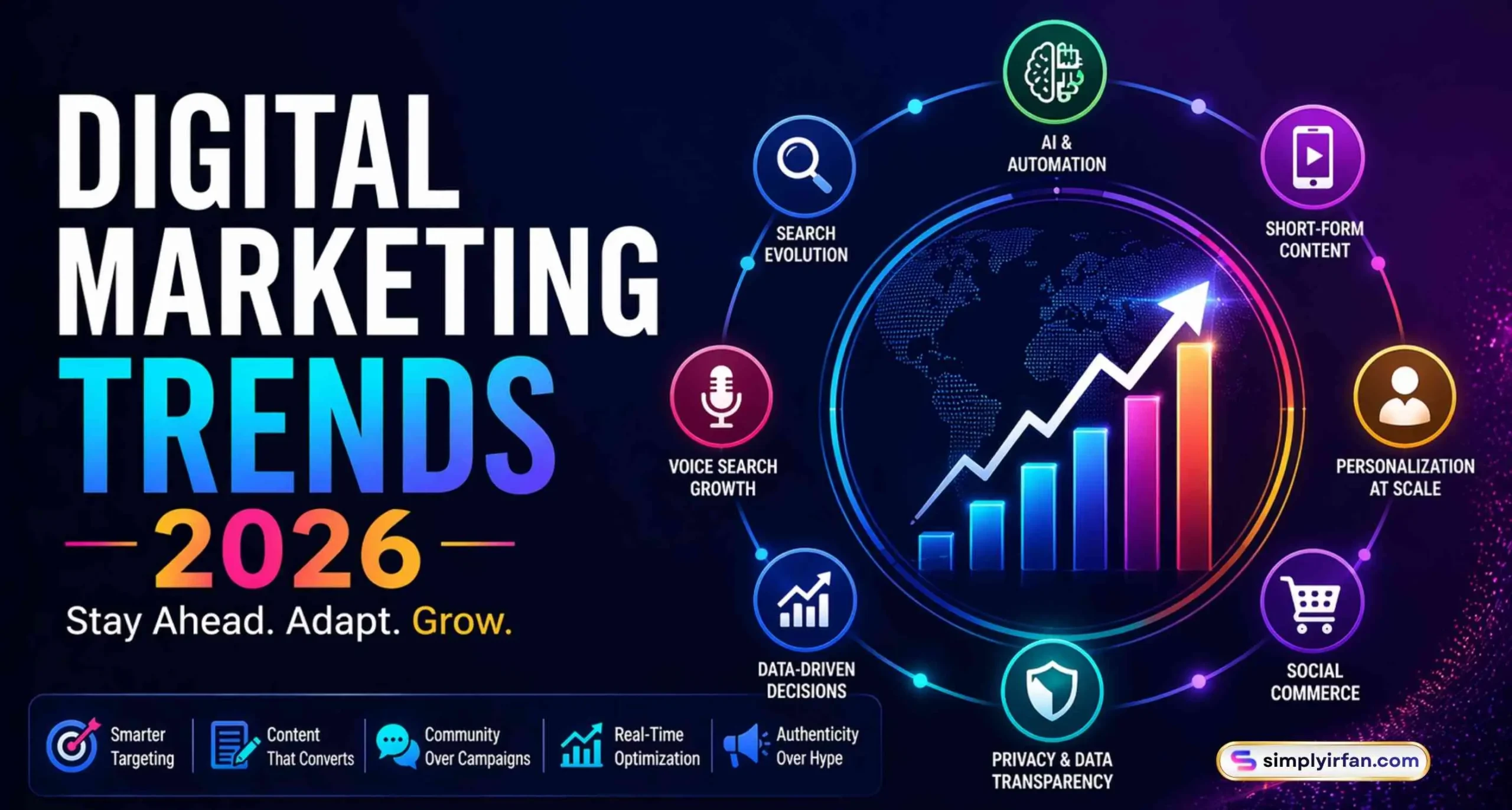
The landscape of online marketing has dramatically shifted from mass broadcasting to hyper-personalized resonance. If your digital strategy isn’t optimizing for both AI-generated answers and genuine human trust, your brand is effectively invisible.
- AEO (Answer Engine Optimization): Content must now directly answer specific user questions to be cited by AI agents (like Gemini, ChatGPT, and Google’s AI Overviews).
- The Trust Gap (Systemic Empathy): Consumers suffer from “AI fatigue.” Algorithms now prioritize high-friction interactions—like deep community discussions and dwell time—over passive likes.
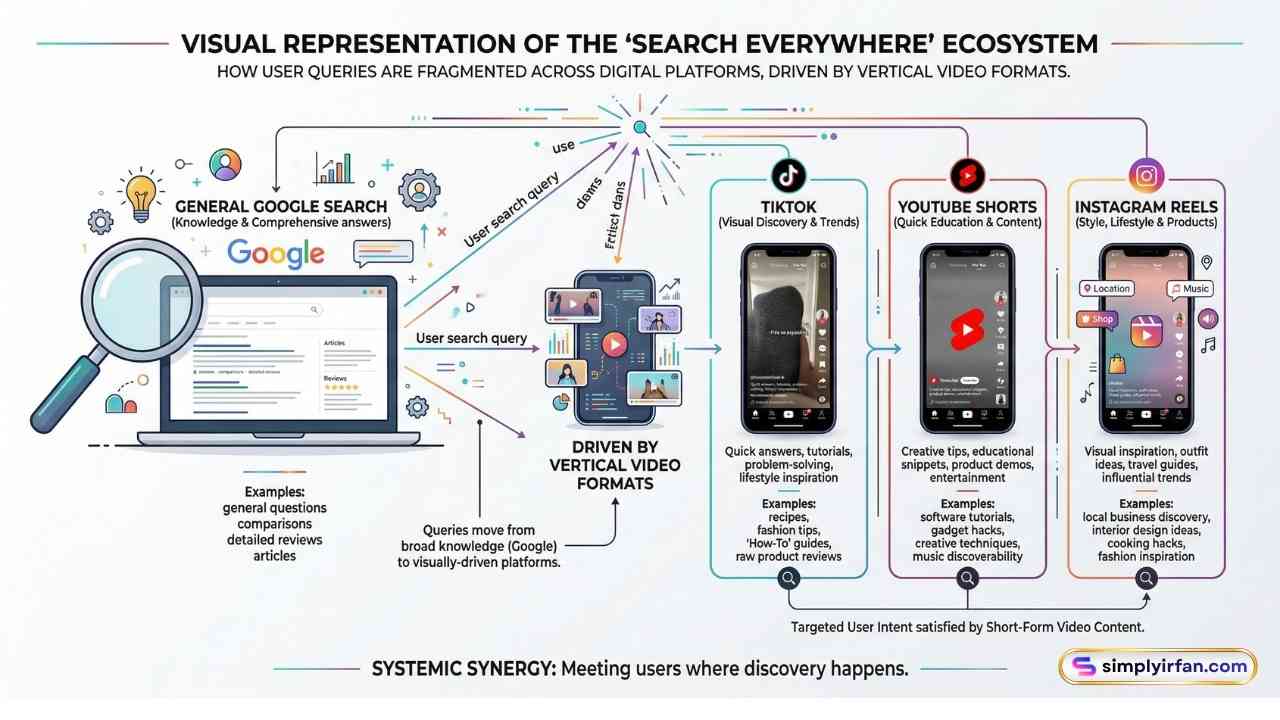
- Search Everywhere: Google is no longer the only starting point. Discovery happens in 15-second Reels, TikToks, and closed communities.
- Zero-Party Data: With the final death of third-party cookies, effective personalized marketing requires building direct, permission-based funnels.
The Fall of Follow-the-Trend Marketing: Why Realness Wins Now
Remember 2024? It felt like every brand discovered generative AI at the exact same moment. Suddenly, the internet was drowning in a sea of beige, robotic content. Every LinkedIn post started with “In today’s fast-paced digital world,” and every brand adopted the exact same generic “hustle” voice.
Fast forward to 2026, and the biggest of the online marketing trends is a fierce, almost aggressive return to radical authenticity. People are incredibly tired of the polished, perfect, and synthetic. They want the “messy middle.”
I recently witnessed an experiment with a mid-sized e-commerce brand that perfectly encapsulates this shift. They were doing everything the “gurus” advised: posting daily, using trending audio, and running highly produced ads. Their reach was a graveyard.
We pivoted. We stopped the professional shoots and had the founder record a raw, unedited 45-second video explaining a product design that completely failed. She detailed why it didn’t work, showed the broken prototype, and asked the audience for their honest feedback on how to fix it.
That single, unpolished video generated more revenue and community engagement than their previous six months of marketing combined.
This is the reality of the 2026 digital strategy. AI is brilliant at handling the heavy backend lifting—the data analytics, the ad bidding, the scheduling—but true online marketing success comes from human stories that an algorithm cannot fake. It is about blending technical precision with systemic empathy.
If you are ready to stop chasing vanity metrics and start building a resilient growth engine, let’s dive into the five critical trends dictating the market right now.
Recommended: Social media audit guide
1. From SEO to AEO: Dominating the Answer Engine Landscape
For two decades, the goal of search marketing was to rank in the “Ten Blue Links.” You stuffed keywords into a blog post, built some backlinks, and waited for the traffic to roll in. In 2026, that playbook is officially obsolete.
We don’t just “search” anymore; we ask our devices to synthesize information for us. This has birthed the most critical discipline of the decade: Answer Engine Optimization (AEO).
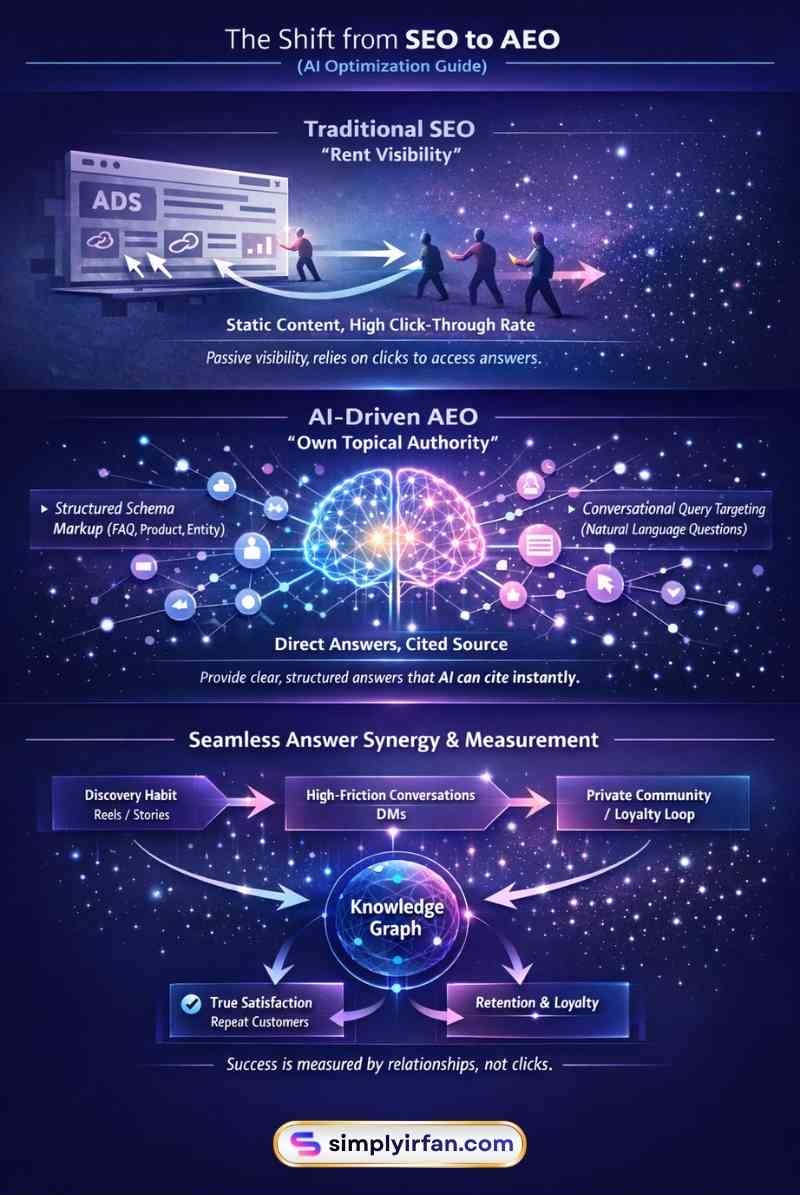
Answer Engine Optimization (AEO) is the technical and structural practice of formatting digital content so it can be easily read, synthesized, and cited by Large Language Models (LLMs) and AI search agents. Unlike traditional SEO, which focuses on earning a page click, AEO focuses on becoming the definitive, cited source within an AI-generated answer.
Recent 2026 data reveals a startling reality: over 60% of informational searches are now “zero-click.” The user asks a question, the AI provides the answer at the top of the screen, and the user leaves without ever visiting a website.
How to Execute AEO in 2026
To survive the zero-click era, your content cannot just be “about” a topic. It must provide definitive answers.
Let’s say you are building an SEO tools hub. A few years ago, you could create a generic landing page with a list of links and rank reasonably well. Today, if your schema markup isn’t pristine, the AI simply won’t understand what your page is. You must use precise structured data to tell the AI exactly what the tool does, who it is for, and why your platform is the authoritative source.
- Implement “Direct Answer” Blocks: Start your articles with a concise, factual summary (just like the TL;DR at the top of this post). AI models look for clear
<ul>lists and bolded definitions to pull into their summaries. - Optimize for Conversational Queries: People speak to voice assistants differently than they type. Optimize for long-tail, natural language questions. Instead of targeting “best digital marketing,” target “how do I use AI for digital marketing in 2026?”
- Double Down on E-E-A-T: Experience, Expertise, Authoritativeness, and Trustworthiness are non-negotiable. The AI needs a reason to cite you over a competitor. Include author bios, cite primary data, and demonstrate real-world experience.
2. The First-Party Data Mandate: Building Owned Assets
The era of cheap, easily trackable third-party data is over. Privacy regulations have tightened globally, and tech giants have effectively killed the third-party cookie. If your entire online marketing strategy relies on Facebook or Google knowing everything about your customer’s browsing history, you are building your house on rented land.
The most successful brands in 2026 operate on Zero-Party Data (data the customer intentionally and proactively shares with you) and First-Party Data (data you collect from interactions on your own platforms).
Escaping the Algorithm Trap
Imagine you run a highly competitive hosting comparison website. If you rely purely on third-party retargeting pixels to bring visitors back to your site, your customer acquisition costs (CAC) will bleed your margins dry.
The modern digital strategy requires you to capture that user’s information the moment they land on your site. You need to create a “value exchange.”
Instead of a generic pop-up offering a 10% discount, you build a high-friction, high-value interaction. You offer a specialized quiz: “Find the perfect hosting architecture for your exact traffic volume.” To get the personalized results, the user provides their email address, their current hosting provider, and their primary website platform.
You haven’t just captured a lead; you have captured deep, contextual zero-party data.
How to Execute a First-Party Strategy
- Build the “Moat”: Shift your budget away from top-of-funnel brand awareness ads and invest in your CRM (Customer Relationship Management) infrastructure.
- Leverage Private Communities: Move your most engaged users off public social media and into owned spaces. Email newsletters, private Discord servers, and exclusive WhatsApp broadcast channels boast open rates that traditional social media algorithms could never dream of.
- Progressive Profiling: Don’t ask for a user’s life story on the first form. Ask for an email today. In next week’s email, ask what their biggest pain point is. Slowly build a comprehensive customer profile over time through consensual data sharing.
3. “Search Everywhere” & The Dominance of Short-Form Video
If you think “Search Engine Optimization” only applies to Google, you are missing out on nearly 40% of the modern consumer market.
Generations Z and Alpha do not inherently “Google” things. If they want a product review, a restaurant recommendation, or a tutorial, they open TikTok, YouTube Shorts, or Instagram Reels. Social media platforms have transitioned from networking sites to primary search engines.
This online marketing trend dictates that your brand must be discoverable wherever the user chooses to search. And in 2026, the language of that search is almost exclusively short-form, vertical video.
Related: Social media campaign ideas
The Anatomy of a Converting Video
Short-form video is no longer just an awareness play; it is a massive driver of social commerce. The gap between “discovering a product” and “buying a product” has been reduced to a single tap.
Even if you are publishing culturally specific or highly localized content—like a vibrant Hindi Shayari portal—the visual packaging on platforms like Instagram Reels dictates your reach. You cannot just post text on a static background. You need pacing, visual hooks, and audio trends to signal to the algorithm that your content holds attention.
How to Execute “Search Everywhere”
- Social SEO is Mandatory: The captions, on-screen text, and hashtags in your short-form videos are being crawled exactly like a blog post. If you post a video about “Local SEO strategies,” those exact words must be spoken in the first three seconds and written in the caption.
- The 3-Second Hook: Attention spans haven’t shrunk; tolerance for boredom has. If you do not communicate your core value proposition within the first three seconds of a video, the user will swipe.
- Shoppable Integrations: Remove friction. If you feature a product in a video, ensure it is linked directly through the platform’s native commerce tools (like YouTube Shopping or Instagram Checkout). Do not make users click “link in bio” if you can avoid it.
4. Systemic Empathy: The Hybrid AI-Human Approach
With the explosion of AI marketing tools, the cost of content production has plummeted to nearly zero. Anyone can generate a 2,000-word article or a hyper-realistic image in seconds.
Because content is infinite, it is no longer a differentiator. Trust is the new currency.
Consumers are developing a sixth sense for AI-generated fluff. When a brand relies entirely on automation to communicate, it creates a sterile, robotic user experience. We call the antidote to this Systemic Empathy.
Systemic Empathy is a digital marketing framework where AI and automation are used to handle backend logistics (data processing, segmentation, delivery), while humans maintain strict control over the frontend creative, storytelling, and relationship-building.
The Rise of Founder-Led Brands
The most effective influencer marketing in 2026 isn’t coming from celebrities; it’s coming from founders and internal team members. People want to buy from people.
If you are a developer grinding away on a complex, custom WordPress theme project, the days of just blasting a polished promo graphic are over. You need to document the build process. Show the bugs you encountered. Show the late nights. Explain why you chose a specific framework. When the theme finally launches, the audience doesn’t just see a product; they see the human effort behind it. They are invested in your success.
How to Execute Systemic Empathy
- The Editor Mindset: Treat AI as your incredibly fast, slightly naive intern. Let AI draft the outline, analyze the keywords, and write the meta descriptions. But a human must inject the tone, the personal anecdotes, and the empathy.
- Unscalable Interactions: In a world of automated DMs, do things that don’t scale. Send a personalized audio message to a new high-ticket client. Reply to comments with specific context, not just a generic “Thanks!” emoji.
- Transparency as a Feature: If you use AI to optimize a service, tell your customers. “We use AI to route your support ticket instantly, but a real human based in our office will always answer it.” Transparency builds immense loyalty.
5. Omnichannel Automation and Predictive Analytics
The final piece of the 2026 online marketing puzzle is how you tie all these channels together.
A customer might discover you through a short-form video, read an AI-generated overview citing your blog, join your email list, and finally convert through a retargeted ad three weeks later. Managing this complex, non-linear journey manually is impossible.
This is where AI transitions from a content tool into a core operational infrastructure.
Predictive Audience Targeting
In the past, we looked at historical data: What did the customer do yesterday? Today, predictive analytics allow us to ask: What is the customer going to do tomorrow?
By utilizing AI-driven marketing platforms, brands can ingest their first-party data and identify micro-patterns. The AI can flag a user segment that exhibits the exact behavioral signals of someone about to make a high-ticket purchase, allowing you to automatically increase your ad bids for just that specific group.
How to Execute Omnichannel Automation
- Consolidate Your Tech Stack: You cannot have your email data, your website analytics, and your paid ad data living in isolated silos. You need a unified Customer Data Platform (CDP) that provides a single source of truth.
- Dynamic Creative Optimization (DCO): Use AI to automatically test hundreds of ad variations. The system can mix and match headlines, images, and calls-to-action in real-time, serving the exact combination most likely to convert a specific user.
- Focus on LTV, Not Just ROAS: Move away from obsessing over immediate Return on Ad Spend (ROAS). Use predictive models to optimize for Customer Lifetime Value (LTV). It is often worth paying a higher acquisition cost for a customer that the AI predicts will become a loyal, repeat buyer.
The 2026 Marketing Benchmark: Rent vs. Own
To truly grasp how much the industry has evolved, let’s look at a direct comparison between the outdated tactics of the past and the essential strategies of 2026.
Frequently Asked Questions (FAQ)
What is the most important online marketing trend for 2026?
The shift from traditional SEO to Answer Engine Optimization (AEO). As AI-generated overviews dominate search results, brands must structure their content with clear definitions and schema markup to be cited directly in AI responses, rather than just relying on website clicks.
How is AI changing personalized marketing?
AI is moving personalization beyond simply inserting a first name into an email. In 2026, AI uses predictive analytics to deliver hyper-tailored content, adjusting website interfaces, product recommendations, and ad creatives in real-time based on a user’s immediate behavioral signals.
Are third-party cookies completely dead?
Yes. Global privacy regulations and browser updates have phased them out. Businesses must now rely entirely on first-party data (collected via their own websites/apps) and zero-party data (information customers willingly share, like survey responses) to target audiences.
Why is short-form video still so dominant?
Short-form video aligns perfectly with shrinking attention spans and the transition of social platforms into primary search engines. Furthermore, the integration of live commerce and shoppable links inside videos has drastically reduced the friction between discovery and purchase.
What does a “human-led” digital strategy mean?
Despite the rise of AI, consumers crave authenticity. A human-led strategy means using AI for backend data processing and automation, while ensuring that the public-facing content—videos, community engagement, and brand voice—is driven by real people, genuine stories, and unpolished authenticity.
Conclusion: Stop Chasing Algorithms, Start Building Trust
The rapid acceleration of online marketing trends in 2026 can feel overwhelming. Between AEO, predictive modeling, and the constant demand for short-form video, it is easy to suffer from tactical burnout.
But if you strip away the jargon and the technology, the core mandate of marketing hasn’t changed: solve a problem and build a relationship.
The brands that will dominate the next decade are not the ones with the most complex AI prompts or the biggest ad budgets. They are the brands that use technology to remove friction, and use human empathy to build undeniable trust. Stop trying to outsmart the algorithm. Focus on out-caring your competition.
If you build an owned audience, provide definitive answers, and show up authentically, the algorithms will naturally work in your favor.
Also Read: