
The Quick TL;DR
Short on time? Here is a lightning-fast summary of what makes a campaign actually work before we dive into the deep end:
- Definition: A social media campaign is a coordinated marketing effort across one or multiple platforms, designed to achieve a specific business goal within a set timeframe.
- The Secret Sauce: The most successful social media campaigns rely on storytelling, interactivity, and authentic human connection, not just hard selling.
- Key Metrics: Don’t just track likes. Watch your save rates, share rates, and click-through rates (CTR) to measure true engagement.
- The Golden Rule: Always provide value first. Whether it’s education, entertainment, or inspiration, give your audience a reason to care.
Look, we’ve all been there. You’re staring at a blank content calendar, the cursor is blinking mockingly at you, and you’re desperately trying to figure out how to make your brand stand out.
The internet is loud. Really loud. And simply posting a graphic that says “Buy our stuff” just doesn’t cut it anymore. If you want to grab attention, you need more than just scattered posts—you need cohesive, engaging social media campaign ideas that actually resonate with humans.
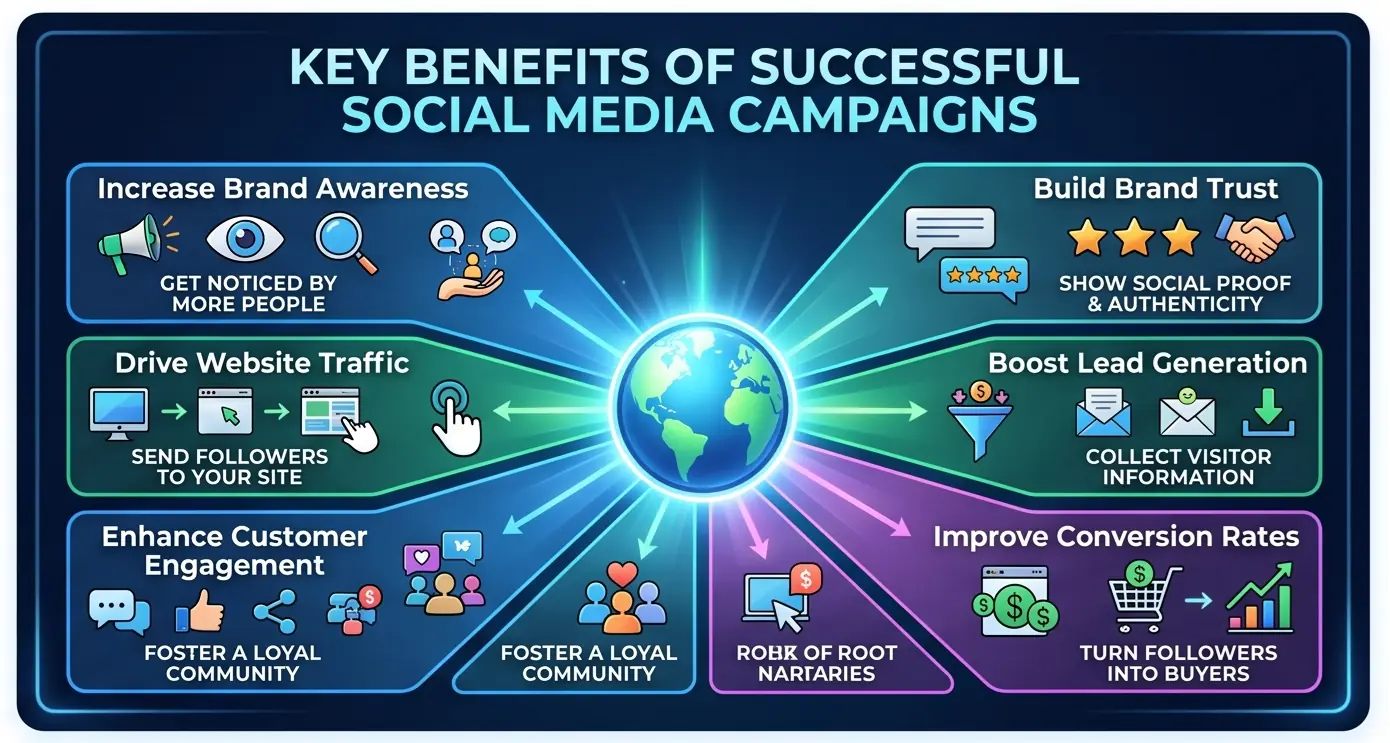
When you get it right, the benefits of social media marketing are undeniable. You aren’t just getting likes; you’re building deep brand trust, fostering a loyal community, and ultimately driving real sales. But how do you bridge the gap between a quiet page and a buzzing community?
You might be wondering, “What are some examples of social media campaigns that actually move the needle?” Or maybe you’re just looking for fresh digital campaign ideas to pitch to your team this week.
Well, grab your favorite drink, settle in, and let’s talk. I’m going to walk you through 20 of the most effective, creative, and successful social media campaigns you can adapt for your own brand. No generic corporate fluff—just real, actionable strategies explained like we’re chatting over coffee.
20 Proven Social Media Campaign Ideas
Forget the fluff. Here are 20 highly actionable concepts, complete with examples, stats, and exact steps on how you can pull them off.
1. The “Pass the Mic” User-Generated Content (UGC) Drive
There is nothing more powerful than digital word-of-mouth. A UGC campaign involves asking your audience to create content featuring your product or brand, usually tied together with a specific hashtag. It takes the pressure off your content team and builds immense trust.
Think about Apple’s iconic “Shot on iPhone” campaign. They didn’t brag about their camera specs using technical jargon. Instead, they just slapped stunning photos taken by everyday users onto billboards and Instagram feeds. It was brilliant because it provided social proof while making their customers the heroes.
Data shows that consumers are 2.4 times more likely to view user-generated content as authentic compared to content created by brands. People trust people, not logos. When your audience sees someone just like them enjoying your product, their defense mechanisms drop.
👉 Create a branded hashtag and run a contest. Ask your followers to show how they use your product in their daily lives. Offer a meaningful prize for the most creative entry, and always ask for permission before reposting their content to your main feed.
2. The Hyper-Niche Micro-Influencer Takeover
We often think we need massive celebrities to make a splash. But in reality, paying a Kardashian a million dollars for a post isn’t realistic—or even effective—for most businesses. Enter the micro-influencer takeover.
This involves handing over the “keys” to your social media accounts (usually Instagram or TikTok Stories) to a niche influencer for 24 hours. A great example of successful social media campaigns using this tactic is Daniel Wellington. They built a multi-million dollar watch empire almost entirely by partnering with hundreds of smaller, highly engaged creators.
Recent 2026 data indicates that micro-influencers (10k-50k followers) boast an engagement rate that is nearly 60% higher than mega-influencers. Their audiences are smaller but fiercely loyal. When they take over your account, they bring that loyal community with them.
👉 Identify 3-5 creators in your exact niche who have high engagement but smaller followings. Invite them to document a “day in the life” using your product on your Stories. It feels raw, unedited, and incredibly trustworthy.
3. The “Peeking Behind the Curtain” Documentary Series
Consumers are tired of overly polished, perfectly curated feeds. They want to know how the sausage is made. A behind-the-scenes (BTS) campaign strips away the corporate veneer and shows the messy, beautiful reality of running your business.
Glossier mastered this early on. Before launching new products, they would show the packaging being designed, the formulation process, and even the debates in their office. By the time the product dropped, their audience felt like they had helped create it.
Showing your humanity builds a deep, emotional connection. It shows that there are real people working hard behind the screen. It also justifies your pricing—when people see the effort that goes into your work, they are more willing to pay for it.
Action Step: Film a short, 3-part video series on your phone. Show your workspace, introduce a team member, and document a real challenge you faced this week. Don’t over-edit it; the raw nature is exactly what makes it engaging.
4. The Value-Packed Mini-Course (Carousel Style)
Social media is increasingly becoming a search engine. People go to Instagram, TikTok, and LinkedIn to learn new skills. You can capitalize on this by running a campaign that acts as a free mini-course, delivered via carousel posts or short video series.
If you are a B2B SaaS company, don’t just say your software saves time. Create a 5-day campaign called “The Productivity Sprint.” Each day, post a carousel teaching a specific time-management technique, subtly weaving your software in as the ultimate solution on the last slide.
This taps into the principle of reciprocity. When you give away incredibly valuable information for free, your audience feels naturally inclined to support you when you eventually ask for a sale. Plus, highly educational carousels get saved and shared, which triggers the algorithm to push your content further.
👉 Break down your biggest piece of gated content (like an eBook or a webinar) into bite-sized social media posts. Challenge your audience to implement one small tip every day for a week.
5. The Data-Driven “Year in Review” Experience
People absolutely love talking about themselves. A data-driven campaign leverages user habits and packages them into highly shareable, personalized graphics.
The undisputed king of this is Spotify Wrapped. Every December, millions of people willingly advertise Spotify on their own feeds simply because the data is packaged in a fun, colorful, and ego-boosting way. It has become a massive cultural event.
You don’t need Spotify’s budget to do this. If you have an app or an email list, you can pull simple metrics. “You saved 14 hours this year using our tool” or “You were in our top 5% of most active community members.” Personalization makes people feel seen.
Action Step: At the end of a quarter or year, email your top customers with a personalized stat about their journey with you. Provide a beautifully designed graphic they can easily share to their Instagram Stories or LinkedIn.
6. The “Us vs. The Industry Enemy” Narrative
Sometimes, the best way to unite your audience is to point out a common frustration in your industry and position your brand as the rebellion. This isn’t about attacking competitors directly; it’s about attacking an outdated way of doing things.
Think about Oatly. Their entire marketing strategy was built on poking fun at the traditional dairy industry and corporate marketing norms. Their billboards and social posts were sarcastic, self-aware, and completely refreshing. They created a movement, not just a milk alternative.
When you take a stand against an industry norm (like hidden fees, toxic ingredients, or terrible customer service), you rally a community around shared values. It transforms your brand from a commodity into a cause.
👉 Identify the number one thing your customers hate about your industry. Run a bold, text-based campaign calling out that exact problem, and show exactly how you are fixing it. Be opinionated!
7. The Gamified Scavenger Hunt
Giveaways where you have to “tag 3 friends and follow” are boring and often attract spam accounts who will unfollow you tomorrow. Instead, turn your campaign into a game. Gamification dramatically increases time spent interacting with your brand.
A few years ago, a clothing brand ran a digital scavenger hunt. They hid small discount codes and clues in their past Instagram posts, inside their YouTube videos, and hidden on their website. Fans spent hours scouring their content to find the winning codes.
This strategy skyrockets your engagement metrics across all platforms. Because users are actively hunting for clues, they are consuming a massive amount of your content, which signals to the algorithm that your brand is highly relevant.
Action Step: Launch a 3-day digital scavenger hunt. Post a riddle on Twitter that leads to a specific TikTok video, which hides a link to a landing page. Reward the first 50 people who complete the journey with a massive discount.
8. The Nostalgia Time Machine
The world is moving fast, and as a result, people crave the comfort of the past. Nostalgia marketing is incredibly effective because it bypasses logic and hits right at the emotional center of the brain.
Look at how successful brands are when they bring back retro packaging, or when a streaming service heavily promotes a classic 90s show. It instantly sparks joy, memories, and conversations in the comment section.
Psychologically, nostalgia makes people feel safe and connected. When you associate your brand with a fond memory from your audience’s childhood or early internet days, you borrow those warm feelings and attach them to your product.
👉 Find an aesthetic, a meme format, or a pop-culture reference from 10-15 years ago that your target demographic would instantly recognize. Recreate it with a modern twist tailored to your brand.
9. The Employee Advocacy Spotlight
People connect with people. If your brand only ever speaks as a corporate logo, you are missing out on your best marketing asset: your team. An employee advocacy campaign empowers your staff to become the face of the brand.
Tech companies have realized that a heartfelt post from a lead engineer about building a new feature performs infinitely better than a sterile press release from the company page. The engineer’s post feels authentic, whereas the company post feels like an ad.
When employees share their wins, their struggles, and their daily routines, it humanizes the B2B or B2C experience. It also doubles as incredible employer branding, attracting top talent to your company.
👉 Pick three employees from different departments. Help them craft a post for LinkedIn or Twitter about a project they are proud of. Have the main company page share their posts, shining a spotlight on the humans behind the work.
Also Read: Key benefits of social media for business
10. Real-Time Trend Hijacking (Done Right)
Also known as “newsjacking,” this involves hopping onto a viral cultural moment or trending topic and adding your brand’s unique spin to it. It requires agility, a great sense of humor, and the ability to post without needing 14 layers of legal approval.
The most famous example remains the Oreo “Dunk in the Dark” tweet during the 2013 Super Bowl blackout. While other brands sat frozen, Oreo’s team quickly designed a simple graphic and hit send. It went globally viral because it was clever and perfectly timed.
You can’t plan these campaigns months in advance. You have to monitor social listening tools and be ready to strike. The key is to make sure the trend loosely relates to your brand—don’t force a connection if it doesn’t make sense.
👉 Keep a close eye on TikTok audio trends or Twitter trending topics. When you see a format exploding, quickly brainstorm how your brand can participate in a self-aware, funny way. Post it within 24 hours.
11. The Immersive AR Filter Experience
Augmented Reality (AR) is no longer sci-fi; it is a standard feature on Instagram, Snapchat, and TikTok. Creating a custom AR filter is a phenomenal way to generate massive brand awareness through interactive play.
Taco Bell created a Snapchat filter that turned the user’s face into a massive taco. It sounds absurd, but it broke records for engagement. Millions of people sent photos of their “taco faces” to friends, acting as free billboards for the fast-food chain.
AR filters work because they provide a tool for self-expression. Users aren’t thinking about advertising your brand; they just want to make a funny video to send to their group chat. You get the brand impressions as a byproduct of their fun.
👉 Use a platform like Spark AR to create a simple, branded filter. It could be a “Which [Your Product] Are You?” randomizer above their head. Promote the filter on your stories and encourage your audience to tag you.
12. The “30-Day Challenge” Community Builder
Commitment drives community. A 30-day challenge campaign invites your audience to achieve a specific goal alongside you. It is highly structured, deeply engaging, and builds a powerful sense of shared momentum.
Fitness brands do this perfectly with “30 Days of Yoga” or “Summer Shred” challenges. But it works for any industry. A finance app could run a “30 Days to Better Credit” campaign. A writing software could run a “Write 500 Words a Day” challenge.
By providing a daily prompt, you guarantee that your audience interacts with your social media accounts every single day for a month. By the end of the challenge, using your product or engaging with your brand has become a literal habit.
👉 Define a small, achievable transformation your audience wants. Map out 30 days of micro-tasks. Create a dedicated hashtag and host weekly live check-ins to keep the energy high and celebrate wins.
13. The Purpose-Driven Impact Campaign
Modern consumers, particularly Gen Z and Millennials, want to buy from brands that give a damn. A cause-driven campaign aligns your company with a social or environmental issue, proving that you care about more than just your bottom line.
Patagonia is the gold standard here. Their “Don’t Buy This Jacket” campaign on Black Friday was a masterclass in anti-consumerism, urging people to consider the environmental impact of their purchases. It paradoxically led to a massive surge in sales because people deeply respected their values.
You cannot fake this. If you run a cause-driven campaign, your internal practices must match your external marketing. If done authentically, it creates brand evangelists who will defend and promote your company relentlessly.
👉 Partner with a recognized non-profit that aligns with your brand values. Launch a campaign where a percentage of sales, or every specific social share, results in a tangible donation to that cause. Be totally transparent with the receipts.
Related: 30 Social media marketing tools
14. The “Unpopular Opinion” Debate Starter
Social media algorithms are fueled by one thing above all else: comments. And nothing generates comments faster than a harmless, lighthearted debate. The “Unpopular Opinion” campaign leverages this by stating a polarizing (but safe) stance to get people talking.
For example, a coffee brand might post: “Unpopular opinion: Iced coffee is superior to hot coffee, even in the dead of winter. Fight us in the comments.” It is low-stakes, but people are incredibly passionate about their preferences.
This type of campaign skyrockets your engagement metrics. As users flood the comments to agree or furiously disagree, the algorithm registers the high activity and pushes the post to a much wider audience, increasing your organic reach.
👉 Think of a harmless debate within your specific niche (e.g., SEO vs. PPC, Morning workouts vs. Evening workouts). Post a bold graphic with your stance and explicitly invite your audience to debate you in the comments.
15. The “Choose Your Own Adventure” Story Line
Instagram and TikTok Stories have native interactive features like polls, sliders, and question boxes. You can string these together to create a campaign where your audience actually dictates what happens next.
A travel brand could let their audience build a dream vacation. Slide 1: “Where are we going? Mountains or Beach?” (Poll). Slide 2: “Beach it is! What are we drinking?” (Slider). Slide 3: “Pack our bags, what is the one essential we can’t forget?” (Question box).
This transforms passive scrolling into active participation. When users feel like they have agency in the narrative, they stick around to the end of the Story sequence to see the results. It is a fantastic way to keep retention rates sky-high.
👉 Map out a 5-part Story sequence using interactive stickers on every single slide. Keep it playful, fast-paced, and related to an upcoming product launch or piece of content.
16. The Teaser and Mystery Drop
Want to create absolute frenzy? Borrow a tactic from streetwear brands and Hollywood movies: the mystery drop. Instead of just announcing a new product, drop cryptic hints over a week to build unbearable curiosity.
Brands like Supreme or major pop stars archiving all their Instagram photos before an album announcement are prime examples of successful social media campaigns using mystery. The lack of information forces the audience to guess, speculate, and talk about the brand constantly.
FOMO (Fear Of Missing Out) is a powerful psychological trigger. When people feel like there is a secret they aren’t in on, they will obsessively check your pages so they can be the first to know when the reveal happens.
👉 One week before a launch, post a zoomed-in, blurred, or silhouetted image of the product. Give a date and a time, and nothing else. Let the comments section go wild with theories.
17. The Deep-Dive Customer Mini-Documentary
Written testimonials are great, but they are a bit dry. A customer spotlight campaign takes your best success stories and turns them into emotional, high-quality mini-documentaries for platforms like YouTube and Instagram Reels.
Instead of having the customer say “I like this software,” show the impact. Show the small business owner who finally had time to attend their kid’s soccer game because your tool automated their workflow. Focus on the emotional transformation, not the features.
Stories are how human beings make sense of the world. When a prospect watches a beautifully shot video of someone exactly like them overcoming a struggle using your product, the mental leap to purchasing becomes effortless.
💡 Reach out to your absolute best, most enthusiastic customer. Hire a local videographer (or just use a high-quality smartphone) to spend an afternoon with them. Edit it down to a powerful 60-second narrative.
Explore More: Best social media design tips
18. The “Roast Us” Radical Transparency Campaign
This requires a thick skin, but it is incredibly effective. A radical transparency campaign involves asking your audience for brutal feedback, acknowledging your past flaws, and showing exactly how you are fixing them.
Domino’s Pizza executed one of the greatest digital campaign ideas in history when they literally admitted their pizza tasted like cardboard. They ran a massive campaign acknowledging the negative feedback and completely overhauled their recipe. It won back millions of lost customers.
In an era of corporate spin, honesty is a breath of fresh air. Admitting a mistake or a weakness makes your brand surprisingly bulletproof. It shows humility, which is a highly attractive trait to modern consumers.
👉 Address a common complaint your brand has received. Post a video from the founder saying, “You told us our shipping was too slow. You were right. Here are the three things we changed today to fix it.”
19. The Cross-Pollination Partnership
Growth can be slow if you are only talking to your own audience. A strategic partnership campaign involves teaming up with a non-competing brand that shares your target demographic to run a joint campaign.
Imagine a premium coffee roaster partnering with a high-end ceramics company. They co-create a “Perfect Morning” bundle and host a joint live stream on Instagram. They share audiences, effectively doubling their reach overnight.
It is a win-win scenario. You get instant access to thousands of pre-warmed leads who already trust your partner brand. The endorsement from the partner acts as instant social proof for your business.
Action Step: Make a list of 5 brands that serve your exact customer but sell a completely different product. Reach out to their marketing team and pitch a simple co-branded giveaway or collaborative content series.
20. The Unhinged Meme-ification Strategy
Sometimes, you just need to throw the corporate rulebook out the window. The meme-ification strategy involves embracing internet culture, absurd humor, and trends that make absolutely no sense to anyone outside of the platform.
The language-learning app Duolingo is the undisputed champion of this. Their giant green owl threatens people in TikTok comments, participates in bizarre dance trends, and generally acts completely unhinged. As a result, they have millions of deeply engaged followers who wouldn’t care about a standard app update.
If your brand voice allows for it, being funny and slightly chaotic breaks the pattern of boring ads on a user’s feed. It makes your brand feel like a friend sending a meme to a group chat, rather than a corporation trying to extract money.
💡 Have a younger member of your team or a culturally plugged-in social media manager find a trending meme format on TikTok or X (Twitter). Let them adapt it to your brand without over-polishing it. Post it and see how the audience reacts.
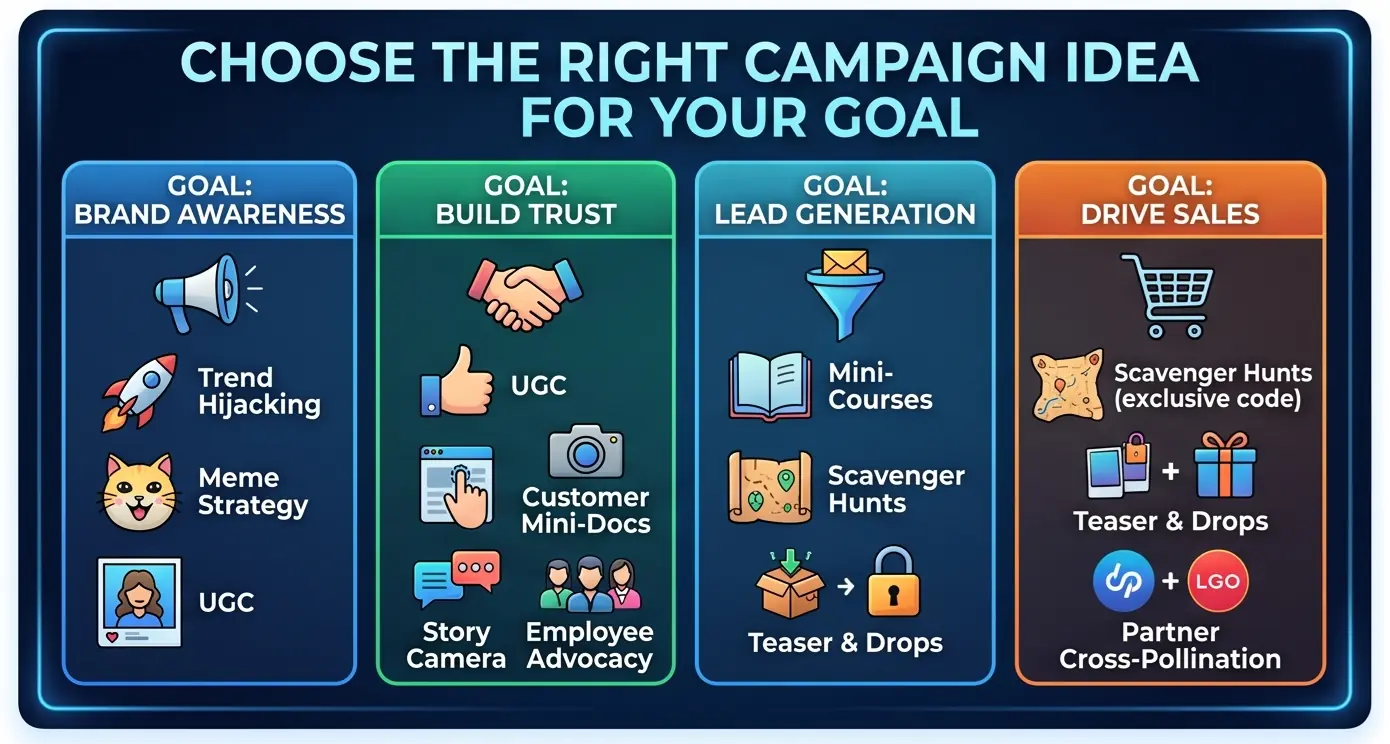
Visualizing the Tactics: A Quick Comparison Table
Not sure which of these digital campaign ideas to use first? Here is a quick breakdown to help you choose based on your current business goals.
| Campaign Type | Best Used For | Required Effort | Risk Level | Primary Metric to Track |
| UGC Challenges | Brand Awareness & Trust | Medium | Low | Hashtag volume, Mentions |
| Micro-Influencers | Targeted Reach & Sales | High (Outreach) | Low | Conversion rate, CTR |
| Trend Hijacking | Virality & Impressions | Low | Medium | Shares, Impressions |
| Mini-Courses | Lead Generation & Authority | High (Creation) | Low | Saves, Email signups |
| Meme Strategy | Community Engagement | Low | High | Comments, Shares |
Recommended: Pillar of Social Media Growth
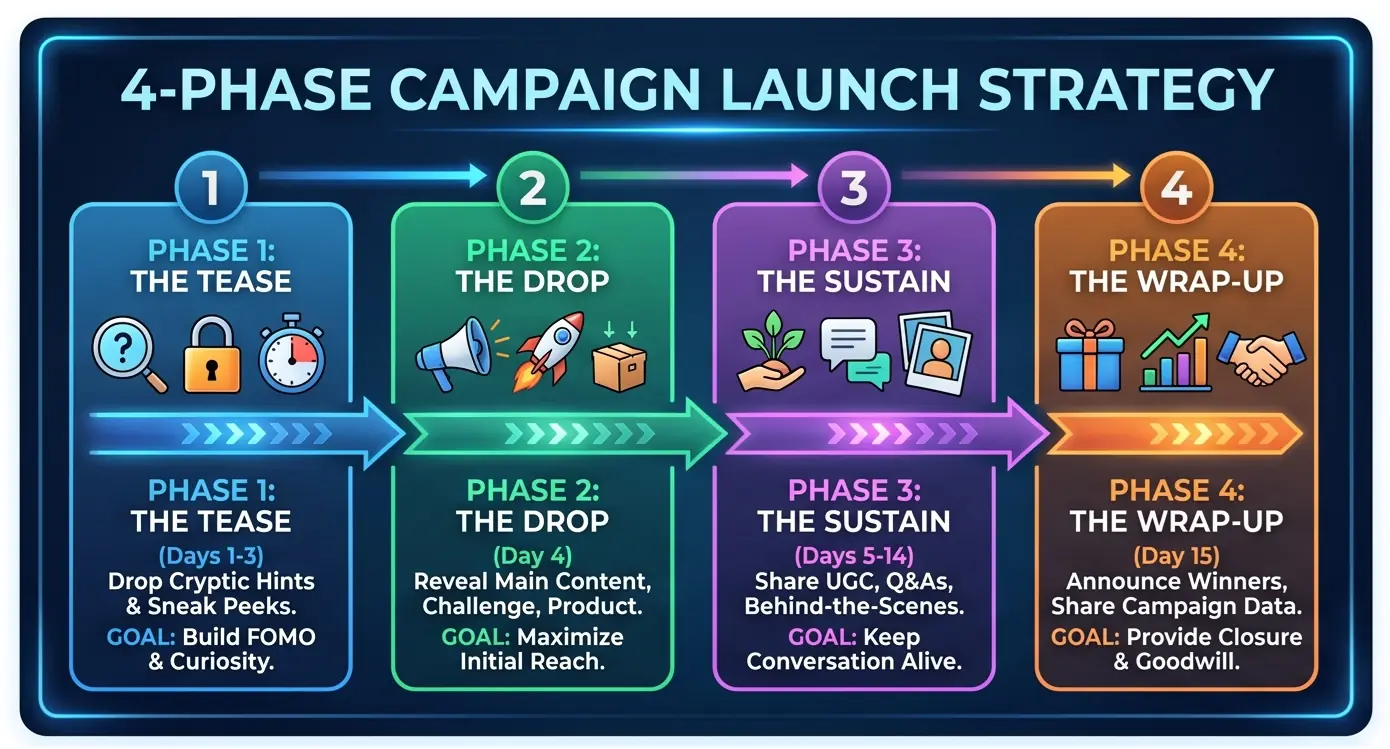
The 4-Phase Campaign Launch
If we were to draw out the perfect campaign timeline, it would look like this step-by-step ladder. Keep this in mind when deploying any of the 20 ideas above:
- Phase 1: The Tease (Days 1-3)
- Action: Drop cryptic hints, blurred images, or questions.
- Goal: Build FOMO and curiosity.
- Phase 2: The Drop (Day 4)
- Action: Release the main content, announce the challenge, or launch the product.
- Goal: Maximize initial reach and engagement velocity.
- Phase 3: The Sustain (Days 5-14)
- Action: Share UGC, host live Q&As, post behind-the-scenes content.
- Goal: Keep the conversation alive and overcome objections.
- Phase 4: The Wrap-Up (Day 15)
- Action: Announce contest winners, share campaign data, say thank you.
- Goal: Provide closure and foster long-term community goodwill.
Frequently Asked Questions (FAQs)
Let’s clear up a few lingering questions you might have about making these strategies work for your specific situation.
What are some examples of social media campaigns that went viral recently?
Beyond the classics like Apple’s “Shot on iPhone,” recent massive successes include Barbie’s AI selfie generator campaign (which created billions of impressions through sheer personalization) and Duolingo’s continued chaotic TikTok presence. Both relied heavily on user participation rather than just passive broadcasting.
What are the 10 examples of social media platforms to run these campaigns on?
While you don’t need to be on all of them, the top 10 platforms for running brand campaigns in 2026 are: 1. TikTok (for viral video), 2. Instagram (for visual aesthetics & UGC), 3. LinkedIn (for B2B & employee advocacy), 4. YouTube (for long-form storytelling), 5. X/Twitter (for real-time trends), 6. Pinterest (for evergreen visual search), 7. Snapchat (for AR filters), 8. Facebook (for localized community groups), 9. Reddit (for hyper-niche AMA campaigns), and 10. Discord (for deep community building).
What makes successful social media campaigns actually work?
The most successful social media campaigns examples all share three common traits: they evoke an emotion (humor, nostalgia, or inspiration), they encourage active participation (gamification or UGC), and they are native to the platform they live on (a TikTok video shouldn’t look like a TV commercial).
How do I measure the success of my digital campaign ideas?
It depends entirely on your initial goal. If you want awareness, track impressions, reach, and share rates. If you want community, track comments, saves, and DM replies. If you want sales, ensure you are using trackable UTM links to monitor Click-Through Rates (CTR) and conversions on your website.
Are the benefits of social media marketing really worth the effort?
Absolutely. In 2026, social media is often the first touchpoint a customer has with your business. The benefits go far beyond vanity metrics; consistent, well-executed campaigns drive lower customer acquisition costs, higher customer lifetime value, and build a protective moat around your brand that competitors cannot easily copy.
Let’s Wrap This Up
Alright, we’ve covered a lot of ground today. From leveraging the raw reality of behind-the-scenes content to launching gamified scavenger hunts, you now have a massive toolkit of social media campaign ideas ready to be deployed.
Remember, you don’t need a massive, Hollywood-level budget to execute a campaign that changes the trajectory of your business. What you do need is a deep understanding of your audience, a willingness to be authentic, and the courage to try something a little outside the corporate box.
Don’t try to execute all 20 of these at once. That’s a recipe for instant burnout. Instead, pick just one strategy from this list that excites you and aligns with your current goals. Sketch out a quick timeline, rally your team, and put it out into the world.
The internet is waiting to see what you build. So, what campaign are you going to launch next month? Drop a comment below or share this post with your marketing team so you can start brainstorming today!