

TL;DR: The 2026 Social Media Landscape
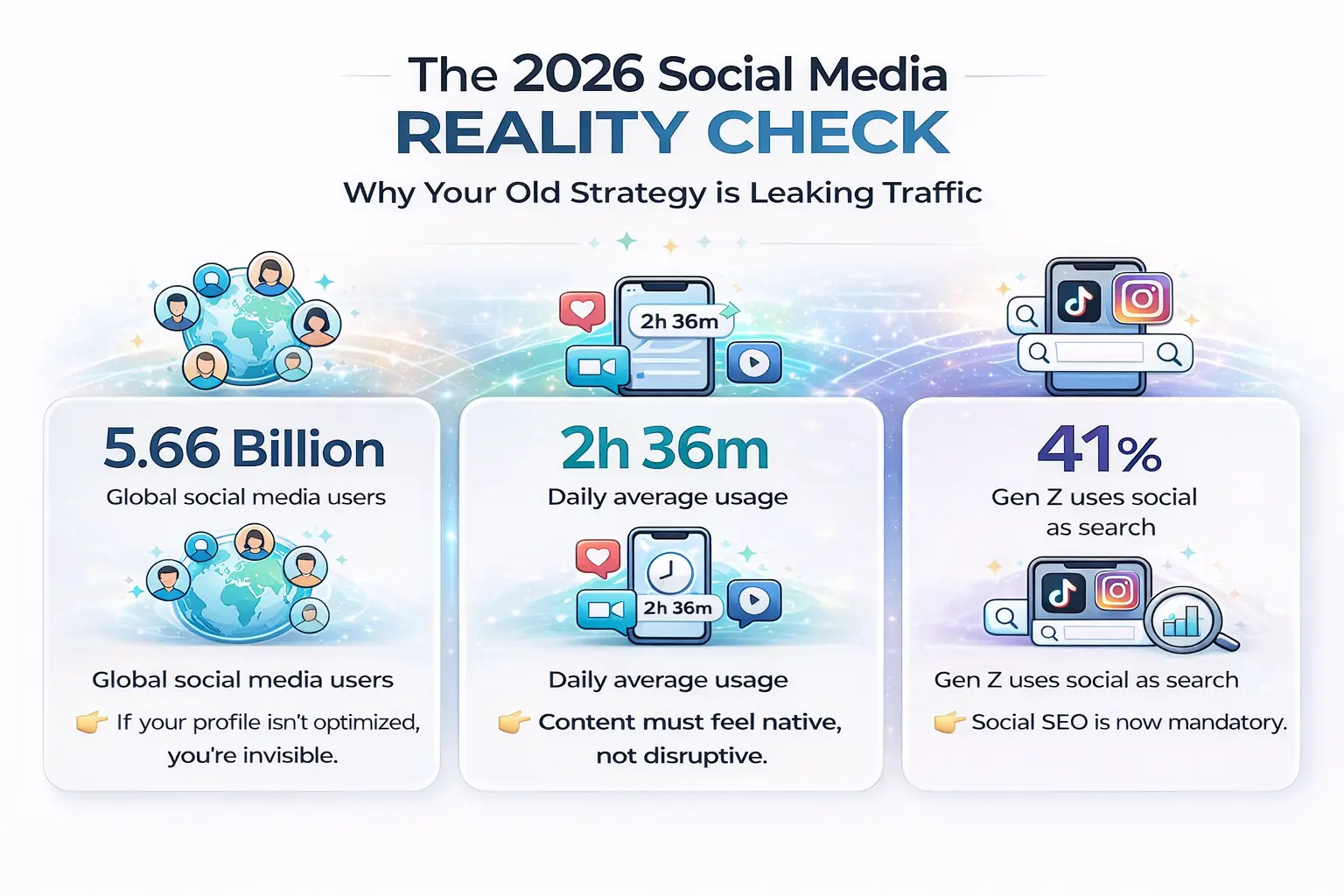
- Users: 5.66 billion people are active on social media.
- Time Spent: The average user spends over 2 hours and 36 minutes daily across apps.
- Search Shift: Social platforms are rapidly replacing traditional search engines for product discovery.
- The Fix: A thorough social media audit process free checklist is your roadmap to cutting waste and doubling your ROI.
The 2026 Social Media Audit Guide (And Why You Need It)
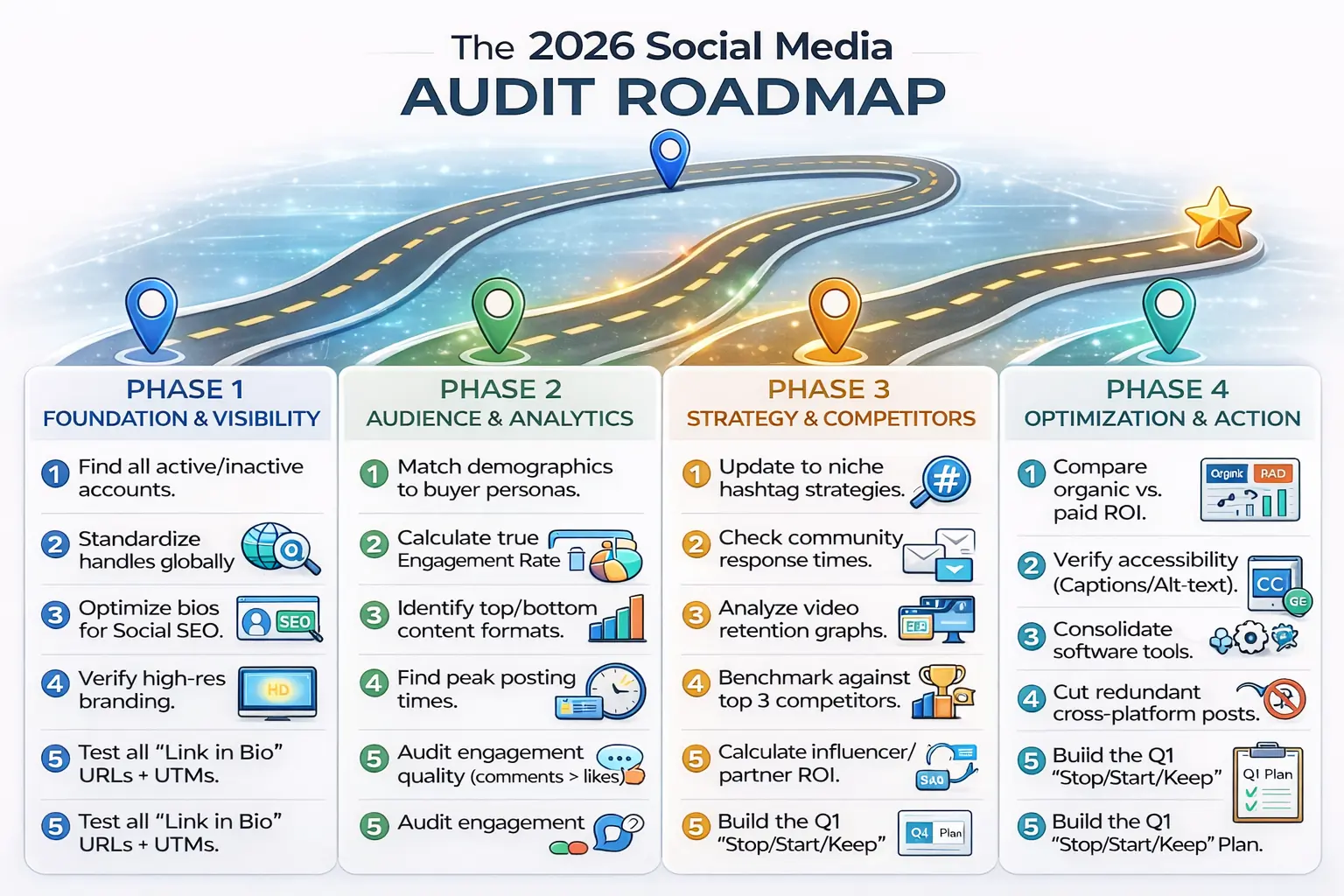
Imagine driving a car for three years straight without ever checking the oil, rotating the tires, or glancing at the dashboard. Eventually, you’re going to end up stranded on the side of the road.
Managing your brand’s digital presence without a regular checkup is exactly the same. You might be posting every single day, but if you aren’t analyzing what’s actually working, you’re just burning fuel.
Welcome to 2026. The digital landscape has shifted dramatically. With 5.66 billion active social media users globally, your audience doesn’t just “visit” social platforms anymore—they live there.
Search behaviors have completely changed, too. Today, 41% of Gen Z users turn to platforms like TikTok or Instagram for information before they even touch a traditional search engine like Google.
If your profiles aren’t optimized, you are practically invisible. Google’s AI Overviews have slashed organic click-through rates, making your social feeds the new front door to your business.
That is exactly why you need a comprehensive audit. You need to know what is driving revenue and what is just creating noise.
A social media audit is a comprehensive, structured evaluation of your business’s social media profiles. It involves analyzing performance data, audience demographics, and content strategy to identify what is working, what is failing, and how to improve your overall digital presence.
Before we dive into the steps, let’s quickly align on the massive benefits of social media marketing when it’s done right.
A well-audited social strategy builds fierce brand loyalty, drives high-intent traffic to your website, and serves as a direct pipeline for customer feedback. It lowers your customer acquisition costs and turns casual scrollers into vocal brand advocates.
Below, I’m going to walk you through this process like we’re sitting at a coffee shop looking over your analytics dashboard together. No fluff, no generic corporate jargon—just pure, actionable strategy.
Discover More: 10 Pillars of social media marketing
Your 20-Point Social Media Audit Process Free Checklist
Grab a cup of coffee, open up a blank spreadsheet (which will become your social media audit template), and let’s get to work. This checklist is designed to help you tear down your current strategy and rebuild it for maximum impact.
1. Hunt Down All Active, Inactive, and Imposter Accounts
You cannot audit what you do not know exists. Start by running a broad web search for your company name across every major platform.
You will likely find your main accounts, but you might also stumble upon abandoned pages created by a former intern in 2019. Even worse, you might find imposter accounts trying to scam your customers.
A regional airline recently lost thousands of dollars in refunds because a fake customer service account on X (formerly Twitter) intercepted passenger complaints. Do a deep sweep. Delete the dead weight, report the imposters, and document every official channel you own.
2. Claim and Standardize Your Handles (Username Uniformity)
Cognitive ease is a massive factor in user experience. If a customer follows you at “@BrandName” on Instagram, they expect to find you at the exact same handle on TikTok and LinkedIn.
If your handles look like a chaotic mix of “@BrandName_Official,” “@TheRealBrand,” and “@BrandName123,” you are confusing your audience.
Audit your usernames. If your exact name is taken on a new platform, establish a standardized naming convention (like adding “HQ” or “App” to the end) and apply it universally.
3. Audit Profile Bios and Keywords (Social SEO)
Because social media platforms are the new search engines, your bio cannot just be a clever pun anymore. It needs to be a highly optimized, searchable asset.
Look at your Instagram or TikTok bio right now. Does it explicitly state what you do and who you do it for? Are you using the keywords your target audience is actively typing into the search bar?
For instance, if you are a wedding photographer in Austin, your name field shouldn’t just say “Sarah.” It should say “Sarah | Austin Wedding Photographer.” This one tweak can skyrocket your organic discoverability.
4. Verify High-Res Branding and Visual Consistency
You have roughly two seconds to make an impression when someone lands on your profile. If your profile picture is pixelated or your cover photo is promoting a holiday sale from three years ago, you lose instant credibility.
Audit your visual assets across the board. Ensure your logo fits perfectly within the circular crop formats of Instagram and TikTok without cutting off the edges.
Check that your brand color palette and typography are cohesive. If someone jumps from your LinkedIn page to your YouTube channel, it should feel like they are walking into the same beautifully designed room.
Explore More: Best social media design tips to skyrocket your brand
5. Review All “Link in Bio” Destinations and Trackable UTMs
A massive leak in most marketing funnels happens right at the link in the bio. You spend hours crafting the perfect post, the user clicks the link, and they land on a broken page or a generic homepage.
Click every single link on your profiles. Are they working? Are they mobile-optimized? More importantly, are you using a link aggregator tool (like Linktree or Later) that actually makes sense for user flow?
Ensure every link has a UTM parameter attached. If you aren’t tracking exactly which social platform drove a specific website purchase, you are essentially flying blind.
6. Evaluate Audience Demographics (Are You Reaching the Right People?)
It is incredibly easy to gain a massive following that consists entirely of people who will never buy your product. If you sell luxury B2B software but your TikTok following is 80% teenagers, your strategy is misaligned.
Dive into your native analytics. Look at the age, gender, location, and active hours of your followers.
Compare this data strictly against your actual buyer personas. If there is a disconnect, you need to radically adjust your content themes to attract the demographic that actually holds the purchasing power.
7. Analyze Follower Growth vs. Engagement Rates
Follower count is the ultimate vanity metric. Having 100,000 followers means absolutely nothing if your posts only get 12 likes.
Audit your engagement rate (Total Engagements / Total Followers x 100). In 2026, smaller, hyper-engaged communities are outperforming massive, passive audiences.
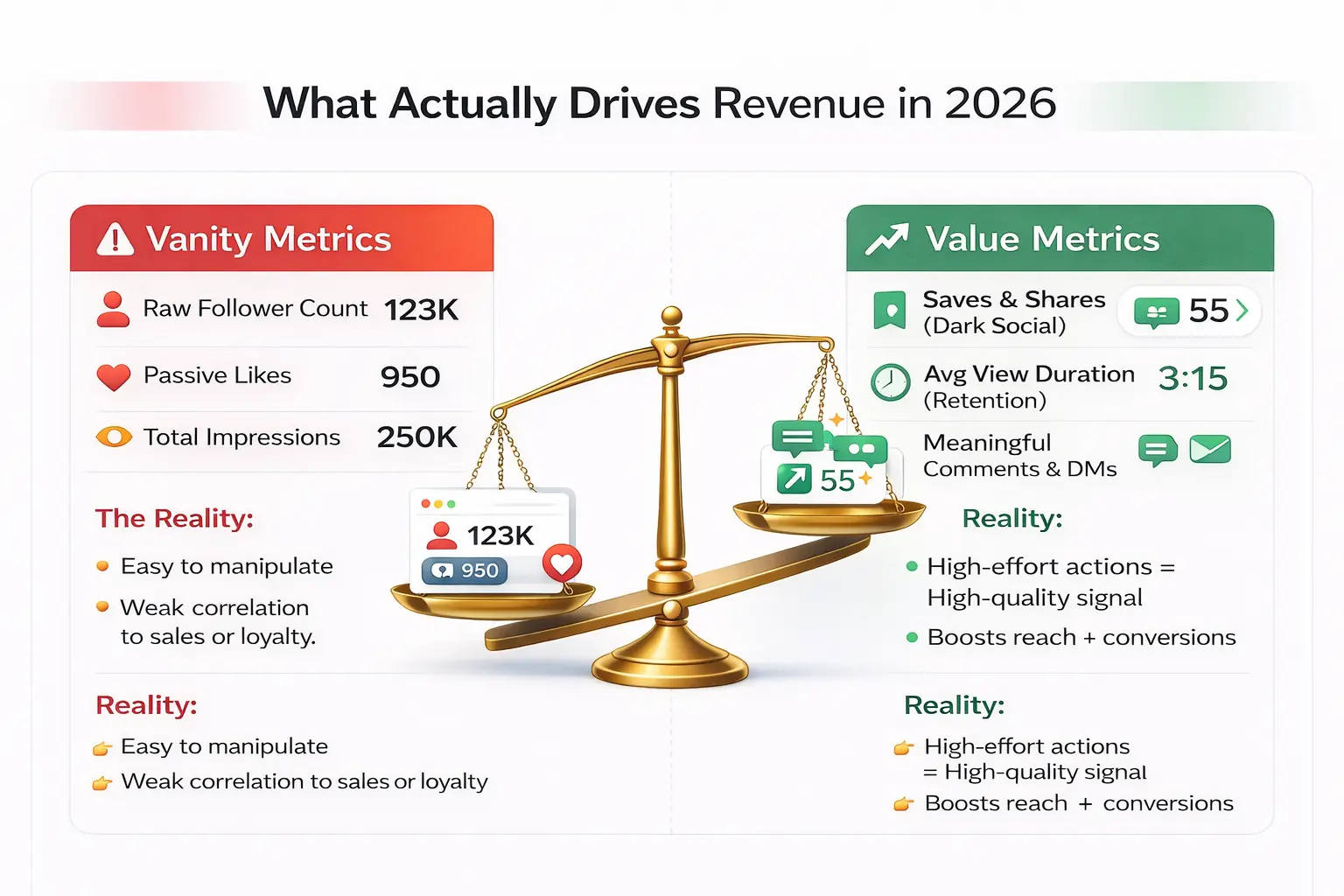
If your follower count is climbing but your engagement is flatlining, the algorithm is going to punish you. It tells the platform your content is boring. Focus on tracking engagement rate tracking over mere growth.
Continue Reading: 30 Free social media marketing tools
8. Conduct a Deep Dive into Content Performance (Formats)
Not all content is created equal. You need to know exactly which formats are driving your business forward.
Review your data from the last 90 days. Are your short-form videos (Reels, TikToks, Shorts) generating 80% of your reach? Are your LinkedIn carousel posts driving the most saves and shares?
Identify your top five performing posts and your bottom five. Look for patterns. Stop wasting hours designing static graphics if your audience is clearly begging for raw, unpolished, behind-the-scenes video content.
9. Evaluate Posting Frequency and Timing
There is a sweet spot between ghosting your audience and aggressively spamming their feeds. Are you posting three times a day on Instagram but seeing diminishing returns?
Check your analytics to find the exact days and times your specific audience is online. The generic “post at 10 AM on Tuesdays” advice is outdated; your audience’s habits are unique to your industry.
Audit your cadence. You might find that posting high-quality content three times a week drastically outperforms posting mediocre content seven days a week.
10. Measure Engagement Quality (Comments vs. Passive Likes)
A “like” takes half a second and requires zero emotional investment. A comment, a share, or a save requires actual cognitive effort.
Audit the quality of your engagement. Are people tagging their friends in the comments? Are they asking questions about your product? Or are you just getting automated bot comments saying “Great pic!”?
High-quality engagement is the strongest signal to the algorithm that your content is valuable. If your comments are dead, your content lacks a strong hook or a compelling call-to-action.
[Infographic Placeholder: A visual funnel showing the hierarchy of social media engagement. Top: Impressions/Reach. Middle: Likes/Reactions. Bottom: Saves/Shares/Meaningful Comments. Arrow points to the bottom labeled “Focus Your Strategy Here.”]
11. Audit Your Hashtag and Keyword Strategy
The days of slapping 30 random hashtags at the bottom of a post are officially over. Platforms have evolved to read the context of your captions, on-screen text, and even the audio in your videos.
Review your hashtag usage. Are you using massive, generic tags like #Marketing that drown your post in millions of others?
Transition to a social SEO strategy. Use niche, highly descriptive keywords woven naturally into your captions. Think about what your ideal customer is typing into the search bar, and mirror that language perfectly.
12. Review Community Management and Response Times
Social media is a two-way street, but many brands treat it like a megaphone. In 2026, 73% of consumers say they will switch to a competitor if a brand ignores them on social media.
Audit your direct messages and comment sections. How long does it take your team to reply to a customer service inquiry?
If your response time is dragging beyond a few hours, you are losing trust. Set clear internal SLAs (Service Level Agreements) for social media community management and stick to them religiously.
13. Analyze Your Video Strategy (Retention is King)
Short-form video is dominating the internet, but simply uploading a video isn’t enough. You have to audit your retention graphs.
Look at your TikTok or Reels analytics. Are viewers dropping off after the first three seconds? If so, your hooks are weak.
You need to analyze the exact moment people scroll past your video. Cut the long, boring introductions. Start right in the middle of the action to maximize your average view duration.
14. Perform a Competitor Benchmarking Analysis
You do not exist in a vacuum. You need to know exactly what your biggest rivals are doing so you can do it better.
Identify your top three competitors. Do not just look at their follower count; look at their content strategy. What formats are they leaning heavily into? What gaps are they missing that you can fill?
Competitor benchmarking on social media isn’t about stealing their ideas. It is about understanding the baseline expectations of your shared audience and finding unique ways to stand out.
Related Reads: 30 benefits of social media marketing in 2026
15. Assess Influencer and Partnership ROI
If you spent money on influencers or brand collaborations last year, you need to ruthlessly audit the return on those investments.
Did that expensive macro-influencer actually drive sales, or did they just bring in a wave of fake followers?
Current data shows that micro-influencers (10K–100K followers) often yield a much higher ROI because their audiences are deeply engaged and trust their recommendations implicitly. Evaluate your partnerships and cut the dead weight.
16. Review Paid vs. Organic Performance
Organic social builds trust and community. Paid social accelerates reach and conversions. You need to audit how these two work together.
Are you boosting posts blindly without a strategy? Are your ads cannibalizing your organic reach?
Look at your ad spend efficiency. Find the organic posts that performed exceptionally well on their own, and put your ad dollars behind those proven winners. Stop paying to promote content that your audience already rejected organically.
17. Evaluate Accessibility and Inclusivity
If your social media presence isn’t accessible, you are actively alienating a massive segment of the population.
Audit your past posts. Are you consistently using closed captions on all your video content? Are you adding descriptive Alt-Text to your images so screen readers can process them?
Are you capitalizing the first letter of each word in your hashtags (#LikeThisExample) so they can be read correctly by accessibility software? This isn’t just about compliance; it’s about basic human empathy.
18. Audit Your Tech Stack (Social Media Audit Tools)
Are you paying for three different scheduling tools that essentially do the same thing?
Review the software your team uses. You might be paying for Hootsuite, a separate analytics dashboard, and a standalone link-in-bio tool, when one consolidated platform could do it all.
Streamlining your tech stack saves money and drastically reduces the friction in your team’s workflow. We’ll cover the best tools for 2026 in the next section.
Don’t Miss These: key benefits of social media for business in 2026
19. Identify Content Gaps and Platform Redundancies
Take a step back and look at the big picture. Are you cross-posting the exact same video to Instagram, TikTok, YouTube Shorts, and LinkedIn without changing the context?
Every platform has its own native language and culture. What works on TikTok feels completely out of place on LinkedIn.
Audit your distribution strategy. Stop treating platforms as dumping grounds for identical content. Tailor the message to fit the medium, or don’t post there at all.
20. Create Your 2026 Action Plan and Resource Allocation
An audit is completely useless if it doesn’t result in action. Once you have gathered all this data, you need to build a roadmap.
Summarize your insights into three categories: Stop Doing, Keep Doing, and Start Testing.
If X (Twitter) is draining your resources but driving zero traffic, sunset the platform. If YouTube Shorts is taking off, allocate more budget there. Set SMART (Specific, Measurable, Achievable, Relevant, Time-bound) goals for the next quarter and get to work.
Essential Social Media Audit Tools & Templates for 2026
You cannot perform a deep, insightful audit using just a pen and paper. You need robust technology to scrape the data, visualize the trends, and spot the anomalies.
The market is flooded with software, but you only need a few core tools to execute flawless social media audit examples. Let’s break down the heavy hitters for 2026.
The 2026 Tool Comparison Table
| Tool Name | Best Used For | Key Features | Pricing Tier |
| Sprout Social | Enterprise Audits & Deep Analytics | Competitor benchmarking, sentiment analysis, custom reporting | Premium / Enterprise |
| Metricool | All-in-One Growth Tracking | Visual dashboard, historical data sync, end-of-year audit reports | Freemium / Affordable |
| Hootsuite | Unified Social Management | Cross-platform scheduling, robust native analytics, team collaboration | Mid-to-High Tier |
| Native Analytics | Granular Platform Insights | 100% accurate algorithm data, retention graphs, audience demographics | Free (Built-in) |
How to Build Your Social Media Audit Template
You do not need to buy expensive software to organize your findings. The best social media audit template is often a meticulously organized Google Sheet.
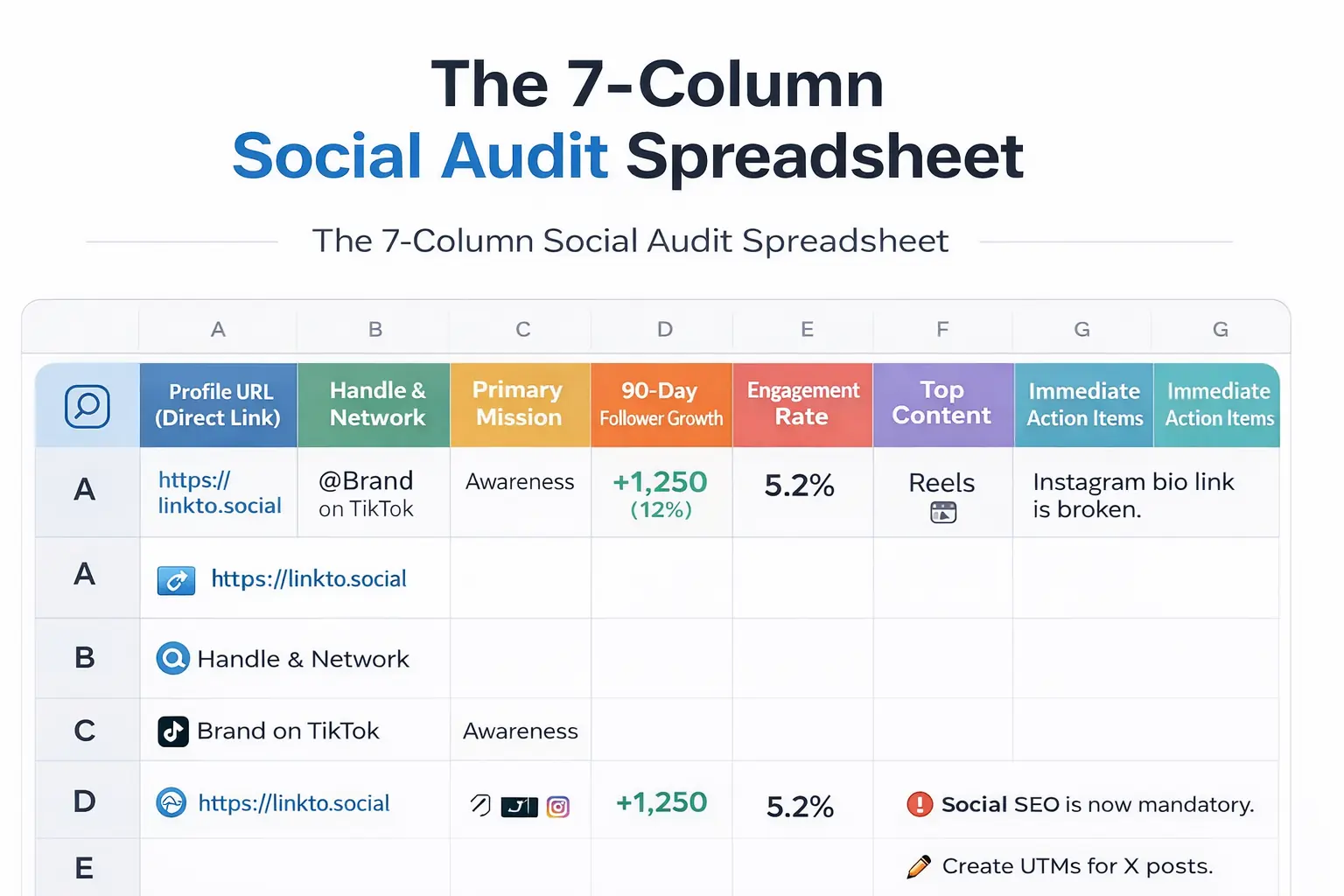
Here is how you should structure your columns to keep everything human-readable and highly actionable:
- Column A (Profile URL): The direct link to the account.
- Column B (Handle & Network): e.g., @BrandName (Instagram).
- Column C (Mission/Goal): Why does this account exist? (e.g., Brand Awareness, Customer Support).
- Column D (Follower Count & Growth): Current number + percentage growth over 90 days.
- Column E (Average Engagement Rate): Your true metric of success.
- Column F (Top Performing Content Type): Reels, Carousels, Static images, etc.
- Column G (Action Items): What needs fixing immediately? (e.g., Update bio link, refresh cover photo).
When you use a structured template, you eliminate the emotional guesswork. You can look at the raw data and make cold, hard decisions about where your marketing budget needs to go.
It is also an incredible asset to hand over to stakeholders or clients to prove the exact value of your social media marketing efforts.
Frequently Asked Questions (FAQs)
To make sure we cover every possible angle, here are the most common questions marketers and business owners are asking about audits in 2026.
What is a social media audit and why is it important?
A social media audit is a complete review of your brand’s social accounts to assess performance, branding, and audience alignment. It is important because it highlights inefficiencies, exposes content gaps, and ensures your marketing efforts are actually driving measurable business outcomes rather than just vanity metrics.
How often should a business perform a social media audit?
You should conduct a light performance review monthly, but a comprehensive, deep-dive social media audit should be performed every quarter (every three months). This quarterly rhythm allows you to spot algorithmic changes and shift your strategy before you waste a whole year on tactics that no longer work.
What are the most critical metrics to track in an audit?
While follower growth is nice to see, the most critical metrics are engagement rate, video retention rate, click-through rate (CTR) on your bio links, and conversion data. These metrics prove that your audience is not just passively scrolling, but actively interacting with and buying from your brand.
Can I do a social media audit for free?
Yes, absolutely. By combining native platform analytics (like Meta Business Suite or YouTube Studio) with a simple spreadsheet, you can execute a highly effective social media audit process free checklist. Paid tools just automate the data collection process and save you time.
How do I know if my social media strategy is failing?
Your strategy is likely failing if your follower count is growing but your engagement rate is dropping, your website traffic from social sources is stagnant, or your audience demographics do not match your actual paying customers. An audit will expose these red flags immediately.
Conclusion: Stop Guessing, Start Growing
Running a business in 2026 without a clear, data-driven social strategy is like navigating a maze blindfolded. You might accidentally stumble your way out, but you are going to hit a lot of dead ends first.
The digital landscape is too noisy, the algorithms are too smart, and your competitors are too aggressive for you to rely on “gut feelings” about your content.
By working through this 20-step social media audit process free checklist, you strip away the illusions. You get to see exactly what your audience craves, where your brand is falling flat, and precisely how to fix it.
You now have the framework, the tools, and the templates to turn your social media presence from a massive time-sink into a predictable revenue engine.
Do not just bookmark this page and forget about it. Open up a spreadsheet right now, pick your most important social platform, and complete just the first five steps today.
Also Read: Best social media campaign ideas for massive growth