
TL;DR: The 2026 Search Marketing Quick-Fix
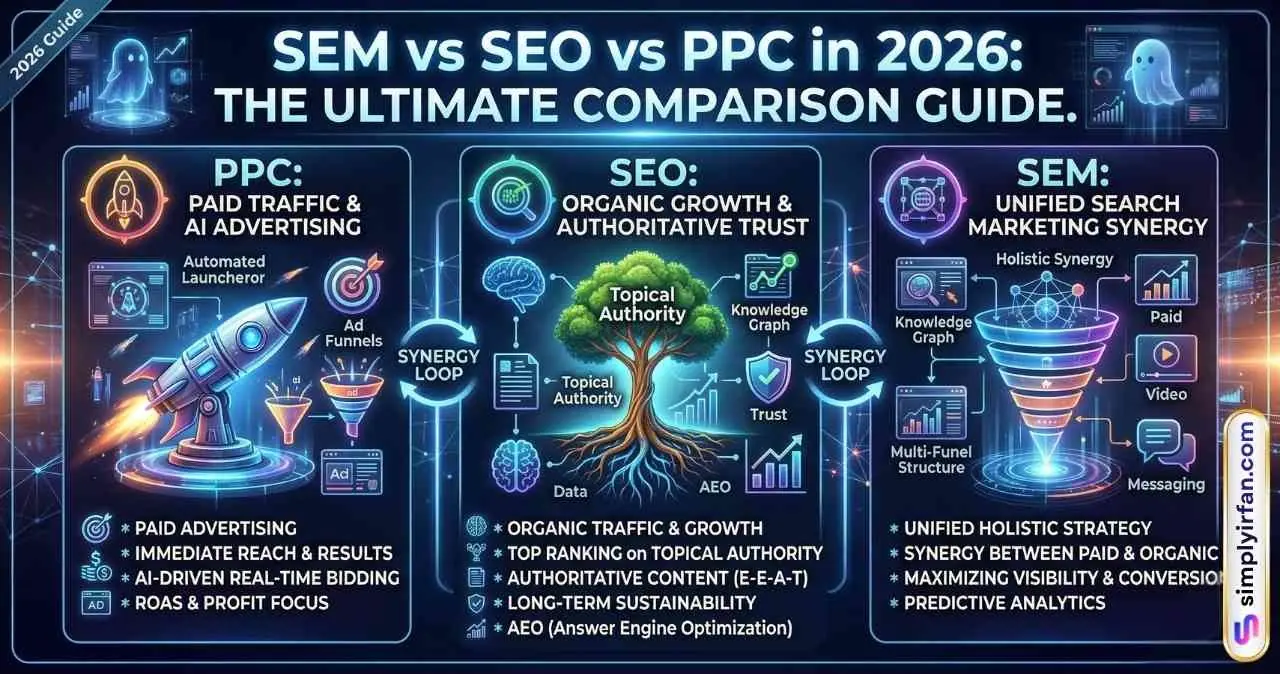
- SEO (Search Engine Optimization): The “Long Game.” High trust, zero cost-per-click, but takes 3–12 months to see a return.
- PPC (Pay Per Click): The “Instant Win.” You pay for every click to be at the top. Traffic stops the second your budget hits zero.
- SEM (Search Engine Marketing): The “Parent Term.” Historically, SEM included both SEO and PPC. Today, many use it to mean “Paid Search” specifically.
- The Golden Rule: Use PPC to test the waters and get immediate sales, while building your SEO foundation for long-term, sustainable profitability.
Imagine you’ve just poured your heart into launching a brand new website. Let’s say it’s a sleek, incredibly helpful hosting comparison website. You’ve spent weeks tweaking the WordPress theme, testing the speed, and writing brilliant reviews. You hit publish. You wait. A day passes. Then a week.
The only visitor is your mom (thanks, Mom), and maybe your dog if he stepped on your keyboard.
This is the dreaded “digital ghost town” phase. It’s the exact moment most website owners realize that having a great product simply isn’t enough. In the crowded internet of 2026, you don’t just need a website; you need to be found.
But when you start looking into how to get found, you are immediately slammed with a wall of acronyms: SEM, SEO, PPC. It feels like you need a Rosetta Stone just to run a digital marketing strategy.
I remember chatting with a brilliant developer who was rolling out a new hub for SEO tools. He was dumping thousands of dollars into ads trying to get people to use his free tools. He was getting clicks, sure. But his profit margins were bleeding out because his cost-per-click was astronomically high.
On the flip side, I’ve seen startups go “all-in” on organic traffic, refusing to spend a dime on ads. They end up running out of cash before their first page-one Google ranking ever materializes.
The secret to winning the search game isn’t blindly picking one acronym out of a hat. It’s understanding the systemic empathy behind how people search, why they click, and how these three pillars work together.
Today, we are going to strip away the jargon. We’re going to break down exactly what Search Engine Optimization, Pay Per Click, and Search Engine Marketing actually mean. More importantly, we’ll look at the latest 2026 data so you know exactly where to put your money.
1. Decoding the Acronyms: SEO, PPC, and the SEM Umbrella
To figure out your digital marketing strategy, we first have to clear up the naming mess. Over the years, marketers have mangled these terms, and the rise of Answer Engine Optimization (AEO) hasn’t made it any easier.
Let’s establish some direct, clear definitions so you can sound like the smartest person in the room during your next marketing meeting.
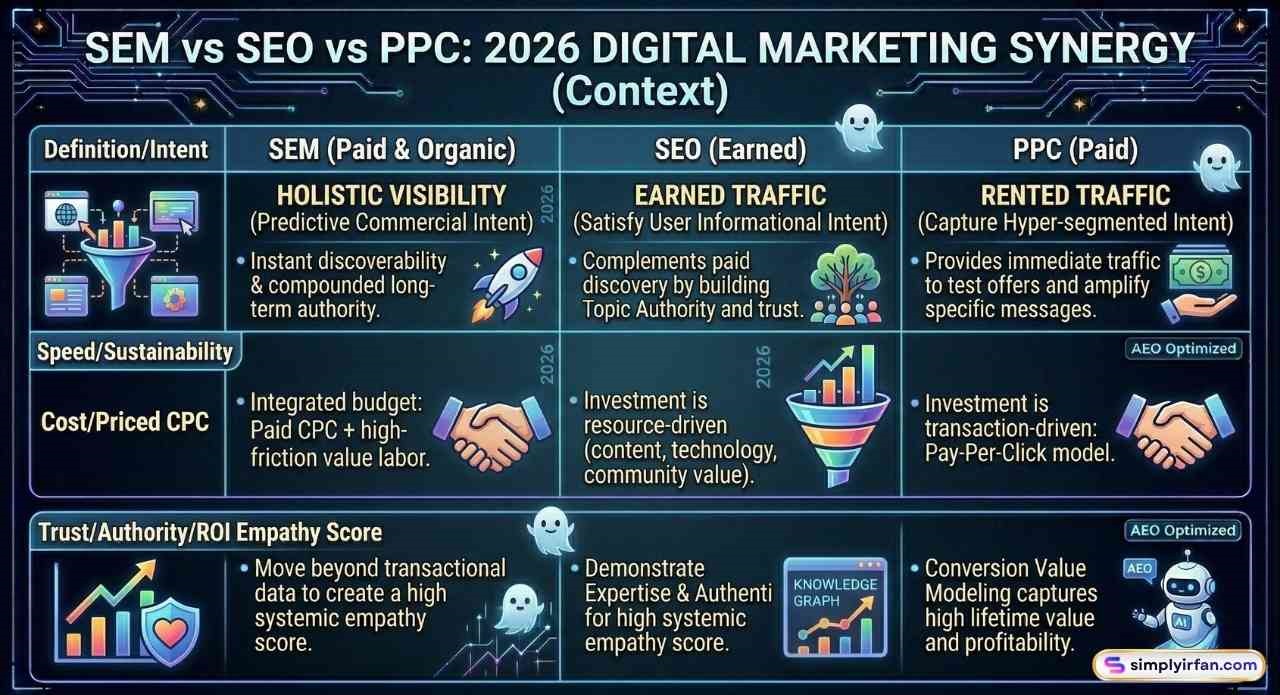
Search Engine Optimization (SEO): The Long-Term Asset
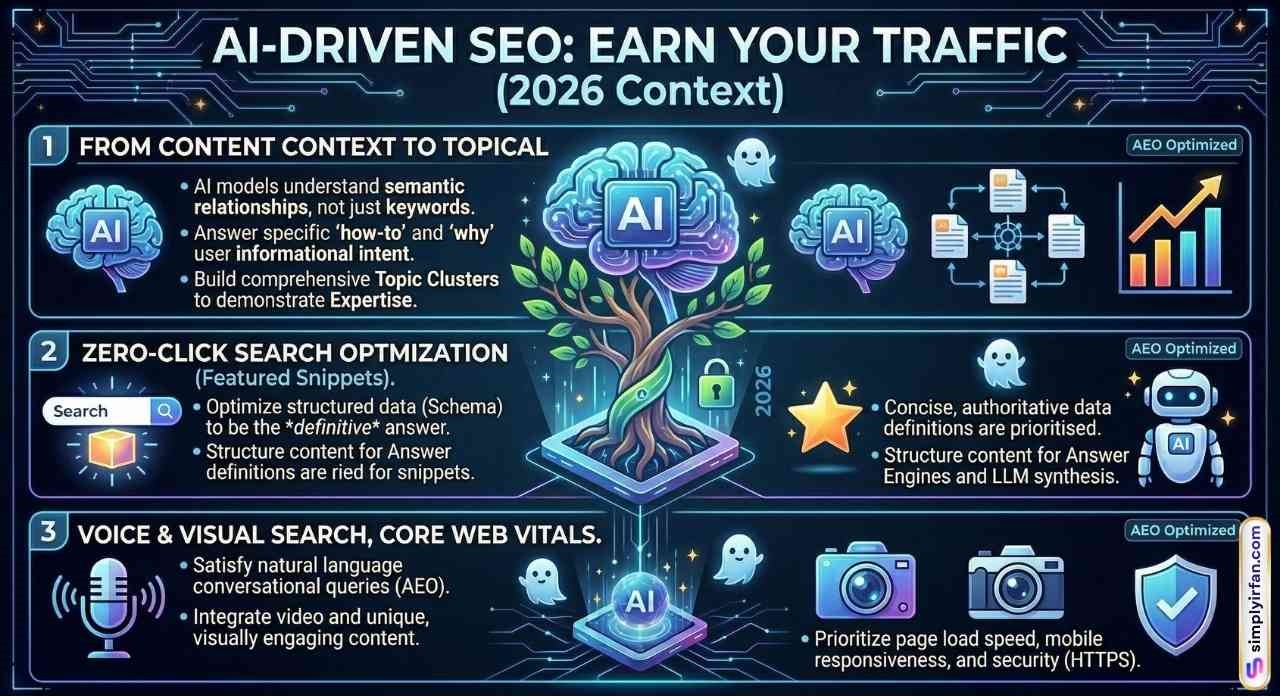
SEO is the process of optimizing your website’s technical setup, content relevance, and link popularity so its pages become easily findable and relevant to user search queries.
Think of SEO as the “earned” side of search. You are convincing Google (and its AI counterparts like Gemini) that you are the absolute most authoritative, trustworthy, and helpful answer for a specific question. If someone searches “fastest WordPress hosting,” your goal is to be the organic result they trust.
- The Cost Profile: Primarily time, labor, and resources. You pay for content creation, technical fixes, and digital PR. You do not pay the search engine for the click.
- The Reward: Extremely high trust. Organic traffic compounds over time, acting like a digital real estate asset that continuously pays dividends.
- The 2026 Reality: It’s no longer about keyword stuffing. Modern SEO requires true Topic Authority. You have to satisfy the user’s search intent completely and concisely.
Pay Per Click (PPC): The Instant Amplifier
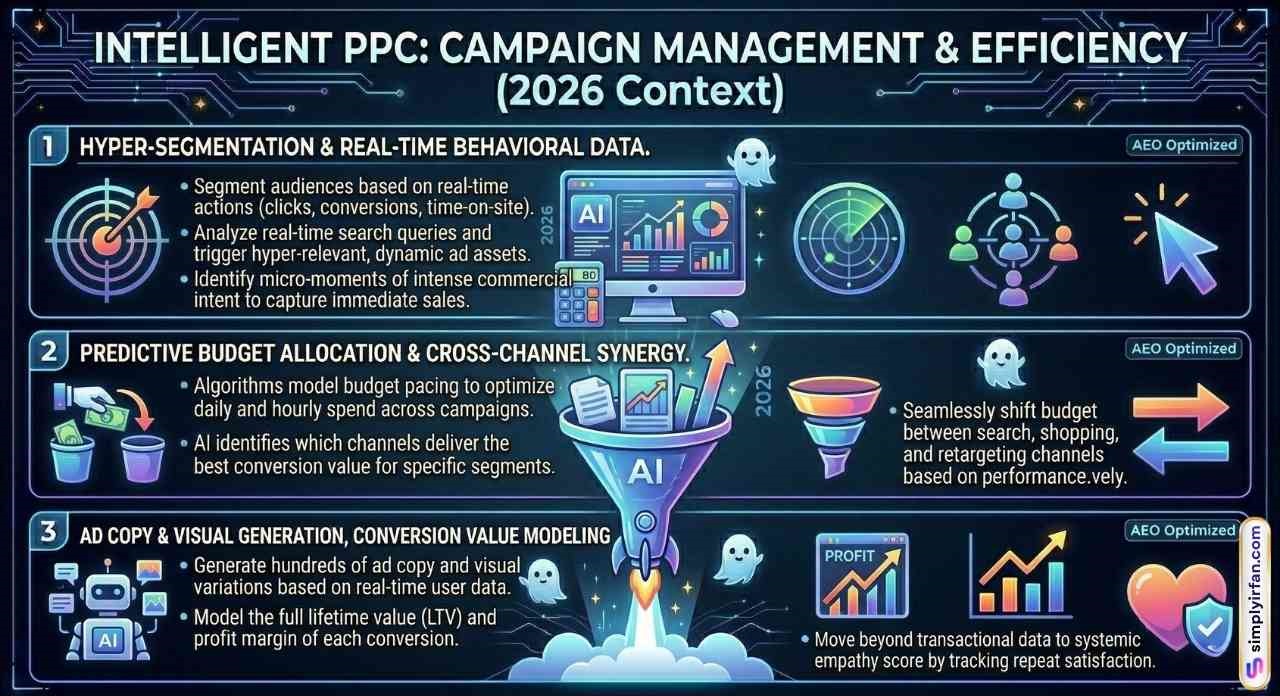
PPC is an online advertising model where advertisers pay a fee each time one of their ads is clicked. Essentially, it’s a way of buying visits to your site, rather than attempting to “earn” those visits organically.
PPC is the “rented” side of search. You bid on specific keywords. If you are willing to pay $5 every time someone clicks on your ad for “best SEO tools hub,” Google puts you at the very top of the page, above all the organic results.
- The Cost Profile: You pay real dollars for every single click. If your budget runs out at 2:00 PM, your traffic completely disappears at 2:01 PM.
- The Reward: Instant visibility, highly targeted leads, and the ability to test landing pages and offers in real-time.
- The 2026 Reality: Google Ads and Bing Ads are heavily automated now. You rely on Smart Bidding, meaning you aren’t just bidding on words anymore; you’re letting AI bid on the users most likely to convert.
Search Engine Marketing (SEM): The Ongoing Confusion
Here is where things get historically messy. What exactly is search engine marketing?
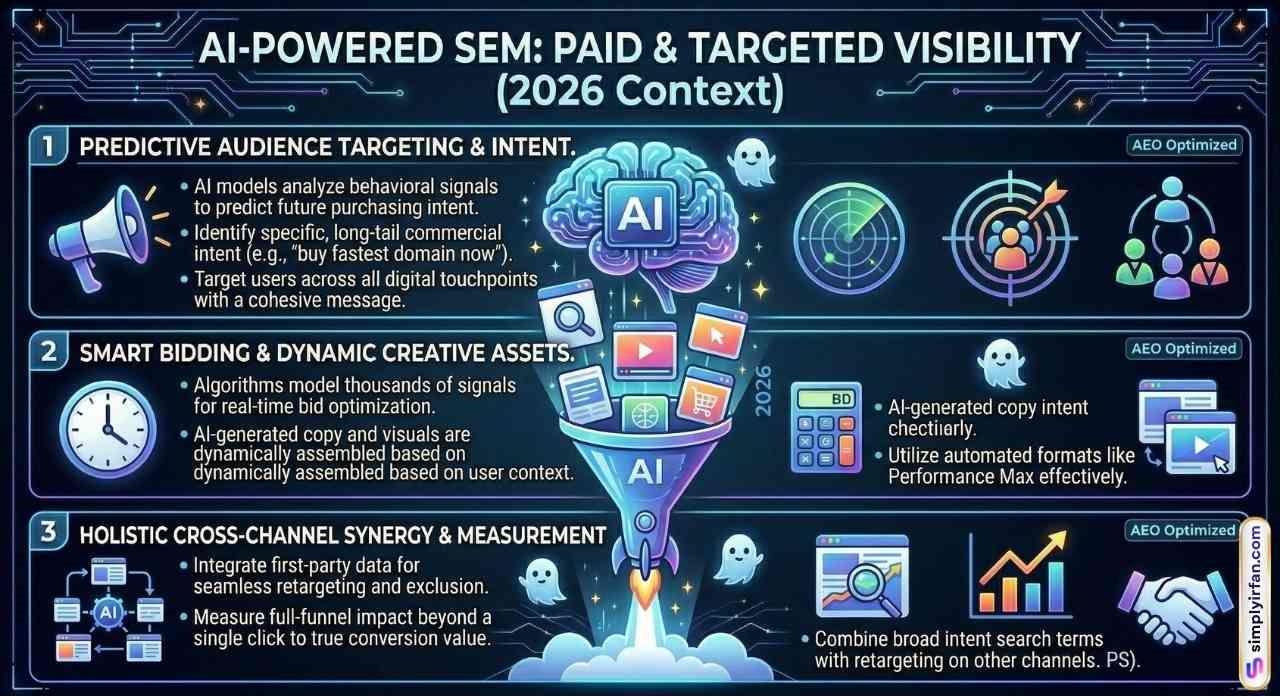
Originally, SEM was the “parent umbrella” term. It included everything you did to market on a search engine—meaning SEM was composed of both SEO and PPC.
However, language evolves. In the 2026 industry vernacular, SEM is almost exclusively used by agencies and marketers to describe Paid Search Marketing. If a consultant offers you an “SEM audit,” they are almost certainly asking to look at your Google Ads account, not your blog’s backlink profile.
For the sake of clarity: SEO is organic. PPC is paid. SEM is the broad industry term that heavily implies paid advertising.
2. The 2026 Data Breakdown: Which Engine Drives Better ROI?
You understand the definitions, but how do you actually choose? There is no universal “best” option. There is only the “best option for your current business stage.”
To help you decide whether to rent or buy your traffic, let’s look at the hard data shaping the 2026 search landscape. User behavior has shifted dramatically with the integration of AI overviews and zero-click searches.
Comparison Table: SEO vs. PPC vs. SEM
| Feature | SEO (Organic) | PPC (Paid Search) |
| Speed of Results | Slow (3–12 months) | Instant (Minutes) |
| Cost Structure | High Upfront (Labor/Content) | Constant (Pay-Per-Click) |
| Traffic Sustainability | High (Persists over time) | Zero (Stops with budget) |
| User Trust Factor | Very High (Earned Authority) | Moderate (Contains ‘Ad’ Tag) |
| Average Conversion Rate | ~2.4% (Trust-Based) | ~1.3% (Offer-Based) |
| Best Used For… | Evergreen content, brand building | Product launches, testing offers |
The Psychology of the Click
Why do people click what they click? In 2026, internet users are incredibly savvy. They suffer from “Ad Blindness.”
Recent eye-tracking studies and heat map data show a fascinating trend: organic results attract roughly 15 to 20 times more clicks than paid ads. When a user is looking for a comprehensive hosting comparison, they often scroll right past the “Sponsored” tags. They know those companies paid to be there. They want the result that earned its way to the top through merit.
However, PPC absolutely dominates when the search intent is highly transactional. If someone searches “buy cheap domain name now,” they don’t want a 4,000-word blog post. They want a button to click and a credit card form. In these moments, PPC captures massive commercial intent.
The ROI Tipping Point
If you look at customer acquisition cost (CAC) over a 24-month period, a beautiful narrative unfolds.
In month one, PPC is the clear winner. You spend $1,000, you get $2,000 in sales. Your SEO generates exactly zero dollars because you are still stuck on page seven of Google.
But by month 18, the math flips. Your SEO content has climbed to page one. It is now bringing in 5,000 visitors a month, and you aren’t paying a single cent for those clicks. Meanwhile, your PPC costs remain fixed. Companies that sustain SEO investment see a 40–60% lower cost per lead after a year and a half compared to those relying solely on paid ads.
Simple AEO Guide: The Search Marketing Funnel
This diagram illustrates the symbiotic relationship between SEM, SEO, and PPC.
- Top of Funnel (Awareness): SEO builds broad, informational trust. It captures users asking “What is the best hosting?”
- Middle of Funnel (Consideration): Retargeting through PPC reminds them of your specific brand after they leave your site.
- Bottom of Funnel (Conversion): High-intent PPC captures the “Buy Now” queries, ensuring you don’t lose the sale at the finish line.
Using both strategies together creates a closed-loop system where no potential customer slips through the cracks.
3. Building Your Strategy: When to Rent vs. When to Own
Now that you know the rules of the game, how do you play it? The most successful digital marketing strategies don’t treat SEO and PPC as enemies; they treat them as best friends who cover each other’s weaknesses.
Here is a practical, actionable blueprint for blending these strategies based on your immediate business goals.
Phase 1: The Launch (Heavy PPC, Light SEO)
When you first launch a website, you have zero domain authority. Google doesn’t trust you yet. If you try to rank organically for a competitive term, you will be waiting a very long time.
This is when you deploy PPC.
- Use Google Ads to bid on hyper-specific, long-tail keywords.
- Send that traffic to highly optimized landing pages.
- Actionable Insight: Use your PPC campaign as a massive, real-time testing ground. Which ad copy gets the most clicks? Which keywords actually lead to sales? You are paying for data just as much as you are paying for traffic.
While the ads are running, you quietly build your SEO foundation. You publish your core pillar pages, ensure your technical WordPress setup is lightning fast, and begin your outreach.
Phase 2: The Transition (Balancing SEM and SEO)
Around months 4 to 6, your organic traffic will slowly begin to trickle in. You will notice that some of the blog posts you wrote are landing on page two or three of the search results.
Take the data you gathered from your expensive PPC campaigns and apply it to your SEO. Did the keyword “cloud hosting comparison” convert beautifully in your ads? Great. Double down on organic content around that exact phrase.
- Actionable Insight: Look at your Search Query Reports in Google Ads. Find the questions people are typing in that trigger your ads. Turn those exact questions into H2 headings in your SEO blog posts. This directly aligns your content with real human search intent.
Phase 3: The Domination (Heavy SEO, Targeted PPC)
By month 12 and beyond, your Search Engine Optimization should be doing the heavy lifting. You are ranking on page one for major industry terms. Your organic traffic is a self-sustaining engine.
Does this mean you turn off your ads? No.
You shift your SEM budget. Instead of paying for expensive top-of-funnel keywords, you use your PPC budget purely for Retargeting and defending your brand name. If someone searched for your site organically, visited, and left, your ads will politely follow them around the internet reminding them to come back.
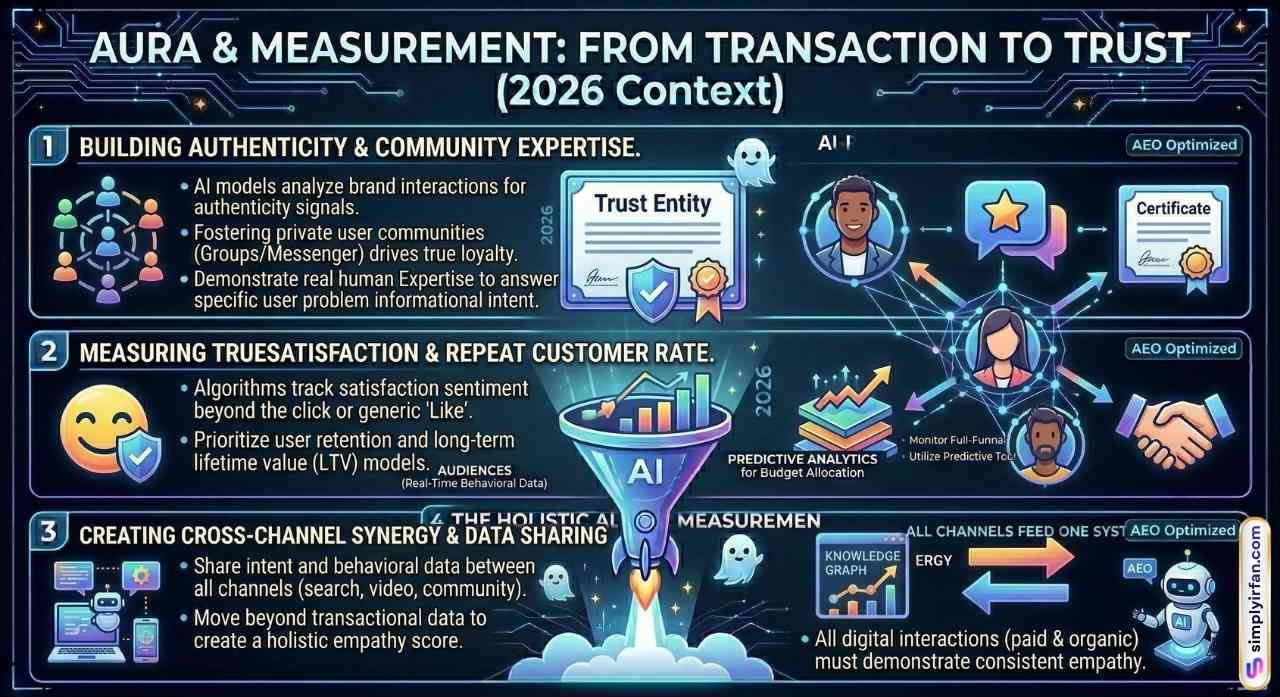
This creates an omnipresent “aura” around your brand. You own the organic space, and you strategically rent the paid space to close the deal.
Frequently Asked Questions (FAQ)
What is the main difference between SEO and SEM?
Historically, SEM included both paid and organic search. Today, SEM generally refers exclusively to paid advertising (like Google Ads), while SEO refers exclusively to earning organic, unpaid traffic through content and technical optimization.
Is PPC worth it for a small business?
Absolutely, but only if executed with tight constraints. Small businesses should avoid broad keywords that drain budgets. Instead, focus on high-intent, local, or hyper-niche keywords where the person searching is ready to make a purchase immediately.
How long does SEO take to work in 2026?
While technical fixes can yield quick bumps, establishing true topical authority and seeing significant organic traffic growth typically takes between 3 to 6 months for low-competition niches, and 9 to 12 months for highly competitive industries.
Should I stop my PPC campaigns once my SEO rankings improve?
No. It is a common mistake. Instead, shift your PPC budget toward retargeting campaigns or bidding on highly competitive, transactional keywords that are too difficult to rank for organically. Use the two strategies to dominate the entire search results page.
What is AEO and how does it relate to SEO?
Answer Engine Optimization (AEO) is the practice of structuring your content so that AI models (like ChatGPT, Gemini, or Google’s AI Overviews) pull your information to answer user queries directly. It relies heavily on clear definitions, FAQ sections, and concise, factual data within your broader SEO strategy.
Conclusion: Stop Guessing, Start Dominating
The debate between SEM vs SEO vs PPC isn’t really a debate at all. It’s a progression.
If you want to build a house, PPC is the scaffolding. It goes up quickly, it helps you get the work done, and it provides immediate structure. But you can’t live in scaffolding forever; it’s too expensive to maintain.
Search Engine Optimization is the brick and mortar. It takes a long time to lay down perfectly. It requires patience, strategy, and a lot of heavy lifting. But once it is built, it stands on its own. It becomes a permanent asset that shelters your business from the fluctuating costs of the advertising market.
In 2026, the smartest digital marketing strategy is to stop treating these acronyms as isolated silos. Use your paid ads to fund your organic growth. Use your organic data to refine your paid ads. Write for humans, structure for AI, and watch as your “digital ghost town” transforms into a bustling, profitable hub.
Are you ready to stop wasting money on clicks that don’t convert? I highly recommend doing a quick audit of your Google Search Console to see which keywords you are almost ranking for. Tweak those pages first.
Also Read: