
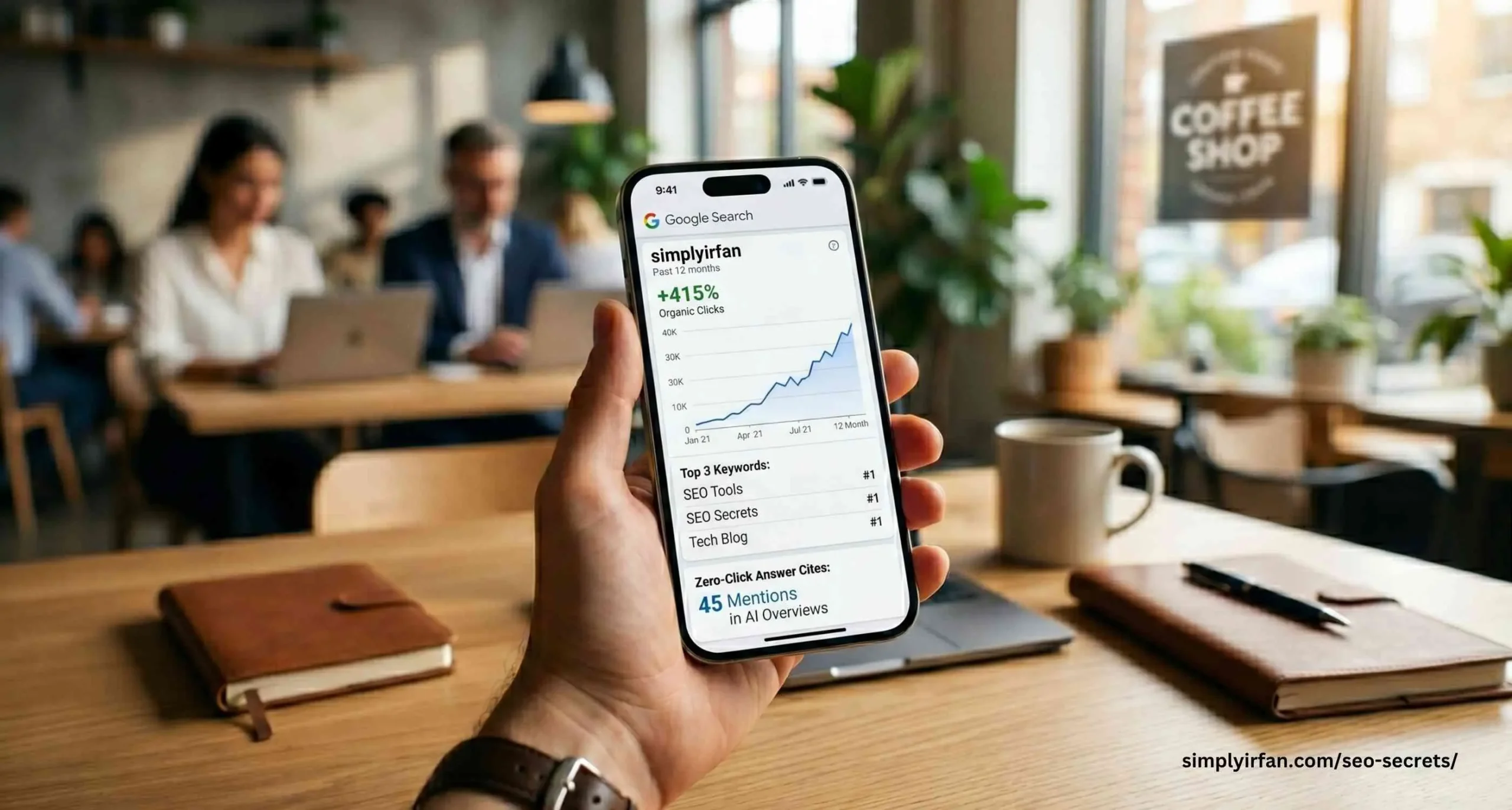
TL;DR: The 2026 SEO Cheat Sheet
If you’re in a rush, here is the “meat” of the matter. In 2026, SEO has shifted from just “ranking links” to “winning citations.”
- The Big Shift: AI Overviews now appear in nearly 50% of searches. You need Answer Engine Optimization (AEO).
- The Gold Standard: E-E-A-T-G (Experience, Expertise, Authoritativeness, Trustworthiness, and Genuine User Experience) is the law of the land.
- The Metric That Matters: It’s no longer just about clicks; it’s about brand mentions in AI-generated answers.
- The Action: Use structured data, answer questions directly in 40-60 words, and build authority through original data.
Have you ever felt like you’re screaming into a void? You spend hours crafting the perfect blog post, you hit publish, and then… crickets. You check your rankings, and you’re buried on page six, right behind a defunct Geocities site and a forum post from 2008.
I get it. SEO (Search Engine Optimization) used to feel like a secret club where only people who knew how to “game the system” got to play. But here’s the reality in 2026: the “system” has grown up. It’s smarter, more intuitive, and—dare I say—more human.
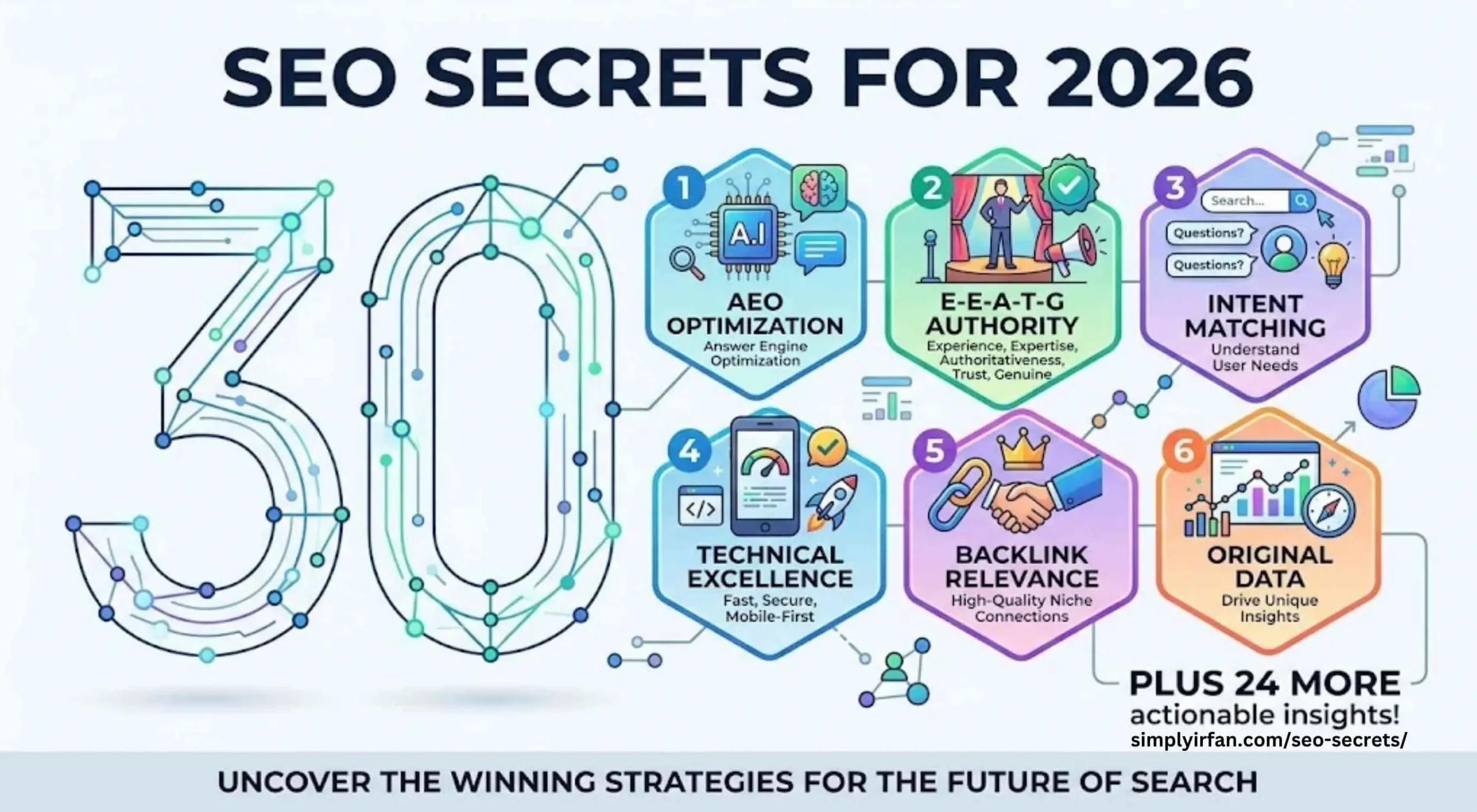
Today, we’re going to pull back the curtain. I’m sharing 30 SEO secrets that aren’t just about keywords; they’re about understanding how people (and AI) actually search today. Whether you’re a seasoned pro or just starting out, these insights will help you navigate the 4 pillars of SEO and beyond.
What Is SEO and Why is it Important?
Before we dive into the secrets, let’s ground ourselves. What Is SEO and Why is it Important? Simply put, SEO is the art and science of making your content visible to people who are looking for it. In 2026, Google handles over 14 billion search queries daily. If you aren’t optimized, you aren’t just missing out on “traffic”—you’re missing out on the primary way the modern world discovers information.
Search has evolved. It’s no longer just a list of blue links. We now live in an era of AI Overviews and Zero-Click searches, where 60% of searches end without a single click because the user got their answer directly on the result page.
This brings us to a critical realization: SEO isn’t just about getting a click; it’s about being the trusted source that Google’s AI cites. If you aren’t in that top AI-generated box, you’re becoming invisible.
Recommended: 40 Game changing SEO benefits in 2026
The Foundation: What are the 4 pillars of SEO?
To master the “secrets,” you first need to understand the architecture. What are the 4 pillars of SEO? Think of these as the legs of a table. If one is weak, the whole thing wobbles.
- Technical SEO: This is the “under the hood” stuff. If your site takes 10 seconds to load or isn’t mobile-friendly, Google won’t bother with you. In 2026, this also includes Schema Markup so AI can “read” your site’s data easily.
- On-Page SEO: This is the content itself. It’s how you use your primary keyword, how you structure your headings, and how well you answer the user’s intent.
- Off-Page SEO: This is your reputation. Backlinks are still the “votes of confidence” of the internet. If high-authority sites link to you, Google trusts you more.
- Content/User Experience: This is the newest and most vital pillar. It’s about E-E-A-T. Does your content provide actual value, or is it just fluff? Does the user enjoy being on your site?
The 30 SEO Secrets for 2026
Now, let’s get into the deep stuff. These are the strategies that the top 1% of marketers are using right now.
1. The “Answer First” Framework
Stop burying the lead. AI systems like Gemini and ChatGPT love “fragments.” Start your major sections with a direct, 40–60 word answer to a specific question. This increases your chances of being featured in an AI Overview by up to 40%.
2. Optimize for AEO (Answer Engine Optimization)
Traditional SEO is for links; AEO is for answers. While SEO builds your domain, AEO makes your content easy for AI to parse. Use clear definitions and structured FAQs to “feed” the LLMs.
3. The “Genuine” Factor (E-E-A-T-G)
Google added a “G” to E-E-A-T. It stands for Genuine. If your content looks like it was spat out by an unedited AI, it will be demoted. Use first-person stories, personal “I tried this” examples, and original photos.
4. Zero-Click Search is Not the Enemy
If a user gets their answer from your content in a “Featured Snippet” but doesn’t click, you still won. Why? Because you just became the authority in their mind. Brand awareness is the new “Click-Through Rate.”
5. Entity-Based SEO
Google doesn’t just look for keywords like “running shoes.” It looks for “entities”—concepts like “Nike,” “marathon training,” and “arch support.” Use Semantic SEO to cover the entire topic, not just one word.
6. Refresh Before You Publish
Before you hit “Post” on a new article, update an old, related one. Link the old post to the new one. This signals to Google that your site is an active, living ecosystem.
7. Reverse Topic Clustering
Most people build a “Pillar Page” first. Secret: Build your small, niche “supporting” posts first. Once they start getting some traction, link them all to a master Pillar Page. It builds momentum faster.
8. The 3-Second Rule (Core Web Vitals)
In 2026, “fast” isn’t enough. Your Largest Contentful Paint (LCP) needs to be under 2.5 seconds. If a user has to wait, they’ll bounce, and your rankings will tank.
Check out: Free SEO Tools
9. Voice Search is Conversational
With over 8.4 billion voice assistants in use, people don’t search for “best pizza NY.” They ask, “Hey Siri, where can I get the best thin-crust pizza near me that’s open now?” Use natural, long-tail conversational phrases.
10. Strategic Internal Linking
Don’t just link randomly. Use Contextual Internal Linking. Link to the page that represents the “next step” in the reader’s journey.
11. Original Data is SEO Gold
Run a survey. Analyze your own customer data. If you provide a new statistic (e.g., “71% of our users prefer X over Y”), other sites will link to you as a source. This is the ultimate backlink magnet.
12. Long-Form Content Still Wins (But With a Twist)
The average word count for a top-ranking page is still around 2,300 words. But don’t use fluff. Use Content Depth. Cover the “Why,” the “How,” and the “What if” of a topic.
13. Video SEO is Non-Negotiable
Google’s “Video” tab is a goldmine. Embed a YouTube video in your blog post. Use video schema. People spend 88% more time on pages with video.
14. The “Alt-Text” Secret
Don’t just describe the image for accessibility. Use it to reinforce your semantic keywords. Instead of “shoes.jpg,” use “best-lightweight-running-shoes-for-marathons.”
15. Local Pack Optimization
If you’re a local business, your Google Business Profile is more important than your website. Get reviews, post updates, and ensure your NAP (Name, Address, Phone) is consistent across the web.
16. Use Author Bios for E-E-A-T
Show Google who wrote the piece. Link to their LinkedIn, their portfolio, and mention their years of experience. Expertise is a ranking factor.
17. Comparison Tables for the Win
Users love them, and AI loves them more. Use tables to compare products or ideas. It’s “structured data” that humans can actually read.
18. Intent Matching Over Keyword Matching
If someone searches “SEO Secrets,” are they looking for a beginner’s guide or advanced hacks? Analyze the current Top 10 results. If they are all “lists,” you should write a list.
19. The “People Also Ask” (PAA) Mine
Look at the PAA boxes for your keyword. These are the exact questions your audience is asking. Answer every single one of them in your post.
20. Secure Your Site (HTTPS)
It’s 2026. If your site isn’t secure, Google won’t even show it to users. This is a basic but essential technical SEO step.
21. Optimize for “Google Lens”
Visual search is massive. Use high-quality, original images. If someone takes a picture of a product like yours, you want your site to show up in the results.
22. The Power of “Micro-Influencer” Backlinks
You don’t need a link from the New York Times. A link from a highly respected niche blogger in your field is often more valuable because it’s more relevant.
23. Audit Your Redirects
Check for “Redirect Chains.” If a link goes from A to B to C, it slows down the crawler and the user. Keep it simple: A to B.
24. Anchor Text Diversity
Don’t use the same “click here” or “SEO secrets” anchor text every time. Mix it up. Use your brand name, long-tail phrases, and natural sentences.
Related: SEO Strategy
25. UX Signals (Time on Page)
If people spend 5 minutes reading your post, Google thinks, “Wow, this must be good.” Use “bucket brigades” (short, punchy sentences that keep people reading) to increase dwell time.
26. Global SEO & Hreflang
If you want to rank in different countries, use hreflang tags. It tells Google which version of your site to show to which user based on their language and location.
27. Eliminate Zombie Pages
If you have 100 pages and only 10 get traffic, those other 90 are “zombie pages.” They are sucking up your “crawl budget.” Delete them or merge them into better posts.
28. Mobile-First is the Only Way
Google doesn’t look at your desktop site anymore. They look at your mobile site. If it’s clunky on a phone, you’re invisible.
29. Podcast SEO
Transcribe your podcasts. AI can now index audio content, but giving it a text transcript makes it 10x easier for search engines to understand the context.
30. The “Human-in-the-Loop” Review
Before you publish, read it out loud. Does it sound like a friend talking to you, or a manual for a microwave? In the age of AI, human tone is a competitive advantage.
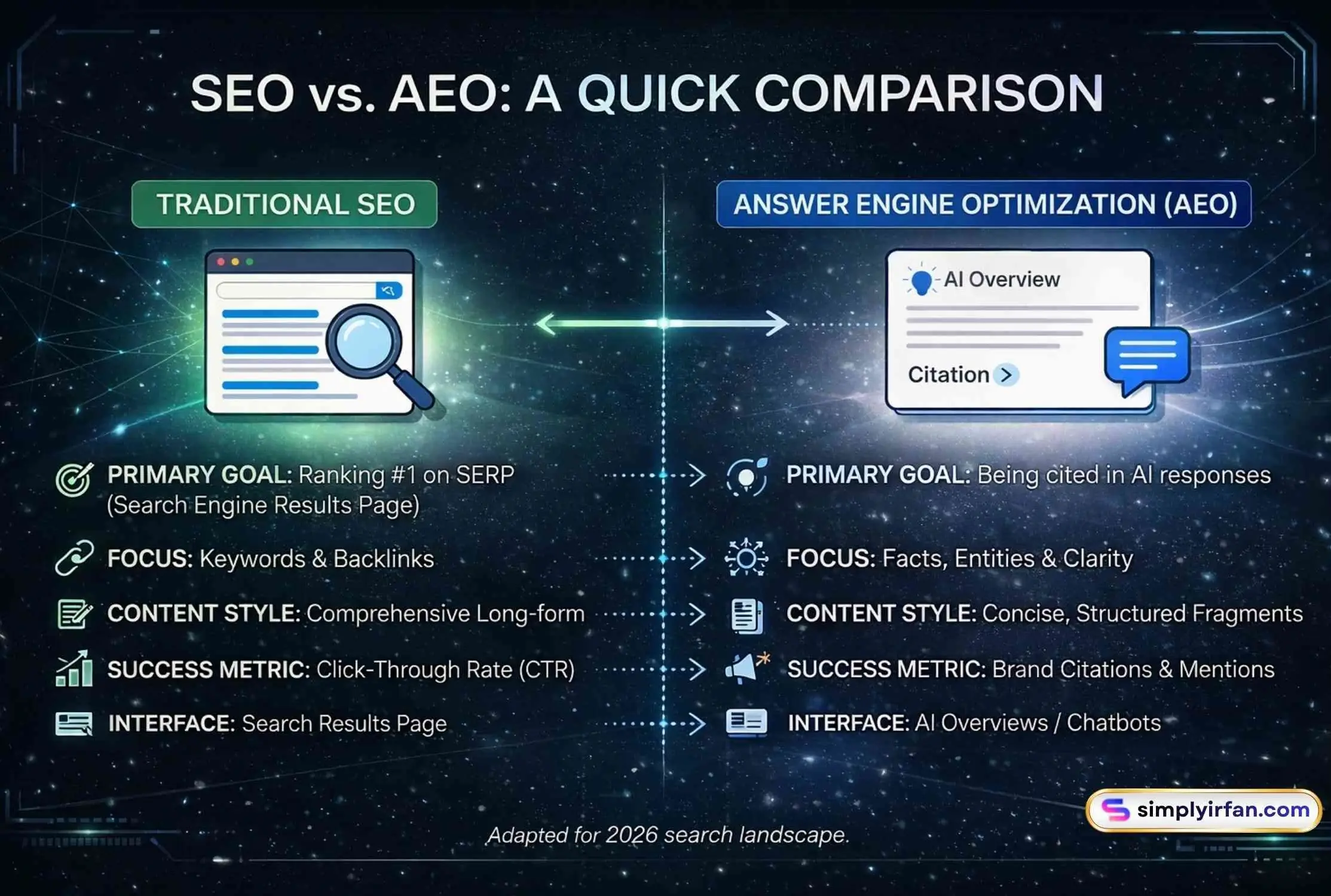
SEO vs. AEO: A Quick Comparison
To help you visualize the shift we’re seeing in 2026, check out this table:
| Feature | Traditional SEO | Answer Engine Optimization (AEO) |
| Primary Goal | Ranking #1 on SERP | Being cited in AI responses |
| Focus | Keywords & Backlinks | Facts, Entities & Clarity |
| Content Style | Comprehensive Long-form | Concise, Structured Fragments |
| Success Metric | Click-Through Rate (CTR) | Brand Citations & Mentions |
| Interface | Search Results Page | AI Overviews / Chatbots |
Don’t Miss: SEM vs SEO vs PPC
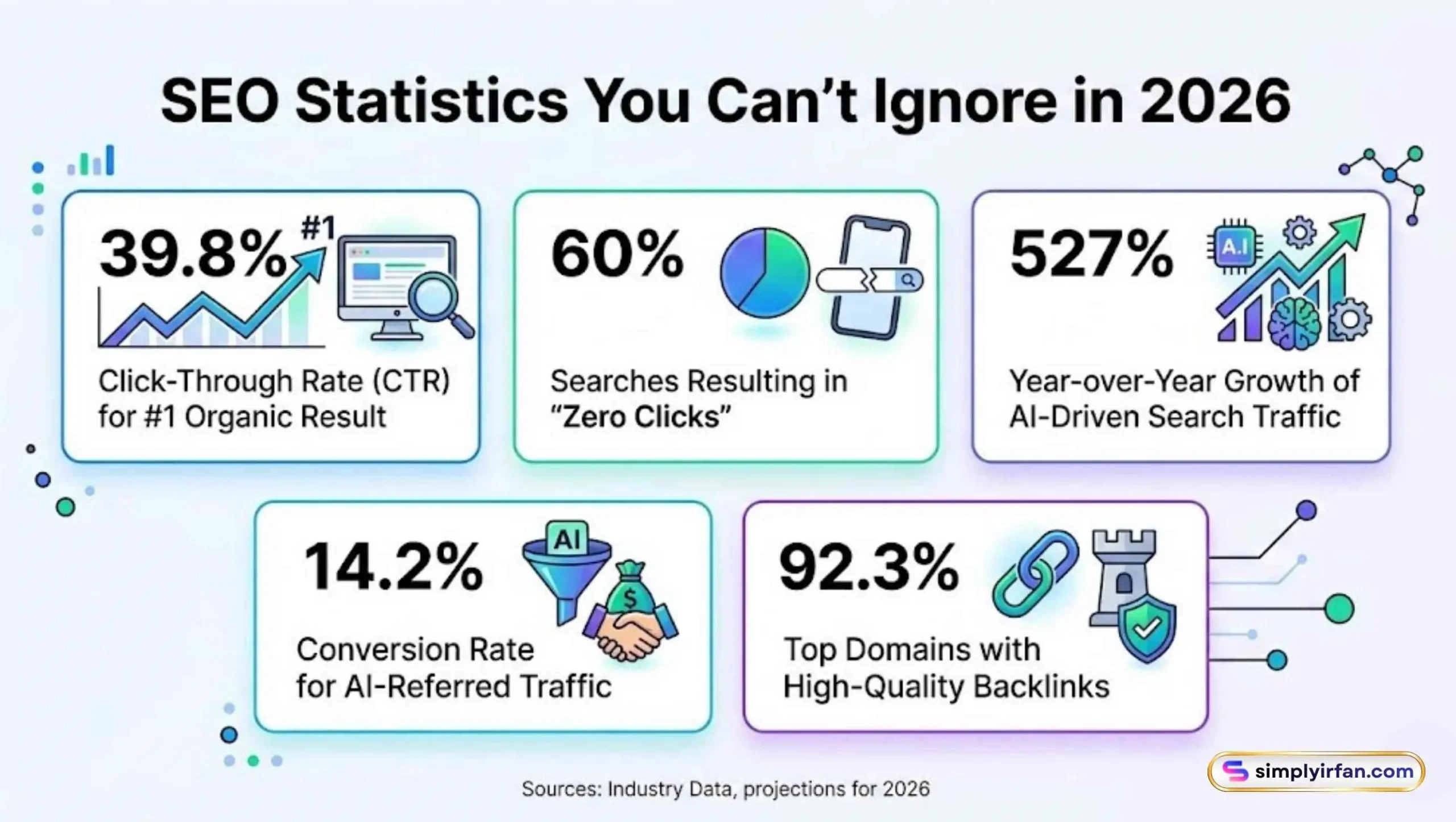
SEO Statistics You Can’t Ignore in 2026
- 39.8%: The click-through rate for the #1 organic result on Google.
- 60%: The percentage of searches that result in “zero clicks” (the answer is found on the SERP).
- 527%: The year-over-year growth of AI-driven search traffic.
- 14.2%: The conversion rate for traffic referred by AI (compared to 2.8% for traditional search).
- 92.3%: Of top-ranking domains have at least one high-quality backlink.
FAQs: Everything You Need to Know
1. How long does it take to see results from these SEO secrets?
SEO is a marathon, not a sprint. Typically, you’ll start seeing movement in 3–6 months. However, with AEO and AI-driven results, you can sometimes see “citation” growth in as little as a few weeks if your content is highly structured.
2. Are backlinks still important in the age of AI?
Absolutely. Backlinks are how Google verifies Authority and Trustworthiness. Even if an AI is generating the answer, it prefers to pull information from sites that other people have “voted” for via links.
3. Is AI-generated content bad for SEO?
Not necessarily, but unfiltered AI content is. Google rewards content that provides “Experience” and “Expertise.” If your AI content is just a rehash of what’s already out there, it won’t rank. You must add a “human-in-the-loop” to provide unique insights.
4. What is the most important ranking factor in 2026?
It’s a tie between Search Intent (did you actually give the user what they wanted?) and E-E-A-T-G (is your site a credible, genuine source of information?).
5. How do I optimize for the “Zero-Click” trend?
Focus on Brand Authority. Even if they don’t click, seeing your brand name as the cited source in an AI Overview builds trust. To “win” the click, offer deep-dive resources (like templates or tools) that an AI can’t summarize in a paragraph.
Final Thoughts: Your Path to the Top
SEO in 2026 isn’t about outsmarting a machine; it’s about being the most helpful, most human source on the internet. By focusing on the 4 pillars of SEO and adapting to the world of AEO, you aren’t just chasing an algorithm, you’re building a brand.
The “secrets” I’ve shared today aren’t shortcuts. They are shifts in perspective. Stop writing for “crawlers” and start writing for the person (or the AI) looking for a solution.
Ready to climb the rankings? Start by auditing one old post today using the “Answer First” framework. You’ll be surprised at how fast the “void” starts talking back.
Dive Deeper: Top SEO Quotes for Motivation