
Google is a name that has become almost impossible to separate from everyday life. People use it to find answers, learn new skills, discover businesses, navigate unfamiliar places, watch videos, and stay connected. For many internet users, opening Google Search is as natural as opening a web browser. But have you ever stopped to ask how old Google is, when it was founded, and how it became so influential?
Google’s story began long before artificial intelligence became a mainstream topic. In the late 1990s, two Stanford University students, Larry Page and Sergey Brin, were working on a better way to organize information on the growing World Wide Web. Their research project eventually became Google, a company that would change how people discover information online.
Google was founded in 1998, making it 28 years old in 2026. However, its history stretches back to 1995, when Page and Brin first met at Stanford, and 1996, when they began developing the search technology that led to Google. Understanding this distinction gives us a clearer picture of how a university research project evolved into one of the world’s most influential technology companies.
In this article, we’ll explore Google’s age, its founders, the meaning behind its name, its major milestones, the evolution of Google Search, and what its future might look like.
How Old Is Google in 2026?
Google was officially incorporated as Google Inc. on September 4, 1998. The company celebrates its birthday on September 27, a date that has become associated with its annual birthday celebrations and Google Doodles.
Here is a quick overview:
| Detail | Answer |
|---|---|
| Company | |
| Founders | Larry Page and Sergey Brin |
| Founding year | 1998 |
| Incorporation date | September 4, 1998 |
| Celebrated birthday | September 27 |
| Age in 2026 | 28 years |
| Original research project | Backrub |
| Parent company | Alphabet Inc. |
| Headquarters | Mountain View, California, USA |
The difference between September 4 and September 27 can be confusing. September 4 marks Google’s incorporation, while September 27 is the date the company has celebrated as its birthday. Google itself has acknowledged that the exact birthday has been a subject of debate. You can read more in its official article, Marking 20(ish) years of Google.
As of October 2026, Google has passed its 28th birthday. Its age is calculated from its 1998 founding, not from the year its founders first met or began developing the search engine.
The Birth of Google: How It All Began
To understand Google’s origins, we need to return to the mid-1990s.
The internet was growing, but finding useful information was not always easy. Websites were appearing rapidly, and search engines were trying different ways to organize the expanding collection of online pages. A search could return results that matched a keyword without necessarily providing the most useful answer.
Larry Page arrived at Stanford University as a prospective graduate student in 1995. Sergey Brin, who was already studying there, was assigned to show him around. Although the two reportedly disagreed about many things during their first meeting, they eventually began working together on a research project.
Their central question was straightforward: could the web be organized more effectively by examining the relationships between websites?
From Backrub to Google
In 1996, Page and Brin developed a search engine called Backrub. Rather than relying only on words appearing on a webpage, their system examined links between pages to help estimate their importance.
This approach contributed to the development of PageRank, an important part of Google’s early search technology. The idea was that links could provide useful information about the relationship and importance of web pages.
The concept was influential because the web was not simply a collection of independent documents. Websites linked to other websites, creating a network of information that could be analyzed.
The project eventually received a new name: Google.
According to Google’s official history, the name was inspired by googol, a mathematical term for the number 1 followed by 100 zeros. The name reflected the founders’ ambition to organize an enormous amount of information.
You can explore the company’s account of these early developments on Google’s official history page.
Google’s First Office Was a Garage
Google’s early history has become closely associated with the idea of a technology startup beginning in a modest space.
After attracting investment, the founders moved from their university environment to their first office: a garage in Menlo Park, California. The property was owned by Susan Wojcicki, who later became YouTube’s CEO.
The early operation was a long way from the global technology business Google would become. Its team was small, its resources were limited, and its main focus was building a search engine that could deliver useful results quickly.
Google’s clean interface also helped distinguish it from search pages that were crowded with links, directories, and other elements. Users could enter a query and get to the results without having to navigate a complicated homepage.
The company attracted attention as its search technology gained traction. Its early growth demonstrated that organizing information effectively could be a significant business opportunity.
What began in a garage eventually grew into a large organization with offices, data centers, engineering teams, and products used across the world.
Why Did Google Become So Popular?
Google entered an already competitive search market. It was not the first search engine, and internet users already had alternatives such as Yahoo!, AltaVista, and Ask Jeeves.
Its growth came from several factors working together.
1. A focus on relevant search results
Google’s early use of link analysis helped it evaluate webpages in ways that went beyond matching keywords. PageRank became one of the technologies associated with its original approach to search.
The system has changed considerably since those early days, but link analysis remains part of Google’s broader ranking technology.
2. A simple homepage
Google’s homepage placed the search box at the center of the experience. This made the service easy to understand, particularly for people who wanted to find information without navigating a complex directory.
A simple interface was not the only reason for Google’s success, but it made the product accessible to a broad audience.
3. Continuous improvements
Google did not stop developing its search engine after its early success. It continued working on indexing, relevance, spelling corrections, query interpretation, speed, and other parts of the search experience.
The web grew dramatically, and search technology had to evolve alongside it.
4. Expansion beyond search
Google gradually introduced products and services that addressed other everyday needs. Gmail, Google Maps, Chrome, Android, Google Drive, and YouTube helped expand its presence across the digital world.
This meant that Google was no longer associated with just one website. Its products became part of how people communicated, worked, browsed, and consumed media.
Google’s History: Major Milestones From 1995 to 2026
Google’s development can be understood through a series of important milestones. The following timeline highlights its early research, business expansion, corporate restructuring, and movement toward AI-powered search.
1995: Larry Page and Sergey Brin meet
The two future founders meet at Stanford University. Their academic connection eventually develops into a collaboration focused on organizing information on the web.
1996: The Backrub project begins
Page and Brin begin developing Backrub, an early search engine that analyzes links between webpages. This research leads to the technology behind Google’s original search approach.
1998: Google Inc. is founded
Google becomes an incorporated company. September 4 is its incorporation date, while September 27 is the birthday the company has traditionally celebrated.
This is the year from which Google’s age is normally calculated.
2000: Google expands its advertising business
Google introduces AdWords, creating a way for businesses to advertise alongside search results. Advertising would become a major part of Google’s business model.
This development helped connect people looking for information with companies offering relevant products and services.
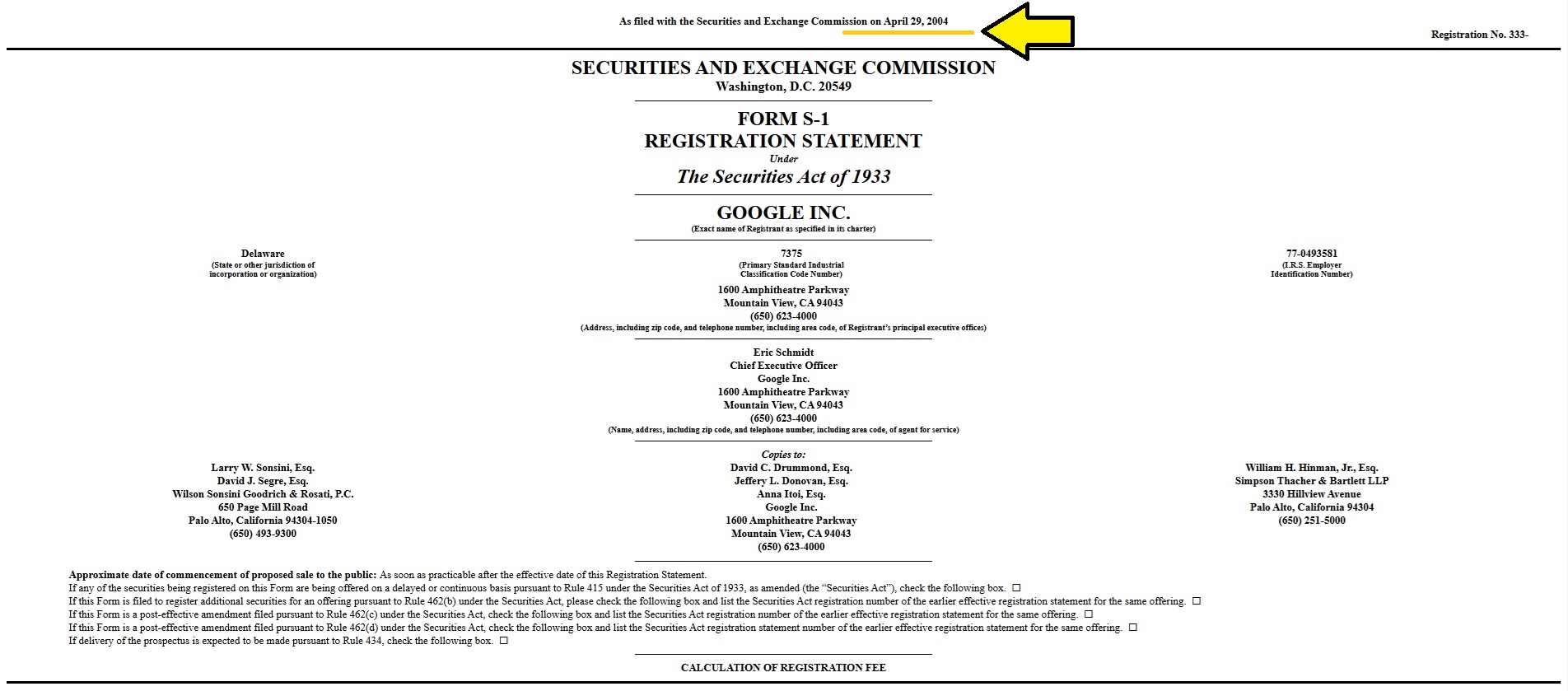
2004: Google goes public
Google completes its initial public offering (IPO) in August 2004. Becoming a publicly traded company gives it access to public capital and marks a significant stage in its corporate growth.
The company’s subsequent expansion would take it well beyond its original search business.
2005: Google Maps and Google Analytics emerge
Google Maps launches in 2005, bringing online mapping and location information to a broader audience. Google Analytics also launches that year, giving website owners tools to understand visitor behavior.
Both products illustrate how Google was expanding from finding webpages to helping people navigate the physical world and measure activity online.
2006: Google acquires YouTube
Google announces its acquisition of YouTube in 2006. The deal expands Google’s presence in online video and eventually connects video discovery, advertising, creators, and search more closely.
YouTube becomes one of the most recognizable services in Google’s wider product portfolio.
2008: Google Chrome launches
Google introduces Chrome, a web browser designed around speed, simplicity, and web application support.
Chrome becomes another major entry point to the internet, alongside Google Search. The browser’s development also gives Google a platform for improving how people interact with web-based services.
2011–2013: Search ranking systems evolve
Google introduces major changes to its search ranking systems during this period.
Panda, announced in 2011, was designed to help surface higher-quality content. Penguin, announced in 2012, targeted web spam associated with manipulative link practices. Hummingbird, introduced in 2013, represented a major improvement in Google’s overall search systems and its handling of search queries.
These changes mattered to website owners, publishers, and SEO professionals because search visibility increasingly depended on more than inserting keywords into a page.
For historical context and details about which systems remain active, see Google’s official guide to Search ranking systems.
2014: Google acquires DeepMind
Google acquires the artificial intelligence company DeepMind in 2014. The acquisition strengthens its position in AI research and becomes part of a much longer investment in machine learning and advanced computing.
AI would later become increasingly important to Google’s products, from understanding language to generating responses and assisting with complex tasks.
2015: Alphabet becomes Google’s parent company
Google announces a major corporate restructuring in 2015, creating Alphabet as its parent company.
Under the new structure, Google remains the main business responsible for products such as Search, YouTube, Android, Chrome, advertising, and cloud services. Other businesses and experimental projects are organized separately under Alphabet.
Sundar Pichai becomes Google’s CEO in 2015.
This distinction is important: Google was founded in 1998, while Alphabet was established in 2015. The two companies are related, but they are not the same corporate entity.
More information is available in Alphabet’s explanation of its reporting structure.
2016–2020: AI becomes more central to Search
Google continues improving its ability to understand language and the intent behind queries. Systems such as RankBrain and BERT represent important stages in this evolution.
These technologies help Google interpret relationships between words and understand context rather than treating every search as a simple keyword-matching exercise.
For people using Search, the goal is to make results more relevant to what they actually mean. For publishers, these changes reinforce the importance of writing clearly and providing useful information rather than relying exclusively on exact-match keywords.
2019–2023: Google experiments beyond traditional search
Google continues exploring new markets and technologies, including cloud computing, AI, and gaming. It announces Stadia, its cloud gaming service, in 2019, but later discontinues the service in January 2023.
This is a reminder that Google’s history includes unsuccessful products as well as successful ones. A large technology company can invest in ambitious ideas without every project becoming a permanent part of its business.
2023: Google celebrates 25 years
Google marks its 25th birthday on September 27, 2023, with a special birthday Doodle.
The anniversary reflects the distance the company had traveled from its early search project to a global collection of products. Google’s own 25th-birthday announcement offers a look back at that journey.
2024: AI Overviews arrive in Google Search
In May 2024, Google launches AI Overviews in Search in the United States. The feature uses generative AI to provide summaries and help users explore information, with links to supporting webpages.
The feature subsequently expands to additional countries and languages.
This represents a meaningful change in the search experience: users may receive an AI-generated overview before deciding which individual pages to visit. It also raises important questions about how people discover publishers and how websites receive visitors from search.
Read Google’s announcement about AI Overviews and their expansion.
2025–2026: Google’s next chapter
Google continues developing AI-powered products and search experiences, while operating established services such as Search, YouTube, Android, Chrome, Gmail, and Google Cloud.
The broader direction is clear: search is no longer limited to returning a list of webpages. Google is also working on ways to understand more complex questions, interpret different types of information, and help users accomplish tasks.
As of October 2026, Google is 28 years old. Its next phase will be shaped by competition in AI, changes in how people find information, and the continuing need to provide useful results.
How Google Search Has Changed Over the Years
One of the most interesting parts of Google’s history is the evolution of its search engine. The company that began by examining links between webpages now uses numerous systems to interpret queries, evaluate content, and select relevant results.
From keywords to understanding meaning
Early search engines often depended heavily on matching the words in a query with the words on a page. Keyword matching remains relevant, but modern search requires a more sophisticated understanding of language and context.
Consider a person searching for “best way to fix a slow phone.” The person may want practical troubleshooting instructions, not a page that merely repeats the phrase several times.
Google’s ranking systems use a variety of signals and technologies to identify pages that may best answer the query.
From link analysis to multiple ranking systems
PageRank was an important part of Google’s original approach, but it does not represent the entirety of modern ranking.
Google’s systems have evolved to consider relevance, content, usability, language, freshness, spam, and many other signals. Different systems address different search needs, and Google regularly evaluates and improves them.
For website owners, this means there is no single algorithm trick that guarantees strong rankings.
From traditional results to AI-generated summaries
AI Overviews introduced another way to interact with search results. Rather than beginning with only a list of links, a user may see a generated summary accompanied by links to relevant sources.
This can make certain searches faster, but it also changes how people encounter information online. Publishers and website owners have a strong interest in how these features cite sources, encourage further exploration, and affect visits to individual sites.
For more detail, Google’s Search ranking systems documentation explains several of the technologies behind modern Search.
How Google Makes Money
Google’s search engine is free to use for ordinary searches, which leads to a reasonable question: if users do not generally pay to search, how does the company generate revenue?
The answer is that Google operates a large advertising business alongside its other products and services.
Search advertising
Businesses can pay to show ads to people searching for particular products, services, or topics. Advertisers compete for opportunities to reach audiences, and advertising is a major component of Google’s business.
Paid advertisements are distinct from ordinary organic search results, even when they appear on the same results page.
YouTube advertising
YouTube provides another important advertising channel. Businesses can advertise through video and other placements, while eligible creators can earn revenue through YouTube’s monetization programs.
The acquisition of YouTube expanded Google’s reach into online video and created another major platform for advertising and content discovery.
Google Cloud and subscriptions
Google also earns money through cloud computing services, paid software plans, subscriptions, and hardware. These businesses serve customers ranging from individual consumers to large organizations.
The important point is that Google is no longer simply a search engine. Search remains central to its identity, but its business model covers multiple areas of technology.
Google and Its Parent Company, Alphabet: What’s the Difference?
Google and Alphabet are often used interchangeably in casual conversation, but there is a corporate distinction.
Google was founded in 1998. Alphabet was created in 2015 as a holding company intended to organize Google and other businesses under a broader structure.
Google remains Alphabet’s largest business. It includes familiar products and services such as Search, YouTube, Android, Chrome, advertising, and Google Cloud.
Alphabet’s wider structure also allows it to report on businesses and projects outside Google’s main products.
For example, Waymo operates in autonomous driving, while other Alphabet initiatives focus on different technologies and opportunities. These activities are not all the same business as Google Search.
This distinction matters when discussing company age, financial results, or ownership. If someone asks how old Google is, the usual answer is 28 years in 2026. If the question concerns Alphabet specifically, its history begins in 2015.
Key Events in the History of Google
In the 25+ years since its founding, Google has reached numerous important milestones and moments. Below are some key events in the company’s journey:
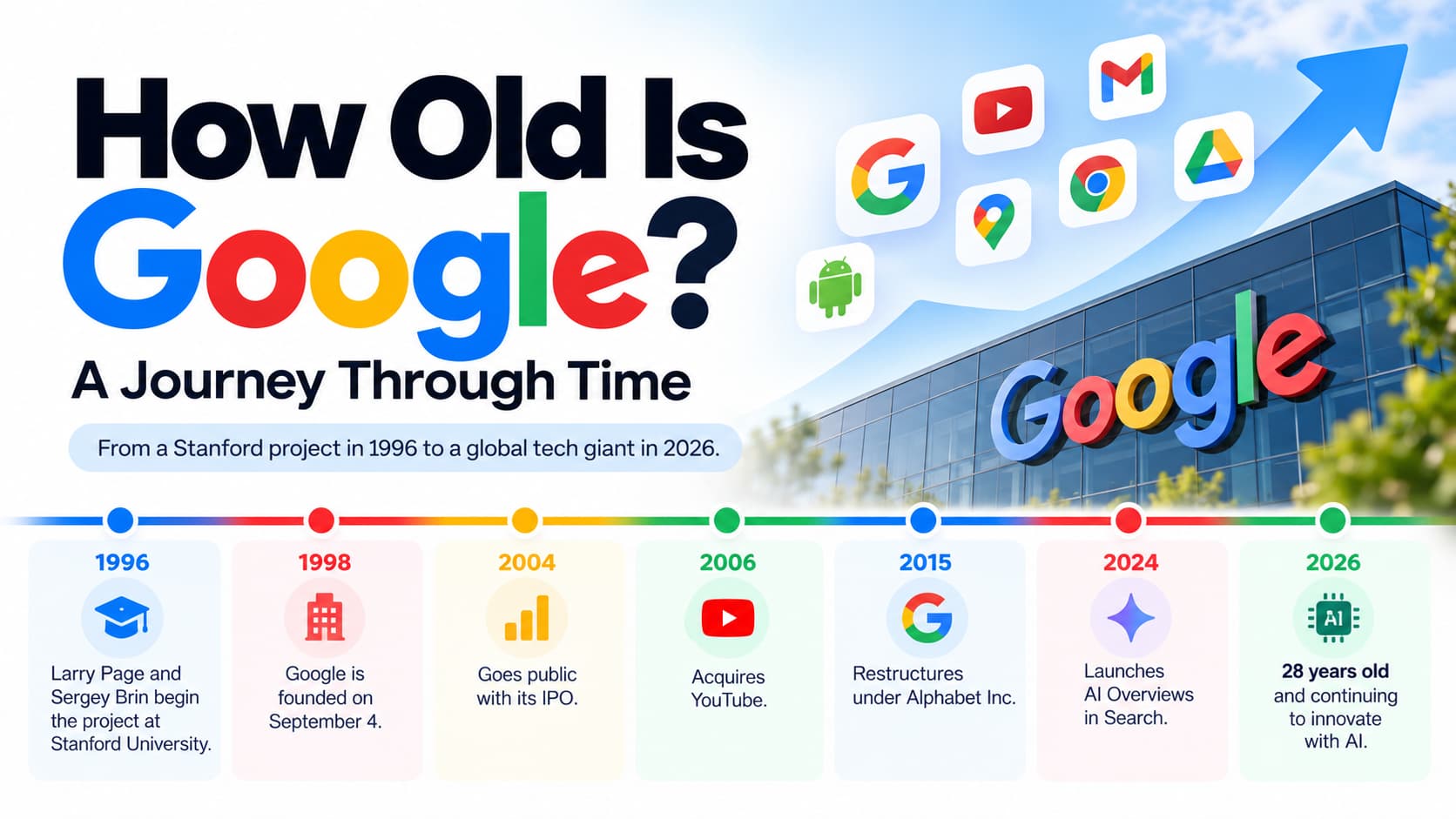
- 1996: Larry Page and Sergey Brin begin the Google project at Stanford University.
- 1998: Google is officially founded on September 4, marking its official birthday.
- 2004: Goes public with its initial public offering (IPO).
- 2006: Acquires YouTube, expanding into video content.
- 2008: Purchases DoubleClick, enhancing its advertising capabilities.
- 2012: Takes over Motorola Mobility, venturing into hardware.
- 2013: Integrates Waze into its services, enhancing map features.
- 2014: Acquires DeepMind Technologies, marking its entry into artificial intelligence.
- 2015: Restructures under Alphabet Inc., and Sundar Pichai becomes Google’s CEO.
- 2017: Dismisses James Damore after his controversial memo.
- 2019: Announces its entry into the video game market with Google Stadia.
- 2019: The U.S. Department of Justice announces an investigation into Google’s antitrust practices.
- 2020: Implements cost-cutting measures due to the impact of the COVID-19 pandemic.
- 2021: The Alphabet Workers Union is founded.
- 2023: Removes Canadian news links from its services in response to new legislation requiring payment for news content.
- 2023: Introduces the Search Generative Experience (SGE).
- 2024: Launches an AI Overview on their Search Result Page (SERPs).
- 2025: Introduces AI Mode in Google Search, expanding AI-powered search with more advanced reasoning and conversational follow-up questions.
- 2025: Launches Gemini 3, bringing more advanced reasoning and multimodal capabilities to Google’s AI products.
- 2025: Expands AI features across Google products, including Gemini, Android, Search, and creative tools.
- 2026: Announces Gemini 3.5 Flash and Gemini Omni at Google I/O, advancing AI reasoning, action-taking, and multimodal content generation.
- 2026: Introduces new AI-powered Search experiences, including information agents designed to monitor topics and provide updates, alongside more interactive search results.
- 2026: Expands its agentic AI strategy, with Gemini and Google Cloud tools designed to help users complete tasks and workflows, not just generate answers.
Key Algorithm Updates in Google’s History
Google’s search algorithm has evolved significantly over the years. Each update aims to improve search results, promote quality content, and penalize low-value websites. Let’s explore some of the major updates in Google’s history that shaped the way we search today.
In 2003, Google introduced the “Florida” update, which brought major changes to the ranking system. This update impacted many websites by changing how rankings were determined, especially for certain types of websites.
A couple of years later, in 2005, Google launched the “NoFollow” attribute to fight against spammy links. This change helped to prevent websites from manipulating search rankings using low-quality backlinks. Around the same time, the “Jagger” update was rolled out to address issues with unnatural link profiles, improving the overall link-building landscape.
The “Vince” update, released in 2009, marked a significant shift by prioritizing larger, well-established brands in search results. It gave more visibility to big companies, favoring them over smaller or lesser-known websites.
In 2010, Google introduced the “May Day” update, focusing on improving long-tail search results. This update aimed to refine how Google handled less common, more specific searches, making results more relevant.
The year 2011 saw the launch of the “Panda” update, a game-changer in how content quality was ranked. This update penalized sites with low-quality content while rewarding those offering valuable, well-researched, and original material.
In 2012, Google rolled out the “Penguin” update to target websites using manipulative tactics, such as unnatural link building, to boost their rankings. This was a crucial step in promoting ethical SEO practices.
A year later, in 2013, Google introduced the “Hummingbird” update, which focused on improving the speed and accuracy of search results. It enhanced the search engine’s ability to understand queries more naturally, allowing it to deliver more precise results.
The “Pigeon” update, launched in 2014, aimed to improve local search results. By taking into account location and proximity, this update made local searches more relevant and useful.
In 2015, GOOG released the “Mobile” update, also known as “Mobilegeddon”. This update favored mobile-friendly websites, ensuring that users on mobile devices got the best possible search experience. It pushed businesses to optimize their websites for mobile.
The “Possum” update in 2016 was another move to improve local search. This update helped diversify the local search results by considering different factors, like search location and business proximity.
In 2018, the “Medic” update focused on improving the quality of health and medical websites. It aimed to make search results more reliable, particularly for topics that could affect people’s well-being.
Fast forward to 2019, when GOOG introduced the “BERT” update. This update improved Google’s understanding of natural language, especially for more complex queries. It helped Google better comprehend the context of a search, making results more relevant.
The “Core” update in 2020 was another step in refining Google’s search algorithm. This update focused on improving the overall relevance and quality of search results, giving users better answers to their queries.
Finally, in 2021, GOOG introduced the “Page Experience” update, which prioritized user experience factors like site speed, mobile-friendliness, and security. This update emphasized how the user interacts with a website, not just the content itself.
Key Google Algorithm Updates From 2022 to 2026
Google’s ranking systems have continued to evolve, with updates targeting content quality, spam, product reviews, helpful information, and the overall relevance of search results. In recent years, Google has also placed greater emphasis on reducing unoriginal content and adapting its systems to changing search behavior.
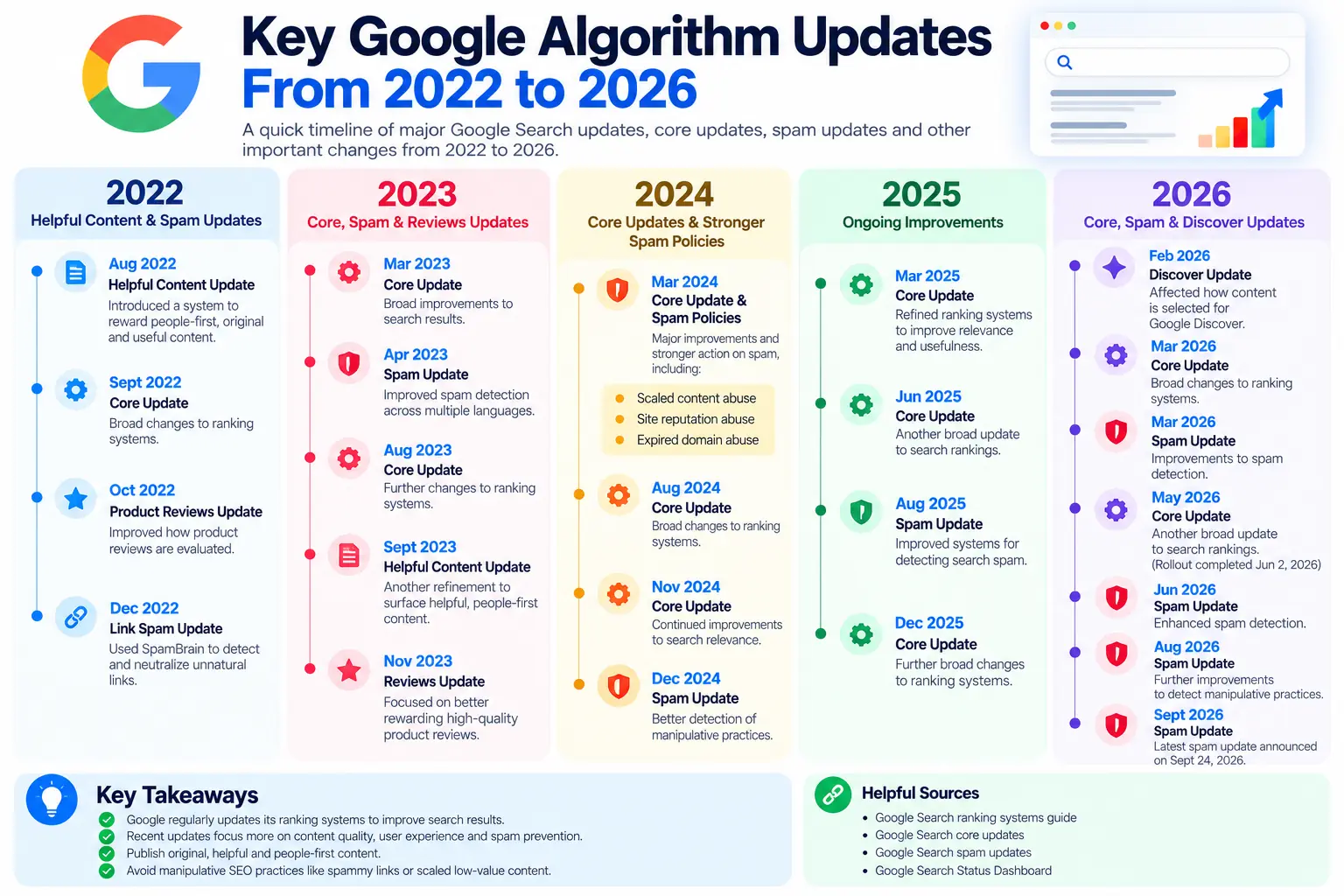
2022: Helpful Content and Link Spam Updates
In 2022, Google introduced its Helpful Content System, initially launched in August. It was designed to help surface original, useful content created primarily for people rather than pages produced mainly to attract search traffic.
Google also released several core updates and product reviews updates throughout the year. Its December 2022 link spam update used SpamBrain, Google’s AI-based spam-prevention system, to identify and neutralize unnatural links.
Google’s official ranking systems guide explains how these systems have evolved.
2023: Core Updates, Spam Detection, and Reviews
In 2023, Google released multiple core updates, spam updates, and reviews updates. The September Helpful Content Update was another effort to improve the visibility of content that genuinely helps users.
Google also continued improving its ability to detect manipulative SEO practices. These changes reinforced the importance of original information, useful analysis, and content that satisfies the user’s actual search intent.
The November 2023 reviews update was the last update announced under the standalone reviews-update label before Google shifted toward more continuous improvements to its reviews system.
2024: Core Updates and Stronger Spam Policies
In March 2024, Google announced major improvements to its core ranking systems and updated its spam policies. The company specifically targeted practices that produced unoriginal, low-value pages at scale.
Three important spam-policy changes addressed:
- Scaled content abuse: Producing large amounts of unoriginal content primarily to manipulate rankings, regardless of whether it is created by humans, automation, or a combination.
- Site reputation abuse: Publishing third-party content on established websites to exploit the ranking signals associated with those sites.
- Expired domain abuse: Purchasing and repurposing expired domains primarily to manipulate search rankings.
Google also released core updates in August, November, and December 2024, alongside spam updates. These changes made 2024 an important year for website owners monitoring organic traffic and content quality.
Read Google’s announcement: New ways we’re tackling spammy, low-quality content on Search.
2025: Core Updates and Spam Updates
In 2025, Google continued adjusting its core ranking systems and spam-prevention technology.
- March 2025: Google released a core update intended to improve the relevance and usefulness of search results.
- June 2025: Another core update brought broader changes to Google’s ranking systems.
- August 2025: Google released a spam update to improve its systems for detecting search spam.
- December 2025: A further core update introduced additional broad changes to search rankings.
These updates did not represent four entirely new ranking algorithms. Core updates make broader adjustments to Google’s existing ranking systems, while spam updates focus on detecting and reducing the impact of policy-violating practices.
You can verify the rollout dates through Google’s Search Status Dashboard.
2026: Core Updates, Spam Updates, and Google Discover
As of October 2026, Google’s published ranking-update history includes several notable updates:
- February 2026: Google released a Discover update, affecting the systems used to select content for Google Discover.
- March 2026: Google rolled out a core update, alongside a separate spam update.
- May 2026: A core update introduced broader adjustments to search ranking systems. Its rollout completed on June 2, 2026.
- June 2026: Google released another spam update.
- August 2026: A further spam update was announced.
- September 2026: Google announced another spam update on September 24. Its status should be checked on the official dashboard for the latest rollout information.
These developments show that Google’s ranking systems are not static. Core updates adjust how its systems assess and rank content, spam updates improve the detection of manipulative practices, and Discover updates address a different content-discovery experience.
What These Updates Mean for Website Owners
Google’s algorithm history shows a gradual move from individual, prominently named updates toward interconnected ranking systems that are continually improved.
For publishers and SEO professionals, three lessons stand out:
- Publish genuinely useful content. Original research, firsthand experience, accurate information, and clear answers provide more value than pages created primarily to target keywords.
- Avoid manipulative SEO practices. Scaled content abuse, unnatural link schemes, and other attempts to exploit ranking systems can put a website’s visibility at risk.
- Use official update records when diagnosing traffic changes. A decline that coincides with a confirmed update is worth investigating, but timing alone does not prove that the update caused the decline.
Google explains that core updates are broad changes and do not specifically target individual websites. Rankings can change as its systems evolve and as competing pages improve. Recovery is not guaranteed simply by waiting for another update.
Google Search Helpful sources:
- Google Search ranking systems guide
- Google Search core updates
- Google Search spam updates
- Google Search Status Dashboard
These updates demonstrate Google’s commitment to improving search results and delivering a better experience for users. Over time, they have ensured that websites with high-quality, relevant content are rewarded, while low-quality websites are penalized. As Google continues to innovate, it will likely introduce more updates to keep improving the way we search online.
Google’s Impact on Technology
Google has shaped the digital landscape in many ways. The introduction of Google Chrome revolutionized web browsing. Google’s Android operating system is now the most widely used mobile OS in the world. Moreover, services like Google Photos, Google Translate, and Google Maps have become essential parts of our daily lives.
The company’s focus on artificial intelligence and machine learning has also pushed the tech industry forward. Google’s AI research is behind tools like Google Assistant and Google Lens, which use voice recognition and image analysis to assist users.
Google Today
Fast forward to today, and Google has become more than just a search engine. It has expanded into numerous sectors, including cloud computing, artificial intelligence, advertising, and even hardware. Google’s parent company, Alphabet Inc., was created in 2015 to separate its core business from its other ventures.
As of October 2026, Google is 28 years old. Over the past two decades, the company has continued to grow and evolve. It’s not just a search engine anymore; it’s a part of nearly every aspect of life, from its Android operating system to services like Google Maps, Gmail, and Google Drive.
How Has Google Influenced Everyday Life?
Google’s impact extends well beyond answering search queries. Its products have changed how people access information, communicate, travel, and work.
Finding information: Search made it easier to locate webpages and answers without manually browsing directories or remembering website addresses.
Email and collaboration: Gmail, Google Drive, Docs, and related tools allow people to communicate, store files, and collaborate online.
Navigation: Google Maps helps people find routes, explore locations, and discover local businesses.
Mobile technology: Android provides a major platform for smartphones and other devices, while Google Play connects users with apps and digital content.
Video and learning: YouTube has become a major destination for entertainment, tutorials, educational material, news, and creator-led content.
Artificial intelligence: Google’s AI research and products are influencing how people interact with information, images, language, and digital assistants.
These services are not all the same age, and some came to Google through acquisitions rather than being created from scratch. Together, however, they illustrate how the company expanded from a search engine into a broad technology ecosystem.
Challenges Google Has Faced
Google’s growth has also brought difficult questions about competition, privacy, advertising, content quality, and the power of large technology companies.
As Google became a major gateway to online information, businesses and publishers increasingly depended on search visibility to reach audiences. Changes to ranking systems could have significant effects on website traffic, making search updates an important concern for the wider internet industry.
The company’s advertising business has also attracted regulatory scrutiny, particularly around competition and the role of dominant platforms in digital advertising and search.
Privacy is another continuing concern. Google provides services that people use to communicate, navigate, watch videos, and search for information, so questions about data collection, user choice, and transparency remain important.
AI introduces additional challenges. AI-generated summaries may help users understand a topic more quickly, but they also create questions about accuracy, source attribution, publisher traffic, and the difference between an original source and a generated response.
These issues do not erase Google’s achievements. They show that a company with such a large role in the digital world faces responsibilities and trade-offs that go far beyond building a useful search box.
What Could the Future Hold for Google?
At 28 years old, Google is an established technology company, but its products continue to change.
Artificial intelligence is likely to remain one of the most important areas of development. Google is working to bring AI capabilities into Search and other products, while competing with other companies developing models, assistants, and AI-powered tools.
Search itself may continue moving toward more conversational experiences. People increasingly ask detailed questions, combine text with images, and expect technology to help them explore a subject rather than simply provide a list of links.
For website owners, businesses, and content creators, these changes make it important to publish accurate, useful, distinctive information. Search interfaces may evolve, but trustworthy sources and clear explanations remain valuable to people who want to learn more.
Google will also have to navigate competition, regulation, privacy expectations, and the practical costs of operating large-scale technology infrastructure.
Its future is not guaranteed by its past success. The company will need to keep earning user trust and adapting to the ways people want to find and use information.
Frequently Asked Questions About Google’s Age
How old is Google in 2026?
Google is 28 years old in 2026, based on its founding in 1998. It celebrated its 28th birthday on September 27, 2026.
When was Google founded?
Google Inc. was incorporated on September 4, 1998. The company celebrates its birthday on September 27.
Who founded Google?
Larry Page and Sergey Brin founded Google. They met at Stanford University and worked together on an early search engine called Backrub before developing Google.
What was Google called before Google?
The founders’ early search engine project was called Backrub. It examined links between webpages to help determine their importance.
Why is Google called Google?
The name is a play on googol, the mathematical term for 1 followed by 100 zeros. It reflected the founders’ ambition to organize an enormous amount of information.
Is Google older than YouTube?
Yes. Google was founded in 1998, while YouTube launched in 2005. Google announced its acquisition of YouTube in 2006.
Is Google the same as Alphabet?
No. Alphabet is Google’s parent company, created in 2015. Google remains its largest business and includes Search, YouTube, Android, Chrome, advertising, and Google Cloud.
How old is Google Search?
Google Search began as a research project in 1996, when Larry Page and Sergey Brin developed Backrub. The Google company was founded in 1998, so the research behind Search is older than the company itself.
What is Google’s most important product?
Google Search remains one of its defining products, but the company operates many major services, including YouTube, Android, Chrome, Gmail, Maps, and Google Cloud. Which is most important depends on whether you mean its identity, its business, or an individual’s daily use.
Conclusion: Google’s Journey Is Far From Over
So, how old is Google? Google is 28 years old in 2026, counting from its founding in 1998.
Its story began with Larry Page and Sergey Brin’s research at Stanford University. Their early search engine, Backrub, explored how links could help organize the web. That work evolved into Google, which grew from a small startup into a company operating across search, advertising, video, mobile technology, cloud computing, and artificial intelligence.
The internet has changed dramatically since 1998. People now use smartphones to access services that once required desktop computers, watch videos from creators around the world, and ask AI systems to help explain complicated topics. Google has adapted to many of these changes, while also facing questions about competition, privacy, content quality, and its influence over online discovery.
Its age is a useful milestone, but the more interesting question may be what comes next. As AI changes how people find information, Google will have to keep evolving while maintaining the relevance and usefulness that made its search engine successful in the first place.
One thing is clear: the company that began by trying to organize the web has spent 28 years helping shape how people experience it, and its next chapter is still being written.
Helpful Sources
For readers who want to explore Google’s history and technology in more detail, these sources provide useful background and primary information:
- Google’s official company history — How Larry Page and Sergey Brin met, developed Backrub, and built the company.
- Marking 20(ish) years of Google — Google’s explanation of its incorporation date and birthday celebrations.
- Google’s 25th-birthday announcement — A look back at the company’s first 25 years.
- Google Search ranking systems guide — Official information about PageRank, BERT, spam detection, and other search systems.
- Alphabet investor information — Corporate information and financial reporting about Alphabet and Google.
- Google’s announcement about AI Overviews — Background on the introduction and expansion of AI-generated summaries in Search.
from simplyirfan:
1: Google Gets Caught Red Handed in Site Reputation Abuse
2: The Mystery of “Googler.com Owner” vs. Googler .com Owner
3: How to Cancel a Google Calendar Event and Reschedule It
4: Why Google Owns Misspelled Domains Like Gogle.com and Googl.com