
Growing your Twitter followers takes more than posting every day or trying to make a viral tweet. You need a clear profile, useful content, meaningful conversations, and a reason for people to return to your account.
Twitter, now known as X, remains a platform where creators, bloggers, businesses, developers, and marketers can share ideas, connect with relevant audiences, and build an online presence.
However, attracting followers is only part of the process. The real value comes from building an audience that reads your posts, participates in discussions, shares your work, and trusts your recommendations.
Whether you are starting from zero or trying to grow an existing account, this guide explains how to get more Twitter followers organically using practical strategies that focus on content quality, profile optimization, audience engagement, and consistent improvement.
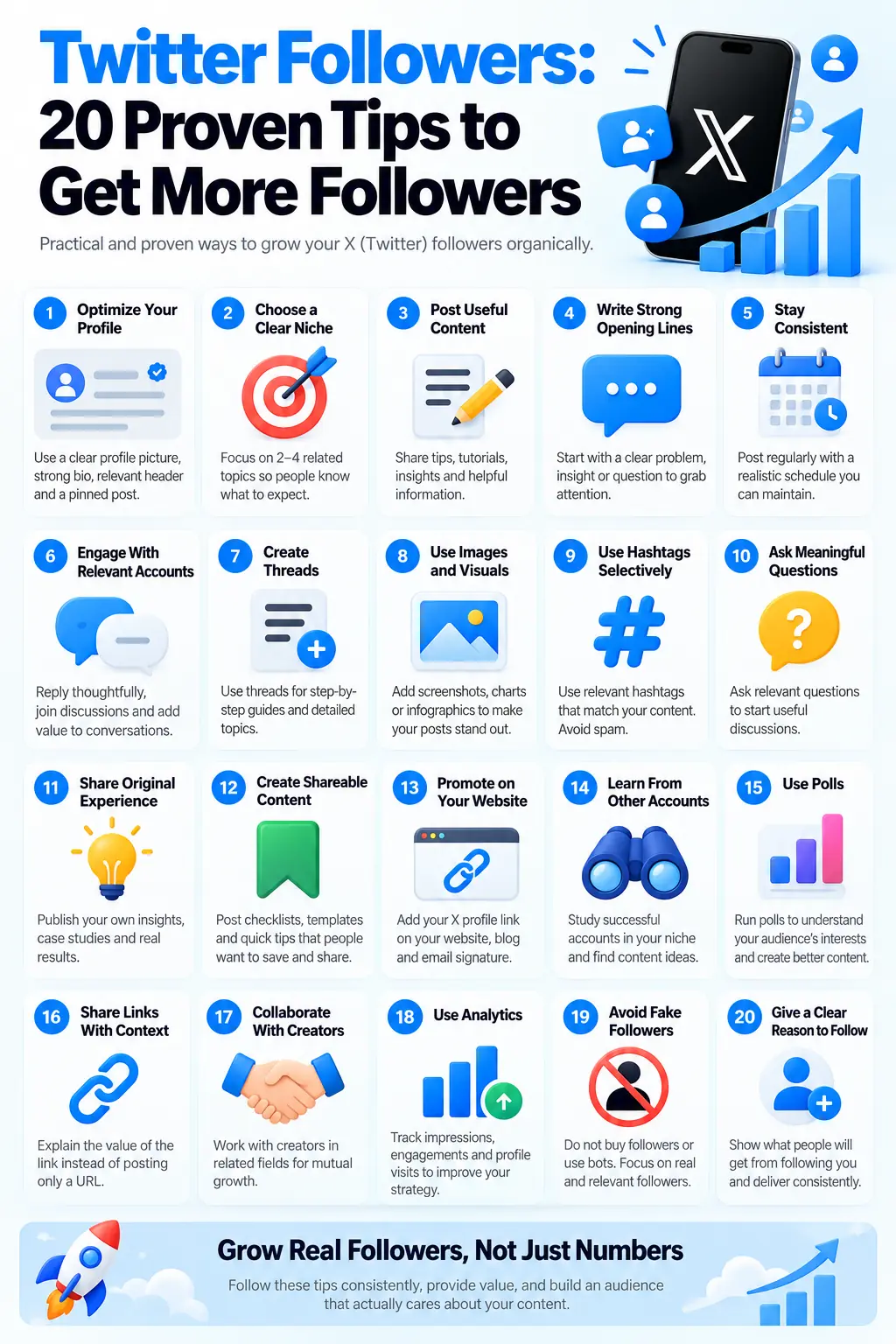
1. Optimize Your Twitter/X Profile
Before trying to attract more followers, make sure your profile gives visitors a clear reason to follow you.
When someone discovers your post, they may visit your profile to learn more about you. If your bio is vague, your profile picture is difficult to recognize, or your recent posts cover unrelated subjects, you may lose that opportunity.
Start with these profile improvements:
- Profile picture: Use a recognizable photograph, brand logo, or consistent visual identity.
- Display name: Choose a name that people can recognize and associate with your work.
- Bio: Explain what you do, which subjects you cover, and what followers can expect.
- Header image: Use a clean design that reflects your expertise or brand.
- Website link: Add your website, portfolio, or another relevant resource.
- Pinned post: Highlight your best introduction, guide, or useful resource.
For example, a digital marketing account could use this bio:
“SEO tips, WordPress tutorials, and practical digital marketing insights to help websites grow.”
This tells visitors what the account offers without relying on generic descriptions.
Think of your Twitter profile as a small landing page. Its purpose is to help the right people understand your value quickly.
2. Choose a Clear Content Niche
People are more likely to follow an account when they understand what it consistently offers.
If you publish SEO advice one day, unrelated celebrity news the next, and random promotional links afterward, visitors may struggle to understand your account’s purpose.
You can discuss several subjects, but they should have a logical connection.
For example, a technology and marketing account could focus on:
- Search engine optimization and website growth
- AI tools and emerging technology
- WordPress tutorials and development
- Content marketing and social media
- Practical website optimization tips
These subjects appeal to overlapping audiences and give you room to publish different types of content without losing your identity.
A clear niche also makes content planning easier. You can identify the questions your audience asks, the problems they face, and the information they need.
A well-defined content strategy also makes it easier to plan posts around your audience’s interests instead of publishing unrelated updates.
You do not have to restrict yourself permanently to one topic. Start with a recognizable focus and expand when you understand which subjects resonate with your audience.
3. Publish Useful Content Instead of Chasing Virality
One of the most effective ways to get more Twitter followers is to publish information people genuinely want to read.
Useful content can answer a question, solve a problem, explain a complicated subject, or offer a perspective that readers have not considered.
For example, a blogger could publish:
- Five common WordPress mistakes and how to fix them
- A simple explanation of a recent SEO change
- Lessons learned from updating an old article
- A comparison of two useful marketing tools
- A practical checklist for launching a website
Avoid publishing content simply because you feel you must post something.
Before publishing, ask yourself whether the post provides a clear takeaway. If it does not teach, inform, entertain, or contribute to a meaningful discussion, consider improving it.
Quality does not mean every post must be long or highly researched. A short, accurate tip can be more useful than a lengthy post filled with generic advice.
4. Write Strong Opening Lines
Your opening line determines whether readers quickly understand why your post deserves their attention.
Start with the problem, insight, question, or useful information instead of a long introduction.
For example:
Less effective:
“I want to share some thoughts about website SEO today.”
More effective:
“Your website can publish excellent content and still struggle to rank. These three technical issues are worth checking first.”
The second example identifies a problem and tells readers what they can learn.
You can also begin with a lesson, a practical observation, a relevant question, or a specific mistake.
Avoid exaggerated claims that the rest of the post cannot support. A compelling opening should create interest without misleading readers.
5. Post Consistently With a Realistic Schedule
Consistency helps your audience become familiar with your account, but posting more frequently does not automatically lead to more followers.
Choose a schedule that allows you to maintain quality without making social media a full-time distraction.
A beginner might start with one useful original post on days they are active, then gradually test different formats and frequencies.
Here is a simple weekly content plan:
| Day | Content idea |
|---|---|
| Monday | A practical tip or tutorial |
| Tuesday | An original observation |
| Wednesday | A relevant question |
| Thursday | A mini-guide or checklist |
| Friday | A lesson learned or case study |
| Weekend | A useful resource or weekly recap |
Treat this as a starting point rather than a universal formula. Your audience, niche, and available time will determine the schedule that works best.
Consistency means regularly delivering something useful, not repeating the same message to fill your timeline.
6. Engage With Relevant Accounts
You do not have to wait for people to discover your original posts. Participating in relevant conversations can also introduce your account to potential followers.
Find creators, businesses, publications, and professionals who discuss subjects related to your niche.
When you see a post worth discussing, add a thoughtful reply.
You could:
- Explain an additional detail.
- Share a relevant experience.
- Offer a different perspective.
- Answer a question.
- Link to a useful source when it genuinely supports the discussion.
Avoid generic replies such as “Great post” or promotional comments that add nothing to the conversation.
The goal is to become a useful participant in your community, not to leave as many replies as possible.
Useful social media tools can help you organize content, monitor performance, and manage your publishing workflow more efficiently.
You can also explore X’s official business resources for guidance on using the platform to build relationships and connect with an audience.
7. Create Threads for Detailed Topics
Some ideas require more explanation than a single post can provide.
Threads allow you to break a complicated subject into smaller, connected posts.
For example, a thread about improving website performance might cover:
- How to identify slow pages.
- Why oversized images affect performance.
- How caching can help.
- Which performance measurements to check.
- How to test whether an improvement worked.
Give the first post a clear topic and reason to continue reading. Keep each subsequent post focused on one useful point.
Do not turn every short observation into a long thread. Use this format when additional context genuinely improves the explanation.
8. Use Images and Infographics When They Add Value
Visual content can help explain information that would otherwise require lengthy descriptions.
Useful formats include screenshots, charts, short demonstrations, diagrams, and infographics.
For example, if you are explaining how to fix a WordPress setting, a screenshot can show exactly where readers need to go.
If you are sharing research, a clear chart can make the main finding easier to understand.
Keep visuals readable and relevant. Avoid overcrowded designs, tiny text, and decorative images that do not support the message.
For accessibility, provide descriptive alternative text where supported by the platform.
9. Use Hashtags Selectively
Hashtags can help communicate a post’s topic, but adding more hashtags does not guarantee greater reach.
Use a relevant hashtag when it provides context or connects your post to an appropriate discussion.
For example, an article about search optimization might use #SEO.
Avoid adding unrelated trending hashtags to attract attention. They can confuse readers and make your content appear spammy.
The same principle applies to trending topics: participate when you have something relevant to contribute, not simply because a subject is popular.
10. Ask Meaningful Questions
Questions can encourage readers to share their experiences and knowledge.
The best questions are specific, easy to understand, and relevant to your audience.
Instead of asking, “What do you think about technology?” try:
“Which WordPress performance issue takes the longest to troubleshoot: caching, JavaScript, or image optimization?”
The more specific question gives people a clear starting point and can produce useful answers for the wider community.
Respond to the replies when possible. A question should open a conversation rather than serve only as a way to collect engagement.
11. Share Original Research and Personal Experience
Original observations can make your account more distinctive than one that simply repeats widely available advice.
You do not need a large research team to share something useful. A small experiment, a carefully explained result, or a lesson from your work can provide value.
For example, you might share what happened after updating an older blog post, testing a website tool, improving page speed, or changing a content workflow.
Explain what you tested, what you observed, and what limitations apply.
Avoid turning a single result into a universal claim. What works for one website or audience may not work for another.
When possible, include supporting evidence or link to a detailed explanation on your website.
12. Publish Content Worth Saving and Sharing
People often appreciate posts they can return to when they need information.
Consider publishing:
- Checklists for recurring tasks
- Short tutorials
- Templates and useful resources
- Troubleshooting guides
- Explanations of technical concepts
- Summaries of important changes
For example, a post listing the essential checks before publishing a WordPress article could serve as a practical reference.
Make each item specific and actionable. A short list of genuinely useful steps is better than a longer list padded with generic advice.
13. Promote Your Twitter Profile on Your Website
Your website can be an additional source of relevant followers.
If you publish tutorials, research, or articles, make it easy for interested readers to find your X profile.
Consider adding a link to your profile in:
- Your author biography
- Your website’s contact page
- Your email signature
- Relevant newsletters
- Other professional social profiles
You can also share useful insights from your articles on X.
Rather than posting only a link, explain the problem your article solves and share one helpful takeaway.
Applying relevant SEO best practices can help people discover your website through search and find your social profiles through your published content.
For example, a WordPress tutorial could be introduced with a short explanation of the problem, followed by a link for readers who want the full walkthrough.
Promote your profile where it is relevant. Avoid unsolicited bulk messages or repeatedly inserting your handle into unrelated discussions.
14. Study Accounts in Your Niche
Look at accounts that consistently publish useful content for the audience you want to reach.
Pay attention to the questions their followers ask, the topics that produce thoughtful discussions, and the ways they explain difficult subjects.
Use those observations to identify content opportunities.
For example, if many people discuss SEO but few explain how to implement a particular technical fix, you could create a practical tutorial covering that gap.
Do not copy another account’s posts or presentation word for word. Use your own experience, evidence, and perspective to produce something original.
You can also use X Lists to organize accounts by subject and follow relevant conversations more efficiently.
15. Use Polls to Understand Your Audience
Polls can help you discover which subjects your audience wants to learn about.
For example, a digital marketing account could ask:
“Which task takes the most time when updating an old blog post?”
- Researching current information
- Rewriting the content
- Updating internal links
- Checking technical SEO
The results could inspire a follow-up tutorial or a more detailed article.
Remember that poll results reflect the people who responded, not necessarily the entire industry. Use them as directional feedback rather than definitive research.
16. Share Website Links With Context
If you want to attract followers and bring visitors to your website, explain why a link is worth opening.
A bare URL offers little information about what readers will gain.
Instead, identify the problem your resource addresses, share a useful takeaway, and provide the link.
For example:
“Struggling with slow WordPress pages? Start by checking image sizes, caching, and unnecessary scripts. This guide explains how to identify common performance problems: [link]”
This approach gives readers useful context before they leave the platform.
Avoid repeatedly publishing identical promotional messages or sharing links unrelated to the conversation.
17. Build Relationships With Other Creators
You can grow your presence by developing genuine relationships with people working in related fields.
A WordPress developer might collaborate with an SEO specialist. A technology blogger could interview a cybersecurity professional. A content marketer might exchange practical lessons with a designer.
Potential collaboration formats include interviews, joint discussions, resource roundups, and thoughtful contributions to one another’s content.
Choose collaborations that provide value to both audiences.
Avoid artificial engagement groups or arrangements designed primarily to exchange follows and inflate engagement numbers.
18. Review Analytics and Improve Your Strategy
Do not measure success only by your follower count.
Review the available analytics to understand which posts attract attention, encourage discussion, lead to profile visits, or bring people to your website.
| Metric | What it tells you |
|---|---|
| Impressions | How often your posts were displayed |
| Engagements | How people interacted with your content |
| Replies | Whether your posts encouraged conversation |
| Reposts | Whether people shared your posts |
| Profile visits | Whether people wanted to learn more about you |
| New followers | Whether your audience grew |
| Link clicks | Whether readers visited your resources |
Metric availability and definitions can vary by account and platform features.
Review patterns across several posts instead of drawing conclusions from one viral result.
For example, a post with many impressions but few profile visits may need a clearer connection between its topic and your account. A post with fewer impressions but more relevant followers may be especially valuable.
Use what you learn to plan your next round of content.
Understanding the benefits of social media marketing can help you connect audience growth with broader goals such as engagement, brand awareness, and website traffic.
19. Avoid Buying Followers and Using Growth Bots
Buying Twitter followers may increase the number displayed on your profile, but it does not necessarily build an audience interested in your work.
Fake or irrelevant followers may not read your posts, visit your website, or participate in discussions. They can also make it harder to evaluate your actual engagement.
X prohibits various forms of artificial follower and engagement inflation. Its authenticity policy explains restrictions on practices such as follow-churn schemes and artificial amplification.
Be cautious with services that promise free followers in exchange for access to your account. X also warns users about the risks of third-party free-follower applications in its follower-app guidance.
Avoid buying followers, automating repetitive replies, sending unsolicited bulk messages, or participating in schemes designed to inflate engagement.
A smaller audience of genuinely interested people is often more useful than a large audience that never interacts with your content.
20. Give People a Clear Reason to Follow You
Every post gives someone an opportunity to discover your account, but you do not need to ask for a follow in every message.
When appropriate, explain what people can expect from your future posts.
For example:
“Follow for practical WordPress tutorials, SEO insights, and website optimization tips.”
Make sure your content consistently delivers on that promise.
Your profile, posts, and conversations should demonstrate the value of following you rather than relying on repeated calls to action.
If you use X to promote a company or professional service, learn how to use X/Twitter for business to connect your posting activity with your broader business goals.
A Simple 30-Day Plan to Get More Twitter Followers
If you are unsure where to start, use this four-week plan.
Week 1: Improve your profile
- Rewrite your bio to explain your value.
- Choose a recognizable profile image and header.
- Pin a useful introductory post.
- Define three related content themes.
Week 2: Establish a content routine
- Publish useful original posts.
- Test tips, questions, and mini-guides.
- Use relevant visuals when they improve understanding.
- Review which subjects attract attention.
Week 3: Engage with your community
- Reply thoughtfully to relevant posts.
- Participate in conversations within your niche.
- Share useful resources with context.
- Start genuine discussions with your audience.
Week 4: Review and refine
- Review your available analytics.
- Compare profile visits with follower growth.
- Identify the topics that attracted the most relevant attention.
- Plan the next month around your findings.
This plan is a practical starting point, not a guarantee of a specific follower count. Results depend on your niche, content quality, audience, and consistency.
Frequently Asked Questions
How can I get more Twitter followers organically?
Optimize your profile, publish useful content consistently, participate in relevant discussions, share original insights, and use analytics to understand what resonates with your audience.
How often should I post on Twitter?
There is no universal posting frequency that guarantees follower growth. Start with a schedule you can maintain while preserving content quality, then adjust based on your results.
Do hashtags help increase Twitter followers?
Relevant hashtags can provide context and connect posts with topic-based discussions, but they do not guarantee additional reach or followers.
Should I buy Twitter followers?
No. Purchased followers may be inactive, fake, or irrelevant. Artificial follower inflation also conflicts with X’s platform rules. Focus on building a genuine audience.
Can beginners grow on Twitter without a large following?
Yes. Beginners can attract attention by sharing useful information, developing a clear niche, and participating in relevant conversations. Growth is possible, although no particular result is guaranteed.
Do links to my website help grow twitter followers?
They can help when the linked content is useful to your intended audience. Explain the value of the resource instead of repeatedly posting URLs without context.
How long does it take to gain Twitter followers?
There is no fixed timeline. Some accounts grow quickly after reaching a relevant audience, while others grow gradually. Review progress over several weeks and months rather than expecting immediate results.
Conclusion
Getting more Twitter followers is not simply a numbers game. Sustainable growth comes from making your account worth following, sharing information people find useful, and participating in conversations where you can contribute something meaningful.
Start with your profile, establish a clear content focus, publish consistently, and engage with people who share your interests. Then use analytics to identify what works and improve your approach.
Avoid shortcuts that inflate follower counts without building genuine interest.
The goal is not just to get more Twitter followers. It is to build an audience that trusts your content, engages with your ideas, and wants to hear from you again.