
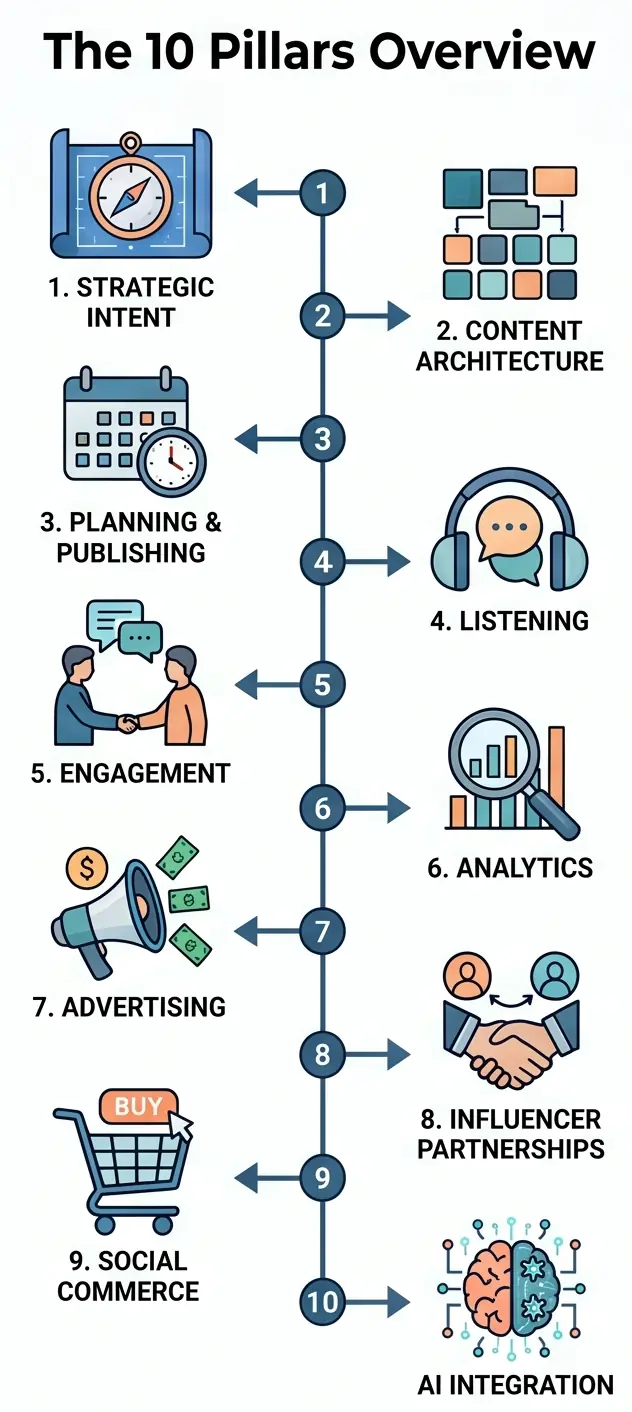
Social Media Marketing Pillars: The 10 Pillars at a Glance
- Strategy: Your North Star; without it, you’re just making noise.
- Planning & Publishing: Consistency is the heartbeat of your brand.
- Listening & Engagement: Social is a two-way street; stop talking, start listening.
- Analytics: If you can’t measure it, you can’t improve it.
- Advertising: Paid social is the fuel that scales your organic fire.
- Content Diversity: Mixing “Searchable Shorts” with “Story-Building Longs.”
- Influencer & UGC Partnerships: Trust is the new currency.
- Social Commerce: Turning “Scroll” into “Sale” natively.
- AI Integration: Using AI as a creative co-pilot, not a replacement.
- Community & DMs: Where the real conversions happen in 2026.
The New Era of Connection: Why “Posting” Isn’t Marketing Anymore
Imagine walking into a massive, echoing stadium filled with 5.66 billion people. Everyone is talking at once, some are dancing, others are teaching DIY crafts, and a few are just screaming into the void. This isn’t a fever dream; it’s the state of social media in 2026.
If you’re a brand trying to stand out, you can’t just walk in and shout your prices through a megaphone. You’d be ignored, or worse, kicked out. To win today, you have to be the person at the party who everyone actually wants to talk to.
Social media has evolved from a digital scrapbook into a complex, AI-driven ecosystem that dictates how we live, shop, and think. In 2026, the benefits of social media marketing go far beyond “likes.” We’re talking about 60% of product discovery happening on platforms like TikTok and Instagram—surpassing Google for the first time in history.
But how to understand social media marketing in such a crowded space? It’s not about the latest dance trend or a viral meme. It’s about building a house on a foundation that won’t crack when the next algorithm update hits. We call these the social media marketing pillars.
Whether you are a seasoned pro or just starting, these 10 pillars will help you stop “using” social media and start mastering it.
1. The Foundation: Strategic Intent
Before you film a single Reel, you need to ask: Why? How did social media marketing start? It began in the early 2000s on sites like MySpace and Friendster, where the goal was simply “to be seen.” Today, visibility is cheap; impact is expensive. A true strategy identifies your specific audience, their pain points, and how your brand uniquely solves them.
In 2026, the most successful social media marketers don’t chase every platform. They choose 2–3 “core” channels where their audience lives and ignore the rest. This is the first of the social media marketing pillars: focus.
2. Content Architecture: The Search-First Shift
We used to talk about “content pillars” as just topics (e.g., “Educational,” “Behind the Scenes”). Now, pillars of social media content are defined by intent.
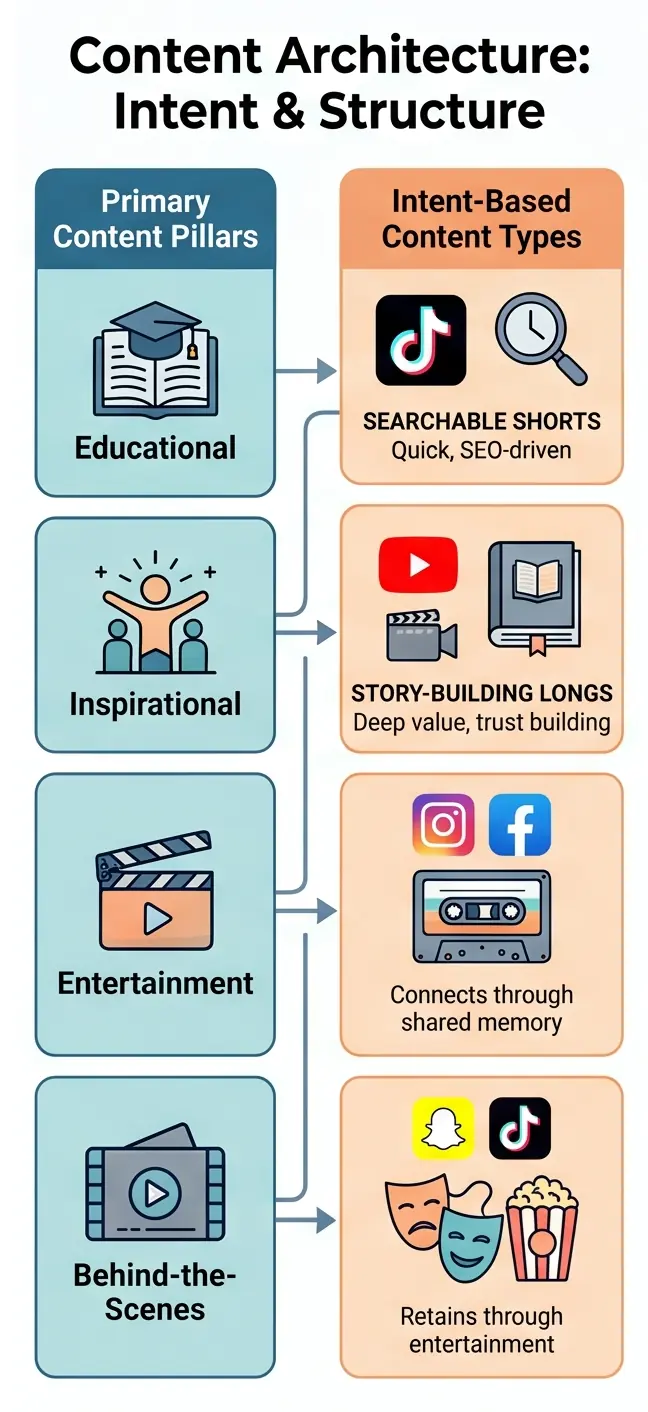
With social platforms behaving more like search engines, your content must be “Searchable.” This means using keywords in your captions and on-screen text so that when someone searches “how to fix a leaky faucet,” your video shows up.
Related: 30 Best Social Media Design Tips to Skyrocket Your Brand
| Content Type | Purpose | Best Platform |
| Searchable Shorts | Rapid discovery & problem solving | TikTok, Reels, Shorts |
| Story-Building Longs | Deep trust & authority | YouTube, LinkedIn |
| Nostalgic Remix | Emotional connection (Gen X/Millennials) | Instagram, Facebook |
| Micro-Dramas | Pure entertainment & retention | TikTok, Snapchat |
3. Planning & Publishing: The Rhythm of Reliability
Consistency doesn’t mean posting five times a day. It means being there when your audience expects you. In 2026, the average user hops between 6.75 different social networks per month. If you’re ghosting your audience on one, they’ll find a competitor on another.
Use scheduling tools, but don’t “set it and forget it.” The “Rapid-Response” trend means you need to be ready to pivot your calendar if a major cultural moment happens.
4. Listening: The Secret Weapon of Market Research
Social media marketers often forget that “social” comes before “media.” Listening is about monitoring mentions of your brand, your competitors, and even broader industry keywords.
How is social media good for marketing? It provides a free, 24/7 focus group. By listening, you might discover that people love your product but hate the packaging. That’s a marketing insight you didn’t have to pay $50,000 for.
5. Engagement: The DM-First Conversion
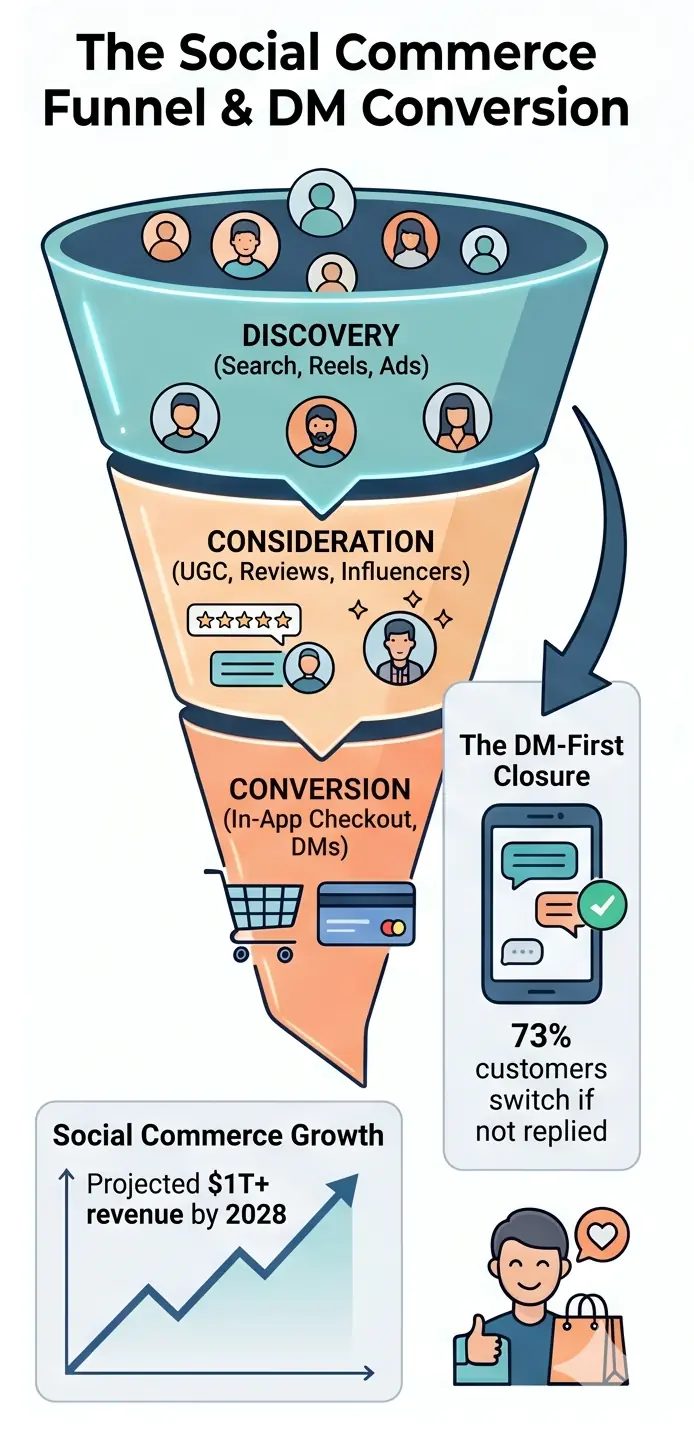
In 2026, the “feed” is for discovery, but the “DMs” (Direct Messages) are for closing. 73% of consumers say they’ll switch to a competitor if a brand doesn’t respond on social.
Engagement isn’t just replying with a “heart” emoji. it’s about starting real conversations. Brands are now treating DMs and private communities (like Discord or WhatsApp groups) as extensions of their customer service and sales teams.
6. Analytics: Beyond the Vanity Metrics
Likes are a dopamine hit, but they don’t pay the bills. The types of social media marketing you employ must be measured by ROI (Return on Investment).
- TikTok: Watch for “Share” rates (indicates viral potential).
- Instagram: Focus on “Saves” (indicates high value).
- LinkedIn: Look at “Click-Through Rates” (indicates professional intent).
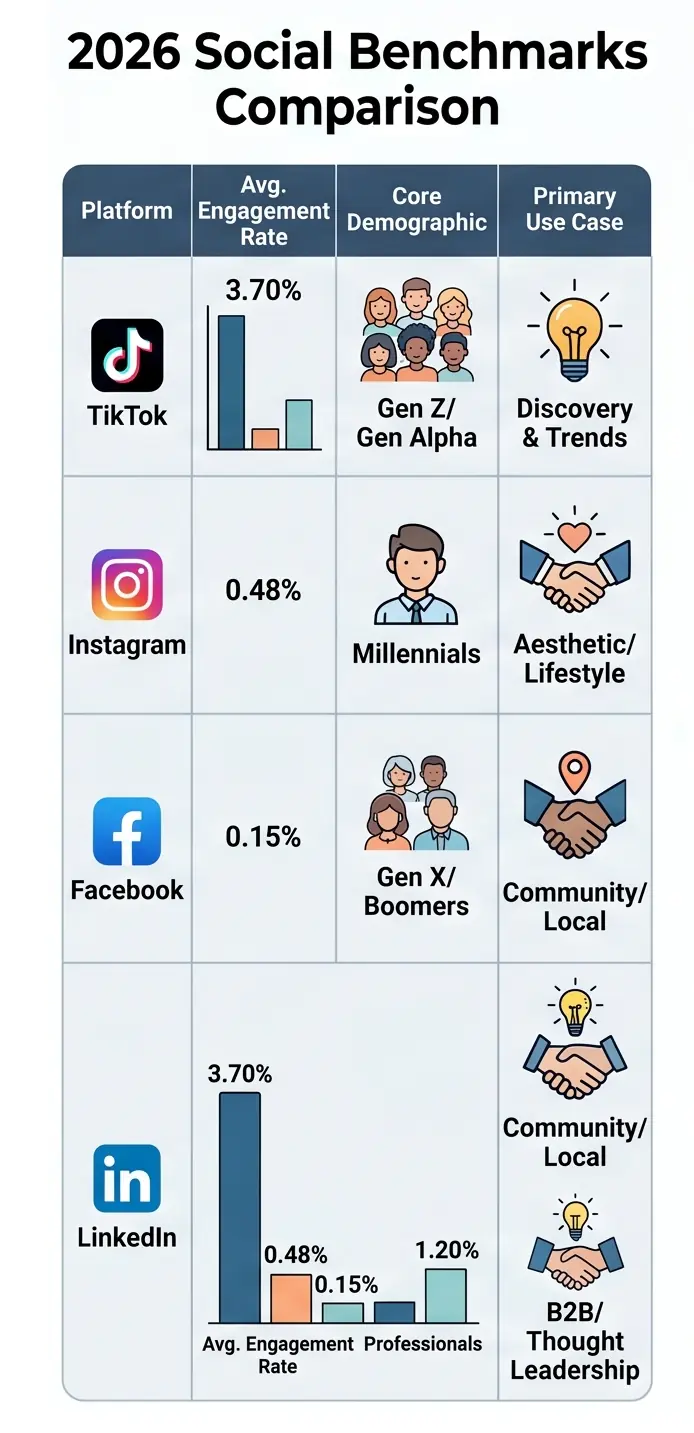
The current benchmark for TikTok engagement is around 3.70%, while Facebook sits much lower at 0.15%. Use these numbers to set realistic goals.
7. Advertising: Scaling the Signal
Organic reach is getting harder. In 2026, total social ad spend is projected to exceed $317 billion. Think of organic content as your “testing ground.” If a post performs well naturally, put money behind it to turn it into an ad.
The most effective ads today don’t look like ads—they look like UGC (User-Generated Content). They feel like a recommendation from a friend, not a pitch from a corporation.
8. Influencer Partnerships: Authenticity Over Reach
The “Mega-Influencer” era is fading. In its place is the rise of the “Niche Creator.” 94% of organizations say influencer marketing outperforms traditional ads. Why? Because people trust people.
Partner with creators who actually use your product. A recommendation from a creator with 10k highly engaged followers is often worth more than a shoutout from a celebrity with 10 million bots.
Recommended: 30 Best Free Social Media Marketing Tools for 2026
9. Social Commerce: The Frictionless Sale
Social media is no longer just the top of the funnel; it is the funnel. With TikTok Shop and Instagram Checkout, users can buy a product without ever leaving the app.
Global social commerce revenue is expected to hit $1 trillion by 2028. If your social strategy doesn’t include a clear path to purchase, you’re leaving money on the table.
10. AI Integration: Your Creative Co-Pilot
AI isn’t here to replace your social media manager; it’s here to give them superpowers. From generating 50 caption variations in seconds to editing videos for different platform ratios, AI is now a standard pillar.
However, the “Human-Generated” feel is still the #1 priority for users. Use AI for the “grunt work” so you can spend more time on the “human work”—the strategy and the storytelling.
2026 Social Media Benchmarks Table
| Platform | Avg. Engagement Rate | Core Demographic | Primary Use Case |
| TikTok | 3.70% | Gen Z / Gen Alpha | Discovery & Trends |
| 0.48% | Millennials | Aesthetic / Lifestyle | |
| 0.15% | Gen X / Boomers | Community / Local | |
| 1.20% | Professionals | B2B / Thought Leadership |
Explore more: Benefits of Social Media Marketing in 2026
Final Thoughts: The Human Element
At the end of the day, social media marketing isn’t about algorithms, it’s about people. The technology will change, the “Pillars” might shift, but the human desire for connection is eternal.
If you build your strategy on these 10 pillars, you won’t just be “posting.” You’ll be building a brand that resonates, a community that advocates, and a business that grows. Ready to stop shouting and start connecting?
Start by auditing your current presence. Which of these 10 social media marketing pillars is your weakest link? Fix that first, and watch the results follow.
Frequently Asked Questions (FAQ)
1. What are the 5 pillars of social media marketing?
Traditionally, the 5 pillars are Strategy, Planning/Publishing, Listening/Engagement, Analytics, and Advertising. However, in 2026, we’ve expanded these to include AI, Creators, and Social Commerce to reflect the modern landscape.
2. How do I start social media marketing for a small business?
Start by identifying where your customers hang out. Don’t try to be everywhere. Pick one platform, post consistently (3x a week), and focus on being helpful rather than “salesy.”
3. Is social media marketing still effective in 2026?
Absolutely. It is the primary driver for product discovery, with over 60% of users finding new brands on social platforms rather than through traditional search engines like Google.
4. What is the most important social media metric?
It depends on your goal, but generally, “Shares” and “Saves” are the most valuable metrics in 2026 because they indicate that your content is either worth spreading or worth coming back to.
5. How much should I spend on social media ads?
A good rule of thumb is to allocate 10–20% of your total marketing budget to social ads, but start small. Test organic content first, then put “fuel” (money) behind the posts that are already performing well.