

Social Media Audit Steps: The Social Media Audit Summary
- Definition: A social media audit is a thorough evaluation of your brand’s digital footprint across all social networks to optimize performance and strategy.
- Inventory First: Locate all active, inactive, and imposter accounts representing your brand.
- Analyze Performance: Look beyond vanity metrics. Focus on engagement rates, click-throughs, and saved content.
- Study Competitors: Perform competitor analysis to spot gaps in their strategy that you can capitalize on.
- Optimize Profiles: Ensure visual consistency, update bio links, and align your messaging with your core website.
- Take Action: Use the data to refine your content performance, drop failing platforms, and double down on what works.
The Anatomy of a Modern Social Media Audit
Imagine you are driving a car with a foggy windshield, a slow leak in one tire, and an engine that randomly sputters. You are still moving forward, but every mile is a struggle. You are burning extra fuel and taking twice as long to reach your destination.
Running a brand online without doing a regular social media audit is exactly like driving that car. You might be posting every day, creating incredible graphics, and spending hours writing captions. But if you aren’t stepping back to look at the hard data, you are practically driving blind.
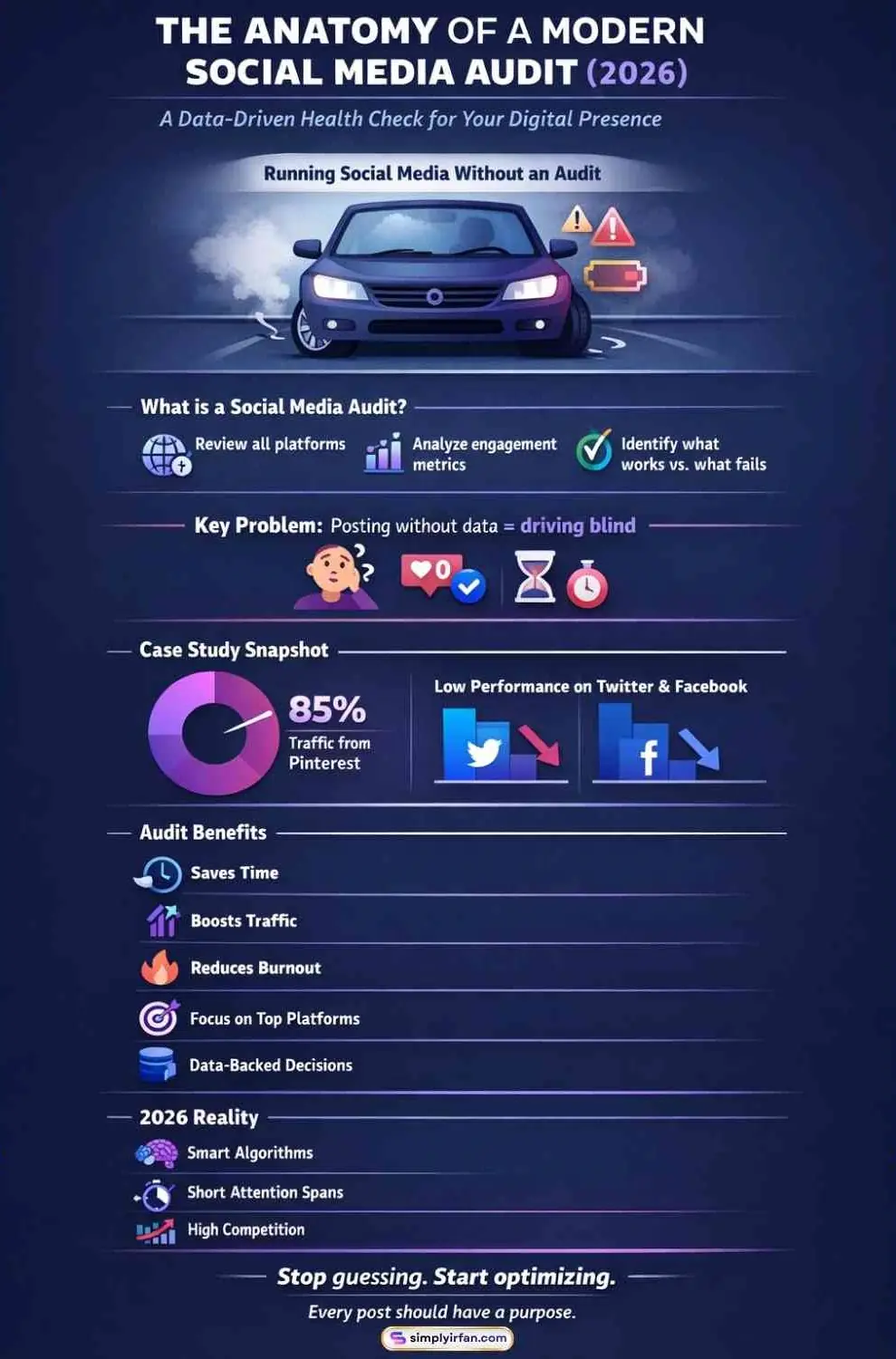
A social media audit is essentially a comprehensive health check for your digital presence. It is the process of reviewing all your social accounts, analyzing your engagement metrics, and figuring out exactly what is working and what is falling flat.
I remember talking to a brilliant content creator a while back. They were pouring their heart into beautifully crafted poetry and status posts, sharing them across five different platforms. But their traffic was entirely stagnant. They felt completely burned out and ready to quit.
We sat down and looked at the numbers. It turned out that 85% of their actual website traffic was coming from just one platform—Pinterest. Their Twitter and Facebook accounts were absolute ghost towns, yet they were spending hours a week trying to force engagement there.
Once they stopped wasting time on the dead platforms and doubled down on highly visual, shareable graphics where their audience actually lived, everything changed. Their traffic skyrocketed, and their stress levels plummeted. That is the true power of a proper audit. It removes the guesswork and gives you a clear, data-backed roadmap.
In 2026, the digital landscape is more crowded than ever. Algorithms are incredibly smart, and user attention spans are fiercely protected. You can no longer just throw content at the wall and hope something sticks. You need a razor-sharp social media strategy.
Whether you are a developer managing multiple digital properties, a brand selling products, or a creator building a community, an audit aligns your social channels with your actual business goals. It ensures that every post, reel, and tweet serves a distinct purpose.
Step 1: Inventory, Analytics, and Benchmarking Your Digital Footprint
The very first of the social media audit steps is to figure out exactly what you own. You cannot optimize a digital footprint if you don’t even know where you are stepping.
Start by opening a simple spreadsheet. You are going to hunt down every single profile associated with your brand name. This includes the major players like Instagram, TikTok, and LinkedIn, but also the forgotten ones. Did you create a Reddit account three years ago and abandon it? Log it. Is there a dormant YouTube channel sitting there with old, outdated branding? Log that too.
You should also do a manual search for your brand name on these networks to catch imposter accounts or fan pages you don’t control. Your inventory should clearly list the platform, the exact profile URL, the current follower count, and whoever holds the login credentials.
Once you have your complete list, it is time to get ruthless. You do not need to be on every platform. In fact, spreading yourself too thin is a guaranteed way to kill your content performance. If a platform is not driving meaningful engagement or traffic to your main site, you need to seriously consider archiving it.
Platform Engagement Benchmarks (2026 Data)
To know if a platform is worth keeping, you need to understand current industry standards. Let’s look at a comparison table of average engagement rates to give you a solid baseline.
| Social Platform | Average Engagement Rate | Primary Content Focus | Best For Driving… |
| TikTok | 3.5% – 5.0% | Short-form, raw video | Brand awareness & viral reach |
| 1.5% – 2.5% | Reels, Carousels, Stories | Community building & visual identity | |
| 2.0% – 3.5% | Text posts, industry news | B2B networking & authority building | |
| YouTube | 4.0% – 6.0% | Long-form video, Shorts | Deep education & evergreen search |
| X (Twitter) | 0.05% – 0.1% | Real-time updates, threads | Customer service & trending topics |
Note: Engagement rate equals total interactions divided by total followers or impressions. Always track by impressions when possible for a more accurate metric.
After establishing your baselines, dive into audience demographics. Who is actually following you? You might think your target audience is college students, but your Facebook insights reveal that your most engaged followers are professionals in their late 30s.
If there is a massive disconnect between who you want to reach and who is actually engaging, your messaging is misaligned. This is incredibly common. It often happens when brands use overly complex language when their audience just wants simple, fast solutions.
When you review your analytics, ignore the vanity metrics. Having 50,000 followers means absolutely nothing if only 12 people click the link in your bio. Focus heavily on actionable metrics: website clicks, post saves, profile visits, and direct messages.
Think of your social channels like the front door to your house. Your main website—running smoothly on a fast, optimized Nginx server, perhaps—is the actual living room where you want people to hang out. Your social media audit must answer one vital question: are these social platforms successfully getting people through the front door?
Step 2: Content Performance and Competitor Analysis
Now that you have your data, you need to analyze the actual meat of your strategy: the content itself. This is where you uncover what your audience genuinely cares about.
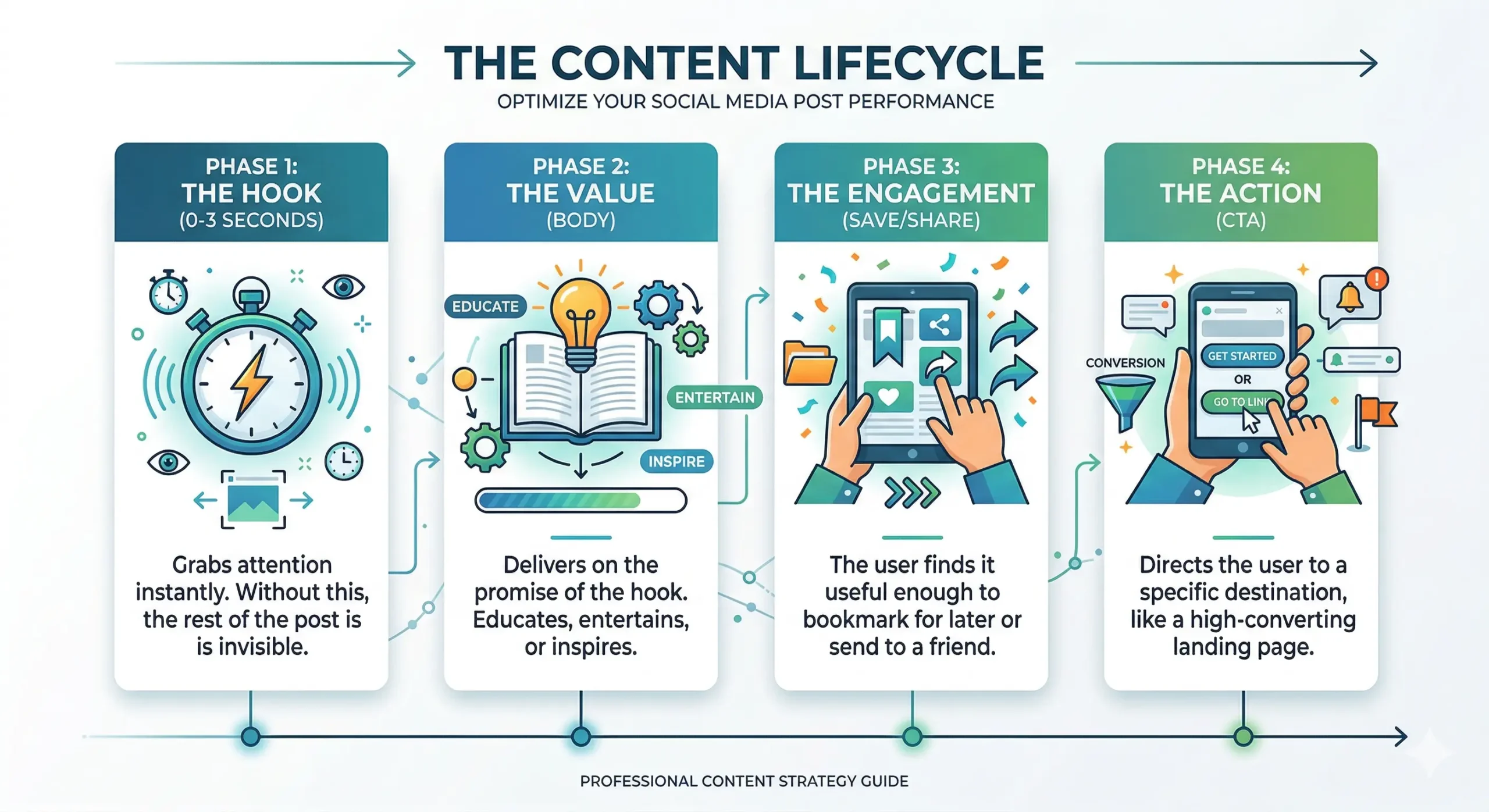
Go through your top five performing posts from the last 90 days. What do they have in common? Were they all educational carousel posts? Were they hyper-realistic AI-generated images that sparked curiosity? Did they feature a strong hook in the first three seconds of a video?
Conversely, look at your five absolute worst-performing posts. Identify the common thread there, too. Maybe they were overly promotional, or maybe the captions were just too long and blocky. By identifying these patterns, you instantly upgrade your social media strategy. You stop guessing and start mass-producing the exact style of content that works.
Next, you have to look over the fence and see what the neighbors are doing. Competitor analysis is not about copying; it is about finding the gaps in the market.
Pick three of your biggest direct competitors. Spend time scrolling through their feeds. What kind of engagement are they getting? Are their comment sections full of people asking questions that the brand is ignoring? That right there is an opportunity for you to swoop in and be the helpful authority.
Pay close attention to their content cadence. How often are they posting? Are they prioritizing high-quality, long-form educational content, or are they just spamming low-effort memes?
If your competitors are all churning out generic, robotic articles, you can stand out by creating highly personalized, deeply researched guides. People crave humanized, relatable content. If you can provide a massive 4,000-word deep dive with custom visuals while everyone else is doing 500-word fluff pieces, you automatically win the trust of the consumer.
Look at the tools they use. Are they leveraging AI to generate creative prompts and scale their production? If they are moving faster than you, it might be time to adopt a structured workflow. Build your own internal library of prompts and templates to speed up your content creation without sacrificing quality.
Ultimately, your goal in this step is to map out the “white space.” You want to find the specific topics, formats, or platforms that your competitors are completely ignoring, and plant your flag right there.
Step 3: Profile Optimization and Future Strategy Implementation
The final phase of your social media audit involves putting on your digital janitor outfit and cleaning things up. You have the data, you know what content works, and you know what your competitors are missing. Now, you must optimize.
Start with visual consistency. If a potential customer clicks from your TikTok to your Instagram, and then to your main website, they should feel like they are in the exact same ecosystem. Your profile pictures, color palettes, and tone of voice must be perfectly aligned.
Next, audit your bios. Your bio is the most valuable real estate on any social platform. It should clearly state who you are, what problem you solve, and who you solve it for. Get rid of vague, poetic bios and replace them with punchy, benefit-driven statements.
Ensure that your links are fully functional and lead to optimized landing pages. There is nothing worse than driving thousands of eyes to a link that results in a 404 error or a slow-loading page. If you are running complex tools—like image resizers or formatting apps—make sure your server infrastructure can handle the social traffic spikes.
Tying Social to SEO
Many people forget that social profiles are an extension of your overall search engine presence. A well-optimized social profile can actually dominate the first page of Google for your brand name.
Ensure that the primary keyword representing your niche is naturally woven into your profile bios and page descriptions. Furthermore, make sure your main website uses valid structured data (like JSON-LD Organization or Person schema) that explicitly links out to these social profiles.
This creates a closed-loop digital ecosystem. It tells search engines exactly who you are and connects your high-authority website to your social presence, establishing a concrete Knowledge Graph entity.
Once your profiles are shining, it is time to implement your new strategy. Create a fresh content calendar based purely on the insights you gathered during step two. If your audit revealed that infographics get shared 300% more than text posts, your new strategy should mandate two infographics a week.
Set clear, trackable goals for the next quarter. Don’t just say, “I want more followers.” Say, “I want to increase our average engagement rate by 1.5% and drive 500 new clicks to the site every month.”
A social media audit is not a one-and-done event. The digital world shifts daily, and what worked six months ago might be completely obsolete today. Make it a habit to run a mini-audit every single quarter.
By consistently reviewing your data, adapting your content, and keeping your profiles optimized, you transform your social media from a frustrating time-sink into a highly efficient, traffic-generating machine.
So, what is your next move? Open up a blank spreadsheet right now. Log your first three accounts, check your bio links, and take that vital first step toward total digital clarity.

Frequently Asked Questions (FAQ)
What exactly is a social media audit?
A social media audit is a structured review of your brand’s active and inactive social channels. It involves analyzing follower demographics, content engagement, profile branding, and overall performance to improve your digital marketing strategy.
How often should I conduct a social media audit?
You should conduct a deep, comprehensive audit at least once a year. However, performing a lighter, mini-audit every quarter (every 90 days) is highly recommended to stay ahead of fast-changing algorithms and audience trends.
What are the most important engagement metrics to track?
While follower count is nice for social proof, the most critical metrics are shares, saves, click-through rates (CTR), and meaningful comments. Saves and shares strongly signal to algorithms that your content is highly valuable.
How do I perform a competitor analysis on social media?
Identify 3 to 5 direct competitors in your niche. Analyze their posting frequency, the types of content that get the most comments, their visual branding, and their target audience. Use this data to find strategic gaps you can fill.
Can I delete social media platforms that aren’t working?
Yes. If a platform consistently yields low engagement and drains your resources after you have tried optimizing it, it is better to archive or delete the account. Focus your energy exclusively on the channels where your target audience is actively engaging.
Also Read:
30 Pro Social Media Marketing Tips for Businesses
Why Social Media Is Important for Business in 2026