
Have you ever opened Facebook and discovered that someone tagged you in a random photo, an embarrassing post, a promotional offer, or content you would rather not have associated with your profile?
It can be frustrating, especially when you do not know the person who tagged you or never agreed to be included in the post.
Facebook tagging is designed to help people connect posts, photos, and other content with the profiles of the people mentioned. But not every tag is welcome. Some people tag friends in jokes, businesses tag people in promotions, and spam accounts may use tags to attract attention.
The good news is that you can control how Facebook handles many unwanted tags. You can review posts before they appear on your profile, review tags people add to your own posts, adjust the audience for tagged content, and remove tags you no longer want.
There is one limitation to understand: these settings do not guarantee that nobody can tag or mention you anywhere on Facebook. They help control your profile and your exposure to tagged content, but the original post may still be visible to its intended audience.
In this guide, you will learn how to stop unwanted tags on Facebook using an iPhone, Android phone, or computer, how to remove existing tags, and what to do when someone repeatedly tags you in spam or inappropriate content.
Can You Stop People from Tagging You on Facebook?
Facebook does not provide a single universal setting that guarantees nobody can tag your personal profile in any post or photo.
However, you can make tagging much more manageable by adjusting your privacy settings.
Here are the main options:
- Turn on Timeline Review: Review posts that tag you before they appear on your profile.
- Turn on Tag Review: Review tags people add to posts or photos that you published before those tags appear.
- Control the audience: Choose who can see posts you’re tagged in on your profile and how your friends may be added to the audience.
- Remove unwanted tags: Disconnect your profile from a post or photo that has already tagged you.
- Block or report abusive accounts: Use Facebook’s safety tools when someone repeatedly harasses you or sends spam.
These controls do different jobs. For example, Timeline Review helps prevent tagged posts from automatically appearing on your profile, but it does not necessarily hide the original post from everyone else.
For the official explanation, see Facebook’s guide to tagging.
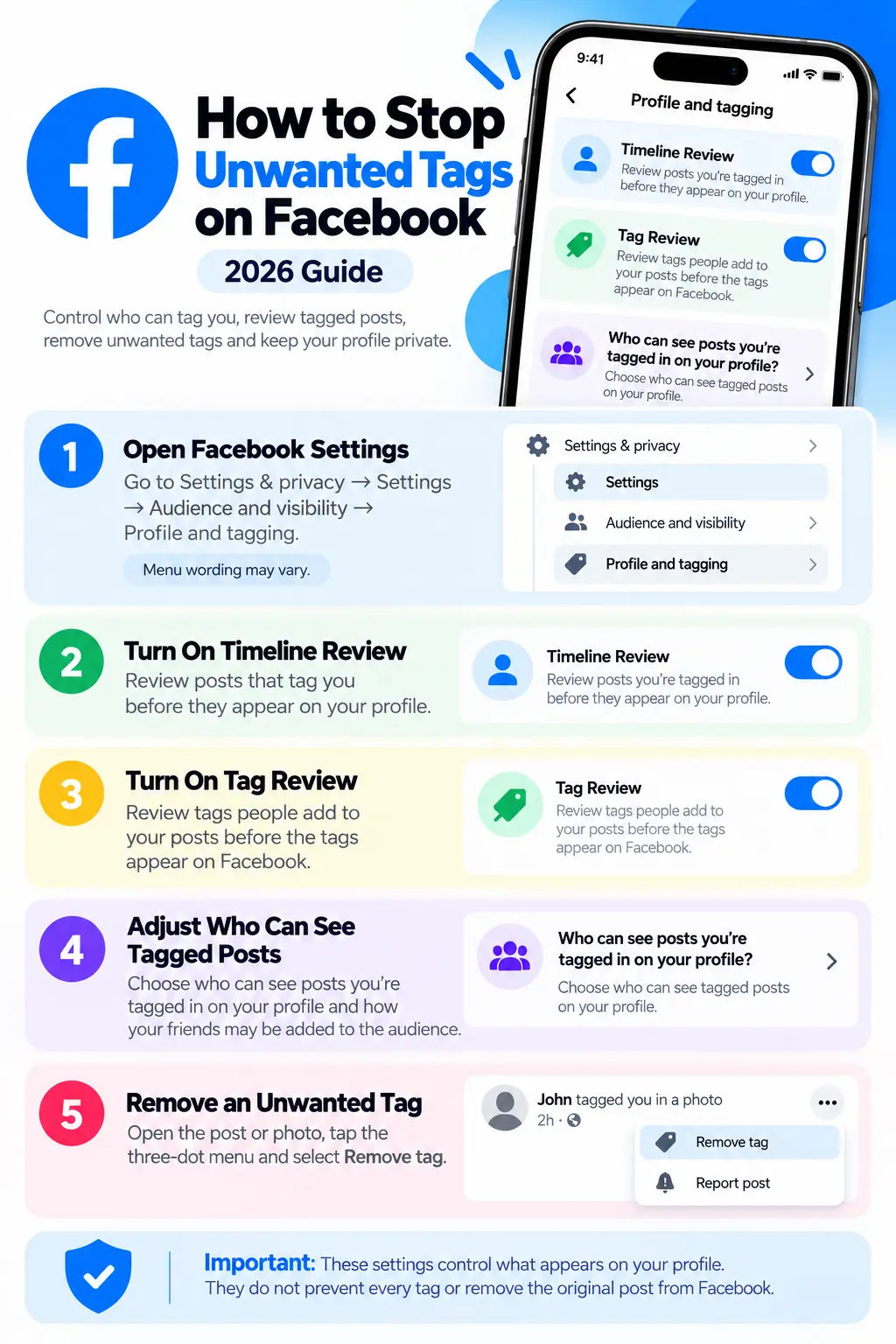
1. How to Stop Unwanted Tags on Facebook Using a Phone
The Facebook app on Android and iPhone provides settings for reviewing tags and managing your profile’s privacy.
Follow these steps:
- Open the Facebook app and sign in.
- Tap your profile picture or the menu icon.
- Open Settings & privacy.
- Tap Settings.
- Look for Audience and visibility.
- Open Profile and tagging.
- Review the available tagging and review settings.
- Turn on the review options explained in the following sections.
The wording and layout can differ slightly by app version, account, and region. If you cannot find a setting, use the search field in Facebook Settings and search for terms such as tag review, timeline review, or profile and tagging.
The two most important settings to check are Timeline Review and Tag Review.
2. Turn On Timeline Review to Approve Tagged Posts
Timeline Review is one of the most useful privacy controls for people who do not want unexpected posts appearing on their Facebook profiles.
When someone tags you in a post, Timeline Review lets you review whether that post should appear on your profile.
How to enable Timeline Review
- Open Facebook.
- Go to Settings & privacy → Settings.
- Open Profile and tagging.
- Find the section called Reviewing.
- Look for the setting worded similarly to Review posts you’re tagged in before the post appears on your profile?
- Turn it on.
Once enabled, Facebook gives you an opportunity to review eligible tagged posts before they appear on your profile.
You can then decide whether to allow the post to appear on your timeline or keep it off your profile.
What does Timeline Review actually do?
Imagine a friend tags you in a photograph from a party. You might be comfortable with the photograph being available to that friend’s audience, but you may not want it displayed on your own profile.
With Timeline Review enabled, you can review the post before it appears on your timeline.
However, remember this important distinction: keeping a tagged post off your profile does not automatically remove the tag from the original post or make that post invisible everywhere on Facebook.
Depending on the original post’s audience and other privacy settings, people may still see it in their Feed, search results, or other places.
Official source: Facebook Help Center — Profile and tagging
3. Turn On Tag Review for Posts You Publish
Timeline Review and Tag Review sound similar, but they are not the same feature.
- Timeline Review controls whether posts that tag you appear on your profile.
- Tag Review controls whether tags people add to content you posted appear without your approval.
Suppose you upload a group photograph to Facebook. Someone identifies another person in the photo and adds a tag. If Tag Review is enabled, you can review that tag before it appears.
This is particularly useful if you publish photographs, family updates, event pictures, or other content and want more control over the people associated with it.
How to enable Tag Review
- Open Facebook and go to Settings & privacy → Settings.
- Select Profile and tagging.
- Find the Reviewing section.
- Look for an option similar to Review tags people add to your posts before the tags appear on Facebook?
- Turn the option on.
The exact wording may vary.
You can now review eligible tags added to your posts before approving them.
Important: Tag Review does not prevent other people from mentioning your name in ordinary text or writing about you. It is a control for tags on content you publish, not a universal filter for every reference to your name.
4. How to Remove an Unwanted Tag on Facebook
If someone has already tagged you in a post or photo, you can often remove the tag directly.
You do not need to wait for future posts to enable the privacy settings described above.
Remove a tag from a Facebook post
- Open Facebook and find the post where you are tagged.
- Tap or click the three-dot menu on the post, if available.
- Look for Remove tag or a similar option.
- Select it and confirm if Facebook asks you to do so.
Depending on the post and the current interface, you may need to open the post or photo to find the tagging controls.
Remove a tag from a photo
- Open the photograph.
- Look for the options menu.
- Select the available option to remove your tag.
- Confirm the action if prompted.
If you cannot find the post, check your Activity Log. It can help you locate and manage content associated with your profile.
Does removing a tag delete the original post?
No. Removing a tag disconnects your profile from that tag, but it does not delete the post or photo uploaded by someone else.
The original content may remain visible to the audience selected by the person who published it.
If the photograph or post is inappropriate, violates your privacy, or contains information you do not want shared, you can ask the person who posted it to remove it. If it violates Facebook’s rules, you can also report it.
Official source: Facebook Help Center — Tagging
5. How to Control Who Can See Posts You’re Tagged In
Even if you allow people to tag you, you can adjust how tagged posts relate to your profile’s audience.
This is important because a post’s visibility may extend beyond the original audience when people are tagged.
For example, a person publishes a post for their friends and tags you. Depending on the post’s audience and your settings, your friends may also be included in the audience for the tagged post.
Facebook provides a setting that lets you choose who should be added to the audience of a post you’re tagged in if they cannot already see it.
How to change the audience for tagged posts
- Open Facebook Settings & privacy → Settings.
- Go to Profile and tagging.
- Find the setting worded similarly to When you’re tagged in a post, who do you want to add to the audience of the post if they can’t already see it?
- Choose the audience that fits your privacy preference.
Depending on the options available to your account, you may be able to select a more restrictive audience, such as Only me, for the additional audience setting.
Be careful with the wording: this setting controls the additional audience associated with your profile. It does not necessarily override the audience selected by the original poster.
If the person who created the post made it public, your audience settings do not automatically make the original post private.
Official source: Choose who can see a post that you’re tagged in on Facebook.
6. How to Find All Your Tagged Posts on Facebook
If you have been using Facebook for years, you may have hundreds of old posts and photos associated with your profile.
You do not have to scroll through your entire timeline to find them individually. Facebook’s Activity Log can help you review and manage activity associated with your account.
Find tagged posts using Activity Log
- Open your Facebook profile.
- Open the profile options menu.
- Select Activity Log.
- Look for the section related to your activity, tags, or posts you’re tagged in.
- Use the available filters to find the relevant content.
- Open a post to review the available actions, such as removing a tag or hiding it from your profile.
The exact location of the filters may vary by device and app version.
What can you do from Activity Log?
Depending on the content and available options, you may be able to:
- Review posts you’re tagged in.
- Find old tagged photographs.
- Remove tags.
- Manage posts displayed on your profile.
- Review other activity associated with your account.
Activity Log is useful when you want to clean up your profile without removing content you published yourself.
Remember that hiding a post from your profile is different from removing your tag or deleting the original post.
7. How to Stop Spam Accounts from Tagging You
Unwanted tags sometimes come from accounts promoting suspicious websites, fake giveaways, questionable products, or other spam.
If you receive a tag from an account you do not recognize, avoid clicking unfamiliar links simply because the post mentions your name.
Here is what you can do.
Remove the tag
If the post includes an option to remove your tag, use it to disconnect your profile from the content.
Report the post or account
If the content appears to be spam, a scam, impersonation, or harassment, report it using Facebook’s reporting tools.
Reporting helps Facebook assess whether the content or account violates its policies. It does not guarantee that the content will be removed.
Block the account when appropriate
If the same person repeatedly tags you in unwanted content, blocking them may help prevent further interactions from that account.
Blocking is more appropriate when you want to limit contact, rather than merely remove one tag.
Keep in mind that blocking one account does not guarantee that other accounts cannot tag you.
Avoid suspicious links
A tag may be used to draw your attention to a fake prize, a fraudulent investment, or a website designed to collect personal information.
Do not enter your Facebook password or payment details on a page simply because a tagged post tells you to claim a reward.
If a message looks suspicious, open Facebook directly rather than following an unfamiliar link.
8. Can You Stop Friends from Tagging You Without Unfriending Them?
Yes, you can use review and privacy settings without unfriending everyone who tags you.
For example, a friend may frequently tag you in jokes, photographs, or posts that you do not want on your profile. You can enable Timeline Review and decide which tagged posts should appear.
You can also remove individual tags without ending the friendship.
This is often the simplest solution when the issue is a difference in posting habits rather than deliberate harassment.
If a friend repeatedly ignores your wishes or uses tags to embarrass you, consider explaining your preference directly. You can also restrict contact or block the person if necessary.
The goal is to control your own profile and privacy without making every unwanted tag a personal conflict.
9. How to Stop People from Tagging You in Facebook Photos
Photo tags can be especially sensitive because they connect your profile to an image that someone else uploaded.
For example, a friend might post a group photo from an event and tag everyone who attended. You may be comfortable with the photograph but not want the tag attached to your profile.
To manage this situation:
- Turn on Tag Review for tags added to your posts.
- Turn on Timeline Review for posts that tag you.
- Review the photo and use the available tag-removal option if necessary.
- Ask the original poster to remove the photo if you do not want it online.
- Report the content if it violates Facebook’s rules or raises a safety concern.
There is a key limitation: these settings do not give you ownership of photographs other people upload. They help manage the tag and its appearance on your profile, but they do not automatically delete the photograph.
If the image is being used to harass you or exposes sensitive information, use Facebook’s reporting options and consider whether further privacy or safety measures are needed.
10. How to Make Your Facebook Profile More Private
Tagging is only one part of Facebook privacy. If unwanted tags are a recurring problem, review your broader privacy settings too.
Consider checking the following:
Who can see your posts? Choose an appropriate audience before publishing personal updates.
Who can post on your profile? If you do not want others posting directly to your timeline, check the available profile settings.
Who can see tagged posts on your profile? Limit the audience if you want fewer people to see posts associated with your profile.
Who can find and contact you? Review the available settings for search, friend requests, and contact options.
Who can see your friends list? Adjust its visibility if you do not want everyone to see your connections.
Which apps and websites are connected to Facebook? Review third-party access and remove connections you no longer use.
You can also use Facebook’s Privacy Checkup to review several privacy settings in one place.
For more help, read our related guide to Facebook marketing and account management.
11. Timeline Review vs. Tag Review: What’s the Difference?
This is the most common source of confusion when people try to stop unwanted tags.
| Feature | What it controls | When it helps |
|---|---|---|
| Timeline Review | Whether posts that tag you appear on your profile | When someone tags you in their post |
| Tag Review | Whether tags added to your own posts appear without approval | When someone tags a person in a photo or post you published |
| Remove Tag | Disconnects your profile from an existing tag | When a tag is already present |
| Tagged-post audience settings | How your friends may be added to the audience of posts you’re tagged in | When you want to limit additional visibility |
| Blocking | Limits interactions with a specific account | When someone repeatedly harasses or targets you |
If your main concern is that strangers or friends keep tagging you in posts that appear on your timeline, start by enabling Timeline Review.
If you also publish photos and do not want other people adding tags to your content without your approval, enable Tag Review as well.
Neither setting guarantees that nobody can mention you or that every post referencing you will disappear from Facebook.
Frequently Asked Questions
1. Can I completely stop people from tagging me on Facebook?
Facebook does not provide a universal setting that guarantees nobody can tag you in every situation. You can enable Timeline Review and Tag Review, control the audience for tagged posts, remove unwanted tags, and block accounts when necessary.
2. How do I stop unwanted tags on Facebook without blocking someone?
Turn on Timeline Review so tagged posts do not automatically appear on your profile. You can also remove individual tags and adjust the audience settings for tagged posts without unfriending or blocking the person.
3. Does Timeline Review stop a tagged post from appearing everywhere?
No. Timeline Review controls whether a post appears on your profile. The original post may still appear in Feed, search results, or other places according to the original post’s audience and other settings.
4. Will someone know if I remove their tag?
Facebook’s interface and notification behavior can change. Do not assume that removing a tag is completely invisible to the person who posted it. The original post will generally remain unless the publisher deletes it.
5. Can I remove a tag without deleting the photo?
Yes. Removing a tag disconnects your profile from the tag but does not delete the photo. If you want the photo itself removed, ask the person who uploaded it or report it if it violates Facebook’s rules.
6. Why am I still being tagged after enabling Timeline Review?
Timeline Review does not prevent people from attempting to tag you. It controls whether eligible tagged posts appear on your profile without your review. You may still receive notifications, and the original content may remain visible elsewhere.
7. Can I stop people from tagging me in photos?
You can review tags on content you publish, review posts that tag you before they appear on your profile, and remove existing tags. These controls do not guarantee that nobody can create a tag on content published by another person.
8. Can I manage tags on Facebook from a computer?
Yes. Open Facebook in a browser, go to Settings & privacy → Settings, and look for Profile and tagging. You can manage review and audience options there. Menu wording may vary.
9. What should I do if someone keeps tagging me in spam?
Remove the tags, report suspicious content or accounts, and block the account if the behavior continues. Avoid clicking suspicious links or sharing personal information in response to spam posts.
10. Does hiding a tagged post remove it from Facebook?
No. Hiding a post from your profile does not necessarily remove the tag or delete the original content. Use the specific tag-removal option if you want to disconnect your profile from the tag.
Helpful Official Sources
For the most accurate instructions, use Facebook and Meta’s official resources:
- What is tagging on Facebook and how does it work?
- View and adjust your Facebook privacy settings
- Choose who can see a post that you’re tagged in
- Share and manage posts on your profile
- Meta Safety Center: Privacy tools
Facebook occasionally changes its settings layout, so if a menu label differs from the one described here, search for the relevant term in Settings or consult the official Help Center.
Final Thoughts
Unwanted Facebook tags can be annoying, but you do not have to accept every tagged post on your profile.
Start with the two main controls: enable Timeline Review to review posts that tag you before they appear on your profile, and enable Tag Review to review tags people add to posts you publish.
Next, review who can see tagged posts, remove existing tags that you no longer want, and block or report accounts that repeatedly send spam or harass you.
Most importantly, remember that controlling a tag is not the same as deleting the original post. If someone has published a photograph or post you want removed, you may need to contact the original poster or report the content.
A few minutes spent reviewing your Facebook privacy settings can help you maintain a profile that better reflects what you actually want to share.