
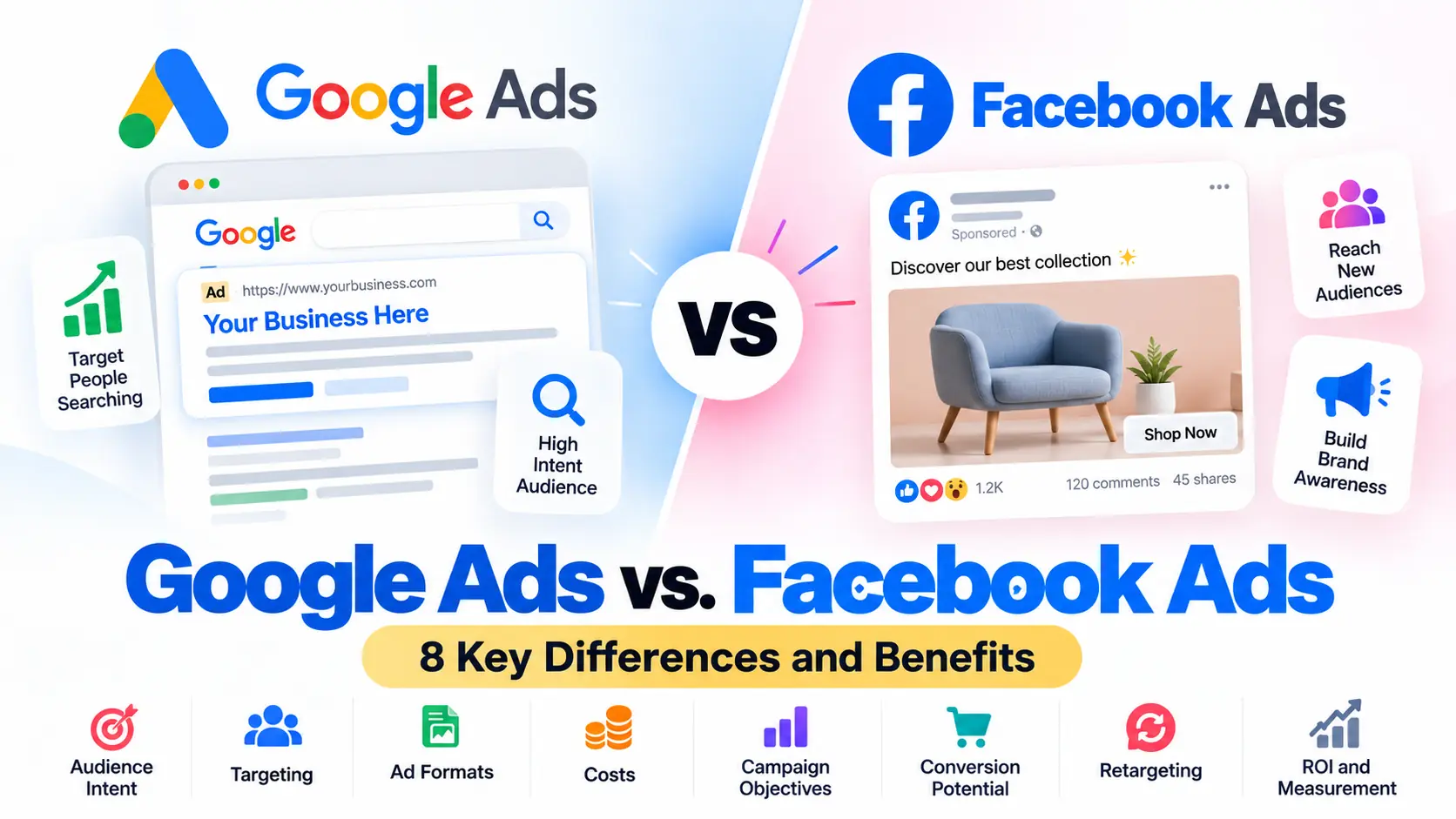
Every business wants more customers, more sales, and better results from its marketing budget. But when it comes to paid advertising, one question often comes up: should you invest in Google Ads or Facebook Ads?
Both platforms can help businesses reach potential customers, generate leads, and increase sales. However, they approach advertising differently. Google Ads can connect your business with people who are actively searching for products or services, while Facebook Ads can introduce your brand to people who may be interested in what you offer, even when they are not looking for it.
That difference matters more than many advertisers realize.
Imagine you run a plumbing business. Someone searching Google for an emergency plumber may need your service immediately. Now imagine you sell handmade jewellery. A person scrolling through Facebook may discover your designs, become interested, and decide to purchase something they had not planned to buy.
Both campaigns can be successful, but they reach people at different moments in the buying journey.
In this guide, we will compare Google Ads vs. Facebook Ads across eight important differences, including audience targeting, advertising costs, formats, customer intent, campaign objectives, and return on investment. You will also learn the advantages of each platform, when to use them, and how combining both can help your business grow.
What Are Google Ads?
Google Ads is Google’s online advertising platform. Businesses can use it to promote products and services across supported Google properties and advertising networks.
One of its best-known formats is the Search ad. These ads can appear when someone searches Google for a relevant product, service, or solution.
For example, a person searching for “best website hosting for small business” may see sponsored results from hosting companies. If your business offers a relevant service, you can compete to show an ad for that search.
Google Ads also supports other campaign types, including Shopping, Display, Video, and Performance Max. Depending on the campaign type and settings, ads may appear on Google Search, YouTube, partner websites, and other eligible placements.
Benefits of Google Ads
- Reach people searching for products or services like yours.
- Target relevant searches using keywords and campaign settings.
- Generate leads, sales, website visits, or other measurable actions.
- Promote products with supported Shopping ad formats.
- Reach customers in selected locations.
- Measure campaign performance and optimize spending.
Google Ads can be particularly useful when people already understand their problem and are actively looking for a solution.
Official resource: Google Ads.
What Are Facebook Ads?
Facebook Ads are paid advertisements delivered through Meta’s advertising platform. Advertisers generally create and manage these campaigns using Meta Ads Manager, which can offer placements across Facebook, Instagram, Messenger, and other eligible inventory, depending on the campaign and placement settings.
Unlike a typical Google Search ad, a Facebook ad does not necessarily depend on someone searching for a specific product. It can appear while someone is scrolling through their Feed, watching videos, viewing Stories, or exploring other content.
Suppose you own a clothing brand. You can use attractive product photographs, videos, customer testimonials, or a carousel to introduce your collection to a relevant audience.
The person seeing your ad might not be shopping at that moment. Your creative needs to earn their attention and give them a reason to learn more.
Benefits of Facebook Ads
- Introduce your brand to potential customers.
- Use images, videos, carousels, and other supported creative formats.
- Reach audiences using available demographic, geographic, interest, and other targeting options.
- Promote offers, launches, events, and seasonal campaigns.
- Build awareness and encourage engagement.
- Reach eligible previous website visitors or engaged audiences through remarketing options, subject to privacy and platform requirements.
Facebook Ads can be especially useful when your product benefits from visual presentation, your audience is identifiable, or you want to create interest in something people may not already be searching for.
Official resource: Meta for Business.
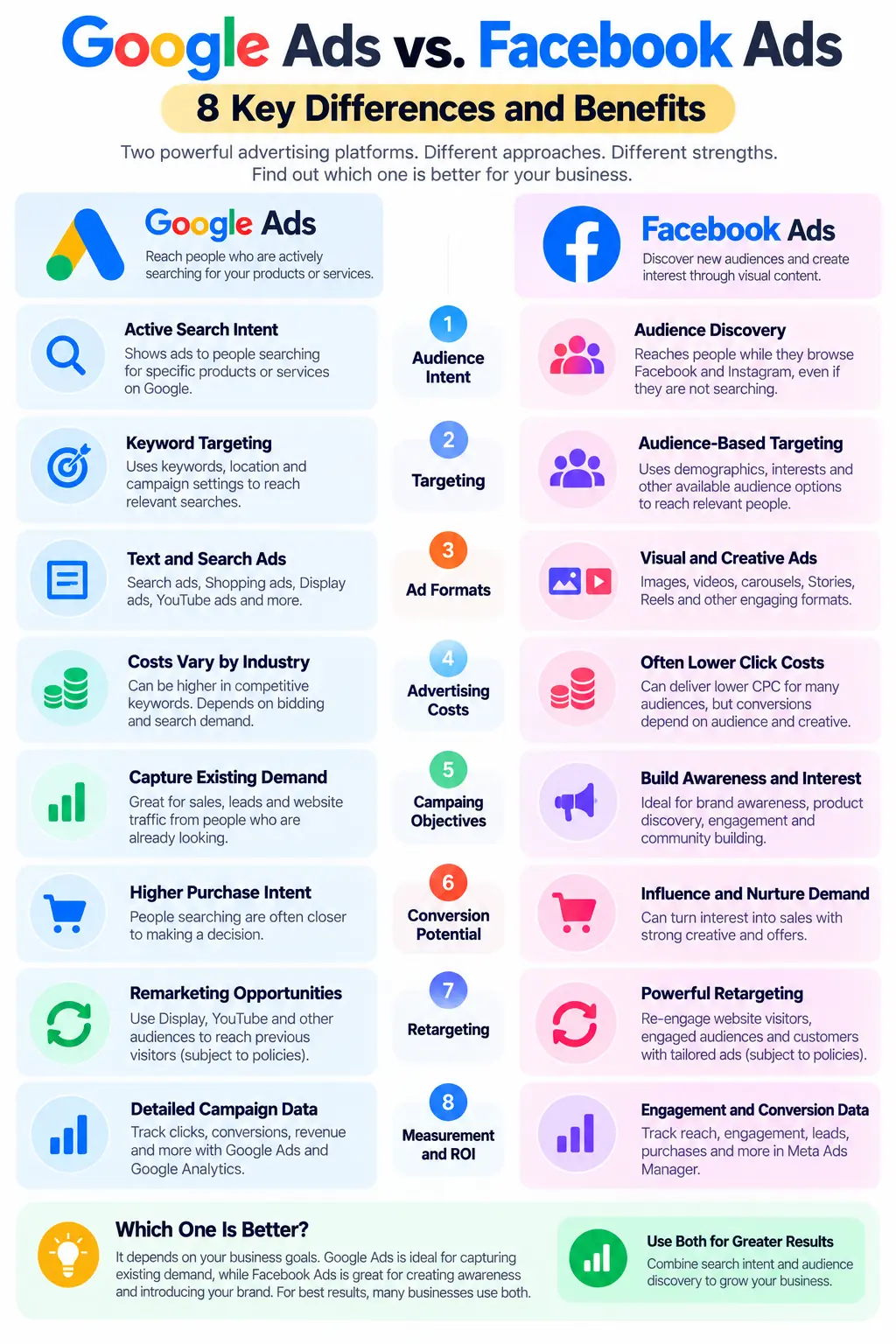
Google Ads vs. Facebook Ads: Quick Comparison
Here is a side-by-side overview before we explore the eight key differences.
| Comparison | Google Ads | Facebook Ads |
|---|---|---|
| Main strength | Capturing existing search demand | Discovering and creating demand |
| Audience intent | Often higher for relevant Search queries | Often exploratory or interest-based |
| Targeting | Keywords, location, audiences, and other campaign signals | Audience settings, interests where available, and other targeting signals |
| Common creative | Search text, product listings, display and video ads | Images, videos, carousels, Stories and other supported formats |
| Best-known use cases | Search-led sales, enquiries, urgent needs | Brand awareness, product discovery, visual storytelling |
| Cost model | Depends on campaign type and bidding strategy | Depends on campaign type, auction, bidding strategy, and delivery |
| Measurement | Conversions, leads, sales, clicks, and other metrics | Conversions, leads, sales, reach, engagement, and other metrics |
| Main challenge | Competition, search intent, and keyword relevance | Creative quality, audience fit, and converting interest into action |
Neither platform is automatically cheaper or better. The right choice depends on your business, audience, offer, competition, and ability to turn advertising traffic into customers.
8 Key Differences Between Google Ads and Facebook Ads
1. Audience Intent: Active Search vs. Content Discovery
The most important difference between Google Ads and Facebook Ads is the reason people encounter an advertisement.
Google Search ads can reach people when they actively search for something. Facebook Ads can reach people while they browse content, whether or not they are currently shopping.
Google Ads: Capture existing demand
Consider someone searching for “buy office chair online.” That search suggests a specific need. The person may be comparing products, checking prices, or preparing to make a purchase.
A relevant Google Search campaign can place your offer in front of that person at the right moment.
This makes Google Ads valuable for businesses selling products and services that customers already search for.
Examples include:
- Emergency repair services
- Website hosting
- Accounting software
- Dental appointments
- Home renovation services
- Products with established search demand
Facebook Ads: Generate interest and demand
Now imagine a person scrolling through Facebook who sees a video showing a beautifully designed ergonomic chair. They were not searching for a chair, but the video may introduce a product they would like to own.
That is the opportunity Facebook Ads creates.
It can help businesses introduce unfamiliar products, communicate their value, and encourage people to consider a purchase.
Examples include:
- Fashion and accessories
- New consumer products
- Home décor
- Food and lifestyle brands
- Events and product launches
- Products that benefit from demonstrations
Which is better?
Choose Google Search ads when customers already search for what you sell. Consider Facebook Ads when you need to introduce your product, demonstrate its benefits, or create interest among a relevant audience.
2. Audience Targeting: Keywords vs. Audience Signals
Both advertising platforms offer targeting options, but they approach audience selection differently.
Google Ads targeting
For Search campaigns, keywords help connect ads with relevant search queries. You can also configure settings such as location, language, audience signals, and other options appropriate to the campaign.
For example, a local interior design company might target searches related to interior designers in its service area.
The goal is to reach people whose searches suggest that they need the company’s services.
However, choosing a keyword does not guarantee that every matching search will produce an ad impression or a customer. Competition, bids, relevance, budget, and other factors affect delivery.
Facebook Ads targeting
Facebook Ads offers audience controls that can help advertisers reach people based on factors such as location, age where permitted, interests where available, and other supported signals.
For example, a fitness brand might use video advertisements to reach a relevant audience interested in fitness content.
Advertisers may also be able to use custom audiences and lookalike audiences, subject to Meta’s eligibility requirements and policies.
A custom audience can help a business reach eligible people who have previously interacted with it. Lookalike audiences can help identify new people who resemble a source audience.
These tools are subject to privacy restrictions, data availability, and changing platform capabilities. Not every targeting option is available in every market or for every campaign.
Which is better?
Google Ads is useful when you can identify valuable search terms that indicate a need. Facebook Ads is useful when you can define a relevant audience and have creative content that appeals to it.
The quality of your targeting matters more than the number of targeting options available.
3. Ad Formats: Search Listings vs. Visual Storytelling
The way an advertisement looks can influence whether someone notices it and understands its value.
Google Ads and Facebook Ads support different creative approaches, although both platforms now offer multiple formats.
Google Ads formats
Depending on your campaign, Google Ads can include:
- Search ads with headlines and descriptions
- Shopping ads featuring product information and images
- Display ads
- YouTube video ads
- Performance Max campaigns that can serve across eligible Google inventory
Search ads are especially useful for communicating a clear offer to someone who has already expressed an interest through a query.
For example:
Need Reliable Web Hosting? Compare Plans and Find the Right Solution for Your Website.
The message connects directly with a potential customer’s search.
Facebook Ads formats
Facebook Ads supports a range of creative formats, including:
- Single-image ads
- Video ads
- Carousel ads
- Stories and Reels placements
- Collection formats where supported
- Lead-generation ads and other objective-specific formats
These formats let businesses demonstrate products, explain benefits, tell stories, and communicate visually.
For example, a skincare brand could create a short video showing how a product fits into a daily routine. A furniture store might use a carousel to display different designs.
Which is better?
If your offer can be explained clearly through a relevant search ad, Google Search may be a natural starting point. If the product needs demonstration or visual appeal, Facebook Ads may provide a more suitable creative environment.
Neither platform is limited to one format, so choose based on the campaign rather than the platform’s name alone.
4. Advertising Costs: Which Platform Is Cheaper?
Many advertisers compare Google Ads and Facebook Ads by looking at cost per click (CPC). That can be useful, but it does not tell the whole story.
Google Ads can be expensive in competitive industries where many businesses bid for the same valuable searches. Facebook Ads may deliver inexpensive clicks for some audiences, but a cheap click is not necessarily a valuable customer.
Actual costs vary by country, industry, audience, campaign objective, competition, bidding strategy, creative quality, and conversion performance.
How Google Ads costs work
Google Ads uses different bidding and charging arrangements depending on the campaign and strategy. Some campaigns focus on clicks, while others optimize toward conversions, conversion value, or other outcomes.
For example, a business bidding on highly competitive commercial keywords may pay substantially more per click than a business advertising a less competitive service.
That expense may still be worthwhile if the clicks generate profitable sales.
How Facebook Ads costs work
Facebook Ads also uses an advertising auction. Costs depend on factors such as audience competition, campaign objective, placement, bidding strategy, and ad performance.
An advertiser may pay for impressions or optimize toward clicks, leads, purchases, or other actions, depending on the campaign setup.
A lower CPC can be attractive, but if the traffic rarely converts, the campaign may not be profitable.
Compare business results, not just clicks
Suppose two campaigns each spend ₹10,000.
- Campaign A generates 200 clicks and 10 sales.
- Campaign B generates 500 clicks and 5 sales.
Campaign B has a lower cost per click, but Campaign A produces more sales from the same advertising spend.
This simplified example illustrates why CPC alone is not enough to decide which platform is better.
Track metrics such as:
- Cost per qualified lead
- Cost per acquisition (CPA)
- Conversion rate
- Revenue generated
- Return on ad spend (ROAS)
- Profit after advertising costs
Which is better?
Neither platform is consistently cheaper for every business. Compare the cost of acquiring a valuable customer, not simply the price of bringing someone to your website.
5. Campaign Objectives: Capturing Demand vs. Building Awareness
Your advertising objective should influence which platform you choose.
Google Ads objectives
Google Ads supports campaign objectives and bidding approaches designed for outcomes such as sales, leads, website traffic, app promotion, and awareness, depending on campaign type.
For example, a local electrician might want phone calls or quote requests from people searching for electrical services.
An online store may want to attract shoppers searching for a specific product.
In both cases, the business can connect its campaign with a measurable action.
Facebook Ads objectives
Facebook Ads can support objectives such as awareness, traffic, engagement, leads, app promotion, and sales, depending on the campaign options available.
For example, a new clothing brand could use Facebook and Instagram placements to introduce a collection, encourage people to visit its website, or promote a limited-time offer.
A local business could also use lead-generation advertising to collect enquiries from interested customers.
A practical distinction
Google Search is often effective for capturing demand that already exists. Facebook Ads can be useful for creating awareness, generating interest, and reaching people who may become customers later.
However, both platforms can support multiple stages of the customer journey. Google Ads can build awareness through eligible campaign types, while Facebook Ads can generate direct sales when the audience, offer, and purchase process are right.
Which is better?
Start with the platform and campaign type that best match your business objective. Do not choose a traffic campaign if your real goal is qualified leads, and do not judge an awareness campaign only by immediate sales.
6. Conversion Potential: When Are People Ready to Buy?
A click is only one step in the customer journey. What happens after the click is what matters to the business.
Google Ads and purchase intent
A person searching for a specific product or service may be closer to making a decision than someone who has never encountered the brand.
For example, someone searching for “book an AC repair service today” has expressed a clear need. A relevant ad and a useful landing page may help that person contact a provider.
However, search intent is not a guarantee of a sale. Some users are researching, comparing prices, looking for information, or simply browsing.
Facebook Ads and the customer journey
Facebook Ads may reach people earlier in their decision-making process.
A person who sees a product video might click out of curiosity, save the product for later, or purchase immediately. Others may need several interactions before they feel ready to buy.
This makes creative quality, the offer, landing-page experience, and follow-up especially important.
Improve conversions on both platforms
Whichever platform you choose:
- Match the advertisement to the landing page.
- Make the main benefit clear.
- Keep forms short and relevant.
- Ensure the website works well on mobile devices.
- Explain pricing, delivery, or service details where appropriate.
- Use accurate conversion tracking.
- Remove unnecessary steps from the purchase process.
A poorly designed landing page can waste traffic from either platform.
Which is better?
Google Search may have an advantage when the customer is actively looking for a solution. Facebook Ads may be effective when a strong offer or creative presentation can turn interest into action. Measure the actual conversion results for your business.
7. Retargeting and Customer Relationships
Not everyone purchases the first time they encounter your business. Some visitors need more information, while others may return days or weeks later.
Retargeting can help advertisers reconnect with eligible audiences who have previously interacted with their business.
Retargeting with Google Ads
Depending on campaign type and eligibility, Google Ads can reach relevant audiences through supported placements such as Display and YouTube. Advertisers can use available audience tools to reconnect with people who have previously engaged with their business.
For example, someone who visits a product page but does not buy may later see an eligible reminder advertisement.
Retargeting with Facebook Ads
Meta supports retargeting options for eligible audiences, including certain website visitors, customers, and people who have engaged with a business’s content.
For example, a visitor who views a product collection could later see a relevant advertisement featuring the products or a related offer.
These features depend on consent, privacy rules, platform policies, available data, and implementation. Advertisers should not assume they can track every visitor or target every person.
Why retargeting matters
Retargeting can reinforce brand recognition and give potential customers another opportunity to consider an offer. It can also help businesses communicate relevant messages to different audience segments.
But frequency matters. Showing the same advertisement too often can annoy people, waste budget, and damage the customer experience.
Which is better?
Both platforms offer useful retargeting capabilities. Choose based on where your audience spends time, what data you can lawfully use, and which placements deliver measurable results.
8. Measurement, Reporting, and Return on Investment
The final difference is how you evaluate whether your advertising is working.
Both Google Ads and Facebook Ads provide reporting tools, but campaign metrics need to be interpreted in the context of your business goals.
Google Ads measurement
Depending on the campaign, you can monitor metrics such as impressions, clicks, conversions, conversion value, cost, and return on ad spend.
For example, a service business may track completed enquiry forms and phone calls. An online store may measure purchases and revenue.
Google Ads can also work with Google Analytics and other measurement tools to help businesses understand what visitors do after arriving at their websites.
Official resource: About conversion tracking in Google Ads.
Facebook Ads measurement
Meta Ads Manager reports campaign performance across supported objectives and placements. Metrics can include reach, impressions, clicks, leads, purchases, and other outcomes.
Businesses may also use Meta Pixel and the Conversions API where appropriate and configured in accordance with privacy requirements.
Official resource: Meta Business Tools.
Why attribution matters
Imagine a customer first discovers your brand through a Facebook ad, visits your website, and later searches for your business on Google before purchasing.
Which platform deserves credit for the sale?
The answer depends on the measurement and attribution methods used. Different platforms can report the same conversion differently because they use different attribution settings, reporting windows, and available signals.
This is why you should not simply add the conversions reported by both platforms and assume they represent unique customers.
Where possible, compare advertising reports with your own sales records, analytics, and customer relationship management data.
Which is better?
Neither platform automatically provides a complete picture of every customer’s journey. Use consistent conversion definitions, check attribution settings, and evaluate performance against actual business results.
Google Ads vs. Facebook Ads: Which Is Better for Your Business?
The best platform depends on what you sell, who your customers are, and how they make purchase decisions.
Here are some common scenarios.
| Business type or goal | Potential starting point | Why |
|---|---|---|
| Emergency repair services | Google Search Ads | Customers may actively search for immediate help |
| Online store with established search demand | Google Ads | Search and Shopping campaigns may capture purchase intent |
| New fashion or lifestyle brand | Facebook Ads | Visual content can introduce products to relevant audiences |
| Local event promotion | Facebook Ads | Audience-based promotion can build awareness and interest |
| Business software | Google Ads | Potential customers may search for specific solutions |
| New product with little search demand | Facebook Ads | Creative can explain the product and create interest |
| Local service business | Test both where feasible | Search can capture active demand; social ads can build awareness |
| Established brand with reliable tracking | Both platforms | Each can support a different part of the customer journey |
These are starting points, not universal rules. A fashion brand can perform well on Google Shopping, and a service company can generate leads from Facebook Ads. Use your own conversion data to validate the choice.
Can You Use Google Ads and Facebook Ads Together?
Yes. In many cases, combining both platforms can provide a more complete advertising strategy.
Instead of treating them as competitors, consider how each can contribute to the same customer journey.
For example, imagine you own an online store selling home décor products.
Step 1: Introduce Your Brand Through Facebook Ads
Create attractive product videos or carousel ads to introduce your collection to a relevant audience.
Your goal may be to build awareness, generate qualified website visits, or encourage people to explore specific products.
Step 2: Capture Active Demand Through Google Ads
Use relevant Google Search or Shopping campaigns, where suitable, to reach people actively searching for products you sell.
This helps your business compete for demand that already exists.
Step 3: Reconnect With Interested Visitors
Use eligible remarketing audiences on the platforms where they are available and appropriate.
For example, someone who viewed a product but did not purchase may see another relevant advertisement later.
Step 4: Measure the Full Customer Journey
Track purchases, qualified leads, revenue, and customer acquisition costs.
Avoid assuming that every conversion attributed to one platform was generated entirely by that platform. A customer may have encountered several advertisements before purchasing.
Step 5: Adjust Spending Based on Results
Increase spending on campaigns that produce profitable results, and improve or pause campaigns that do not meet your goals.
Do not split your budget equally just because you are using two platforms. Allocate spending according to opportunity, performance, and the amount of data available.
How to Choose the Right Advertising Platform
Before spending money, answer these questions.
1. Are People Already Searching for Your Product?
Use keyword research and customer feedback to understand whether potential buyers actively search for what you sell.
If relevant search demand exists, Google Ads may be a logical starting point.
If your product is unfamiliar or people do not yet know they need it, audience-based advertising may help you introduce it.
2. Can You Explain Your Offer Visually?
If your product looks impressive, needs a demonstration, or benefits from storytelling, Facebook Ads may be a useful option.
If customers mainly need a clear answer, comparison, price, or service provider, a relevant Search campaign may be more suitable.
3. What Is Your Budget?
Set a budget you can sustain long enough to collect meaningful performance data.
Avoid spreading a small budget across too many campaigns, audiences, keywords, and creative variations. Start with a manageable test and improve it based on evidence.
There is no universal minimum budget that guarantees success. The amount you need depends on your industry, conversion costs, sales cycle, and testing objectives.
4. Can You Track Meaningful Results?
Before launching, decide what counts as success.
For an online store, that might be a completed purchase. For a service company, it might be a qualified enquiry rather than a simple website visit.
Set up appropriate conversion measurement so you can evaluate campaigns based on outcomes rather than impressions alone.
5. Is Your Website Ready for Paid Traffic?
Advertising cannot compensate for a confusing website, an unclear offer, slow pages, or a difficult checkout process.
Make sure your landing pages explain what you offer, answer likely questions, and provide a clear next step.
For businesses that also rely on organic search, our guide on how to make your website a preferred source on Google Search discusses visibility in Google’s search ecosystem. Organic search visibility and paid advertising are different channels, but both benefit from useful content and a trustworthy website.
Common Mistakes to Avoid With Google Ads and Facebook Ads
Even a well-known advertising platform can waste money when campaigns are poorly planned.
Choosing a Platform Only Because Clicks Are Cheap
Low CPC does not automatically mean high profitability. Compare qualified leads, sales, customer acquisition costs, and revenue.
Using the Same Creative Everywhere
A message designed for someone actively searching may not work as a Facebook Feed ad.
Adapt your creative to the platform, audience, and context in which people encounter it.
Sending Everyone to the Homepage
A dedicated landing page that matches the advertisement can make it easier for visitors to understand the offer and take action.
If an ad promotes a specific service, send visitors to the relevant service page rather than making them search your website for it.
Ignoring Conversion Tracking
Without reliable tracking, you may optimize for clicks that never become customers.
Set up the appropriate measurement tools and verify that conversions are recorded correctly before making major spending decisions.
Expecting Instant Results From Every Campaign
Some campaigns can produce results quickly, but others need time to collect data and test different approaches.
Do not make large decisions based on a handful of clicks. At the same time, do not keep funding a campaign indefinitely without reviewing performance.
Forgetting the Customer Experience
Misleading claims, unclear pricing, intrusive follow-ups, and excessive advertising can harm trust.
The best campaign is not simply the one that attracts attention. It is the one that makes a relevant promise and delivers a good experience after the click.
Frequently Asked Questions
1. Is Google Ads better than Facebook Ads?
Neither platform is better for every business. Google Ads can be particularly useful for reaching people who actively search for a product or service. Facebook Ads can help introduce products, build awareness, and reach relevant audiences while they browse social content.
2. Which platform is cheaper?
Costs vary by industry, audience, campaign type, competition, and conversion performance. Facebook Ads may generate cheaper clicks in some situations, while Google Ads may produce more valuable leads for certain search terms. Compare the cost of acquiring a customer rather than CPC alone.
3. Which platform is better for small businesses?
A small business should start with the channel that best matches its customers’ behavior and available budget. A local plumber may benefit from Google Search ads, while a new handmade-products brand may find Facebook Ads useful for visual discovery. Testing both can help when the budget allows.
4. Can Facebook Ads generate direct sales?
Yes. Facebook Ads can drive purchases when the audience, creative, offer, website, and campaign objective are aligned. However, results depend on the product and campaign execution.
5. Can Google Ads build brand awareness?
Yes. Although Search ads are often used to capture existing demand, Google Ads also supports campaign types designed for awareness and reach, including eligible video and display campaigns.
6. Should I use both platforms at the same time?
You can, provided you have the budget, conversion tracking, and resources to manage them properly. Google Ads can capture existing demand while Facebook Ads introduces your brand to potential customers and supports retargeting.
7. How do I measure which platform gives the best ROI?
Track conversions, qualified leads, revenue, cost per acquisition, and return on ad spend. Consider profit margins and customer value as well. Compare results over a meaningful period and account for differences in attribution reporting.
Final Verdict: Google Ads vs. Facebook Ads
Google Ads and Facebook Ads serve different but complementary purposes.
Google Ads can help you reach people who are actively looking for a solution. Facebook Ads can help your business reach relevant audiences, introduce products, tell stories, and create interest before a person begins searching.
If customers already know what they need and search for it regularly, Google Ads may be the better place to start. If your product benefits from visual storytelling, audience discovery, or a compelling introduction, Facebook Ads may be a strong choice.
For businesses with sufficient resources and reliable measurement, using both platforms can be more effective than relying on a single channel.
The most important lesson is simple: do not choose an advertising platform based on popularity or click prices alone. Choose it based on customer intent, campaign objectives, and the results it produces for your business.
Start with a clear goal, test a focused campaign, measure real outcomes, and improve your strategy using evidence.
Helpful Official Sources
- Google Ads — Explore Google’s advertising platform and campaign options.
- Google Ads Help — Learn about campaign objectives, bidding, and conversion tracking.
- Meta for Business — Explore Facebook and Instagram advertising solutions.
- Meta Business Help Center — Find guidance on campaign setup, audiences, measurement, and advertising policies.
Related Articles on SimplyIrfan
- How to Use Facebook: A Beginner’s Guide — Learn Facebook’s core features and how to use the platform.
- Facebook Demographics — Explore Facebook’s audience and demographic considerations.
- Facebook Page Posts — Learn more about publishing content on Facebook Pages.
- How to Make a Facebook Post Shareable — Understand post visibility and sharing settings.
- Social Media Campaign Ideas for Facebook — Find ideas for planning Facebook campaigns.
- How to Make Your Website a Preferred Source on Google Search — Explore ways to improve your website’s search presence.
- How Old Is Google? A Journey Through Time — Discover Google’s history and development.

you may also read,