
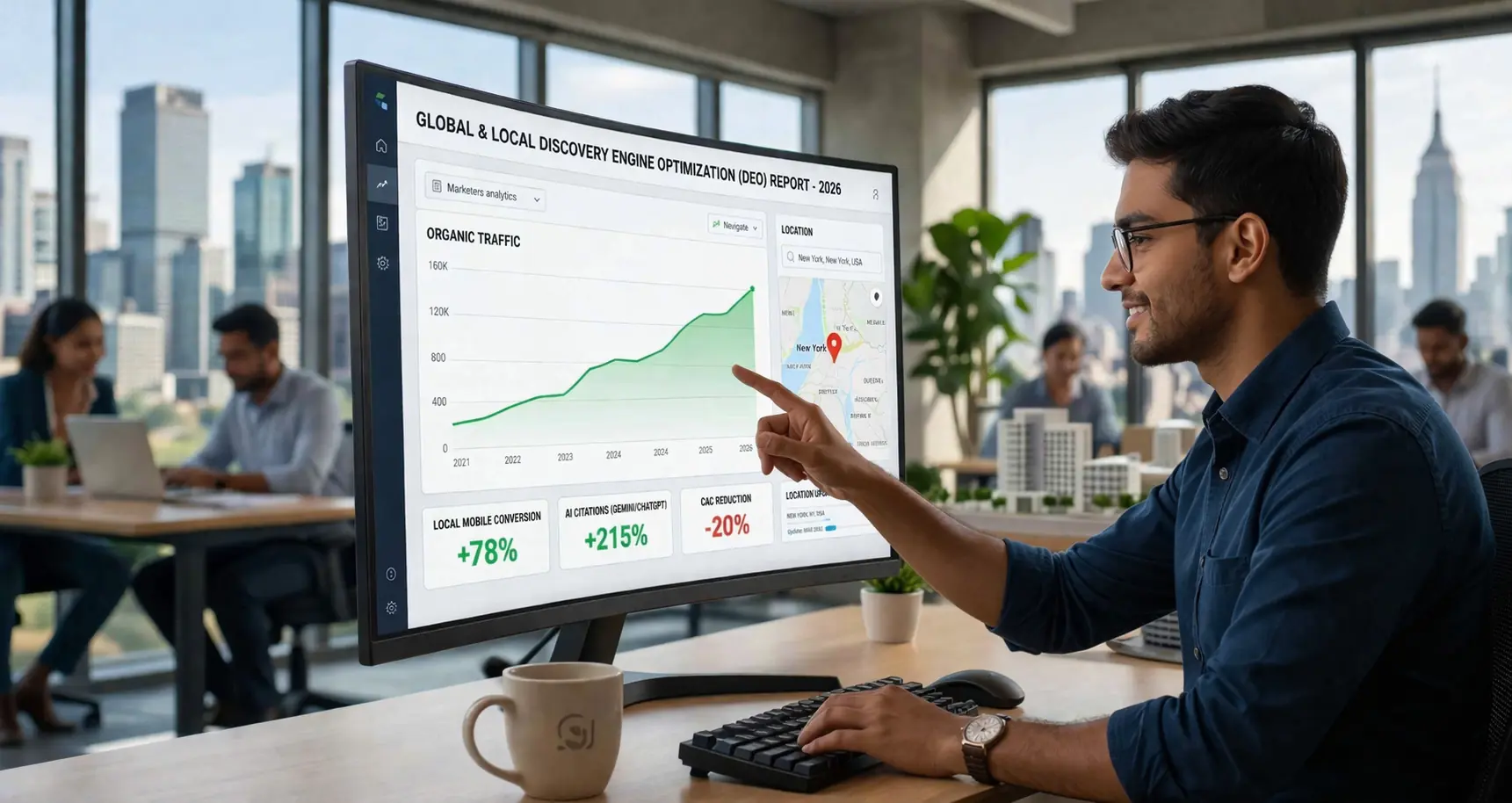

TL;DR: Why SEO Still Rules in 2026
- Trust is the New Currency: In an age of AI-generated noise, ranking organically proves you’re a real, trusted authority.
- AI Integration: SEO isn’t just for Google anymore; it’s about being the “cited source” for AI models like Gemini and ChatGPT.
- Efficiency: While PPC costs have jumped 15-20% in many industries, SEO remains a compounding asset with a decreasing cost-per-lead.
- Local Dominance: Over 46% of searches have local intent, and 78% of those on mobile lead to an offline purchase within 24 hours.
The Hidden Truth About SEO in 2026
I remember sitting in a coffee shop back in 2022, listening to a “guru” proclaim that SEO was dying. Fast forward to 2026, and not only is it alive, but it’s the backbone of the digital economy.
If you’re running a business today, you’ve likely noticed that the digital landscape feels… crowded. It’s like trying to be heard at a rock concert where everyone has a megaphone.
Ads are getting pricier, social media algorithms are more unpredictable than the weather, and AI is changing how we find answers. But here’s the secret: SEO has evolved into something much more powerful than just “ranking for keywords.”
It’s now about Discovery Engine Optimization (DEO). It’s about being the answer when someone asks their glasses, their car, or their AI assistant for help.
In this guide, we’re going to dive deep into 40 SEO benefits that are actually moving the needle for businesses this year. No fluff, no “keyword stuffing” lectures—just real talk between friends about why this matters for your bottom line.
What Is SEO and Why it is Important?
At its heart, SEO (Search Engine Optimization) is the art and science of making your business “findable.” In 2026, it’s not just about Google. It’s about appearing in AI Overviews, TikTok search, Reddit threads, and Apple Maps.
Why it is important?
Because search is the only channel where the customer comes to you with a specific problem.
When someone searches for “emergency plumber near me” or “best CRM for small agencies 2026,” they aren’t just browsing. They are in the “buying window.” SEO ensures you are standing right there when they open that window
Recommended: How SEO for small businesses work in 2026
The 4 Pillars of SEO in 2026
To win today, you need to balance four specific areas. Think of these as the legs of a table; if one is weak, the whole thing wobbles.
- Technical SEO: This is the “under the hood” stuff. Is your site fast? Is it secure? Can AI agents crawl it without getting stuck?
- Content & User Experience: It’s not just about words. It’s about providing the most helpful, easy-to-read answer. If a user lands on your page and leaves in three seconds, Google notices.
- On-Site Optimization: This is how you signal to search engines what your page is about. It includes your titles, meta descriptions, and how you structure your data.
- Off-Site Authority (The “Trust” Pillar): This is what the rest of the web says about you. Backlinks, brand mentions on Reddit, and high-quality reviews are your digital “street cred.”
40 SEO Benefits for Your Business in 2026
1. AI Discovery & Cites
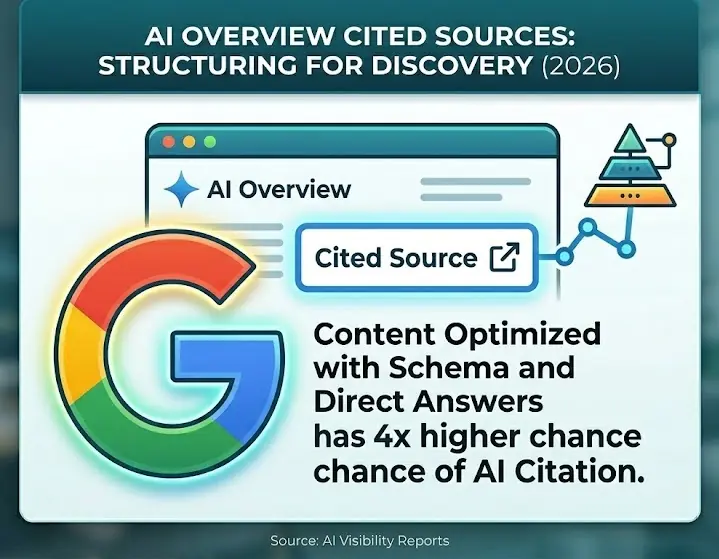
In 2026, AI models like Gemini and ChatGPT are the new “front page.” SEO ensures your content is structured so these models cite your business as the primary source.
2. Drastically Lower Customer Acquisition Cost (CAC)
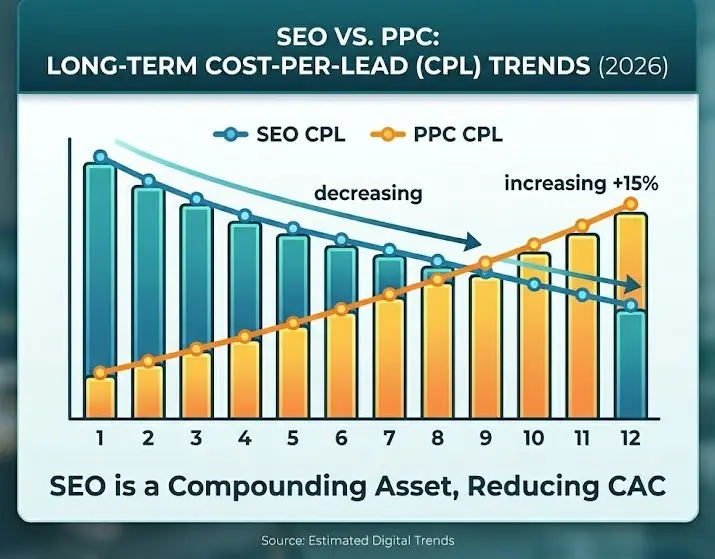
Paid ads are like a faucet; turn off the money, and the water stops. SEO is like digging a well. It takes work upfront, but eventually, the “water” (traffic) flows for free.
3. Local SEO Benefits: Winning the “Near Me” War
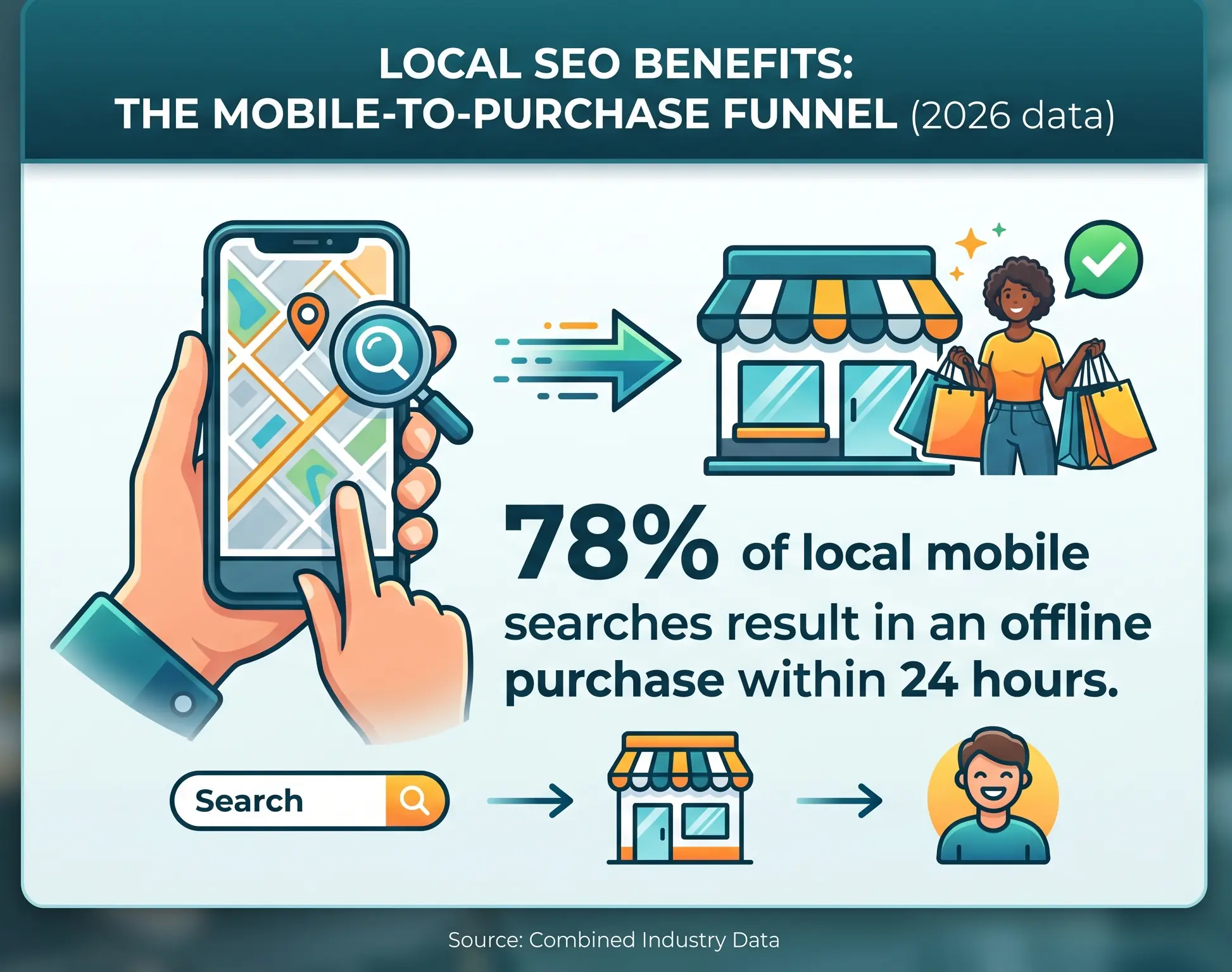
Recent data shows that 30% of all mobile searches are related to location. If you’re a local business, SEO isn’t an option—it’s your digital storefront.
4. Compounding ROI
Unlike an ad campaign that ends on Friday, a high-ranking blog post can bring in leads for years. I have clients still getting sales from articles written in 2023.
5. Building “Inherent” Trust
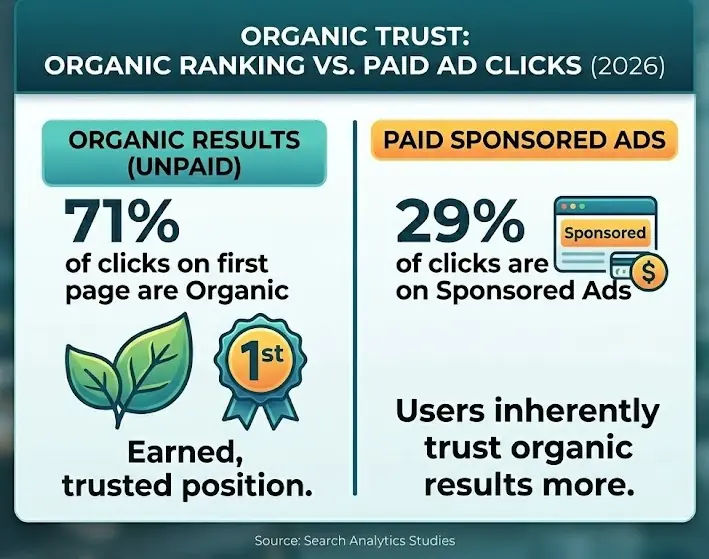
Let’s be honest: we all skip the “Sponsored” links sometimes. Ranking #1 organically tells the user, “This company didn’t just pay to be here; they earned it.”
6. Better User Experience (UX)
SEO forces you to have a fast, mobile-friendly site. By optimizing for Google, you’re accidentally making your site much better for your actual customers.
7. Sustainability Against Algorithm Shifts
While social media platforms can go “dark” or change their feed overnight, a diversified SEO strategy provides a stable foundation that survives the “trend of the week.”
8. High-Intent Traffic
People don’t search for “how to fix a leaky pipe” for fun. They have a problem. SEO brings you people who are ready to spend money to solve that problem.
9. Global Reach with Local Nuance
You can run a business from a garage in Lucknow and sell to a client in London. SEO removes the geographical barriers that used to limit small businesses.
10. Insights Into Your Customer’s Brain
Google Search Console is essentially a direct line into your customers’ thoughts. You can see exactly what questions they are asking, allowing you to pivot your products or services.
11. Short-Form Video Visibility
In 2026, Google indexes TikToks and Reels. SEO helps your videos show up in search results, giving your content a second life.
12. Dominating “Zero-Click” Searches
Even if a user doesn’t click your link, seeing your brand name in an AI Overview or a Featured Snippet builds massive brand awareness.
13. Supporting the “Messy Middle” of Buying
Most people don’t buy the first time they see you. SEO provides the “how-to” guides and “comparison” articles that nurture them until they are ready to click “buy.”
14. Leveling the Playing Field
A small boutique can outrank a massive corporation if their content is more helpful and localized. Money can’t buy “helpfulness.”
15. Increased “Share of Voice”
The more spots you occupy on page one (videos, images, maps, snippets), the less room there is for your competitors.
16. Mobile Optimization Perks
Since 2026 search is 80% mobile, SEO ensures your business looks perfect on every screen size, from a phone to a smart watch.
17. Enhanced Brand Credibility
Multiple touchpoints in search results create a “halo effect.” If they see you everywhere they look, they assume you’re the industry leader.
18. Better Conversion Rates
SEO traffic is “pulled” in by the user, not “pushed” on them like a pop-up ad. This results in much higher conversion rates because the user wants to be there.
19. Synergizing with PPC
When you rank organically for a term you’re also bidding on, your total click-through rate (CTR) increases. It’s a 1+1=3 situation.
20. 24/7 Lead Generation
Your SEO doesn’t take sick days. It’s working at 3 AM on a Sunday when your sales team is asleep.
21. Protection Against Competitor Bidding
Competitors can “bid” on your brand name in ads, but they can’t steal your organic #1 spot for your own brand.
22. Accessibility Compliance
Good SEO (alt text, clear headings) makes your site accessible to visually impaired users, which is not only ethical but often a legal requirement in 2026.
23. Faster Site Speed
Core Web Vitals are a major ranking factor. Optimizing these makes your site feel “snappy,” which reduces bounce rates.
24. Integration with Voice Search
As more people use “Hey Siri” or “Alexa,” SEO ensures your conversational content is the one being read aloud.
25. Long-Tail Keyword Opportunities
Ranking for “shoes” is hard. Ranking for “best eco-friendly running shoes for flat feet in 2026” is easier and brings in a much more specific customer.
Related Article: SEO Strategy in 2026
26. Social Media Proof
Content that ranks well on Google often gets shared more on LinkedIn and X (Twitter), creating a viral loop.
27. Attracting Top Talent
Your future employees are searching for you, too. A strong SEO presence shows them you’re a modern, successful company they’d want to work for.
28. Better PR Results
Journalists use search to find experts. Being visible for your niche often leads to “unearned” media mentions and interview requests.
29. “Zero-Waste” Marketing
Unlike a billboard that 99% of people will ignore, SEO only shows your “message” to people who actually care about it.
30. Improved Inventory Management
By tracking search trends, you can predict what products will be popular next season and stock up accordingly.
31. Building an Asset, Not an Expense
Think of SEO as real estate. You are building equity in your domain name. A domain with high “Authority” is a sellable business asset.
32. Higher Trust in Reviews
Local SEO encourages a steady stream of Google reviews, which 88% of customers trust as much as personal recommendations.
33. Clarifying Your Business Message
The process of SEO forces you to define exactly what you do and who you do it for. If Google can’t understand you, your customers probably can’t either.
34. Adapting to “Visual Search”
In 2026, people “search” by taking a photo of an object. SEO for images (alt tags, high-res) ensures your products appear in these visual results.
35. Resilience During Economic Downturns
When budgets get cut, the first thing to go is the ad spend. If you have a strong organic foundation, your traffic won’t disappear when the “ad money” does.
36. Strengthening the Marketing Funnel
SEO provides content for every stage: Awareness (blog posts), Consideration (case studies), and Decision (product pages).
37. Multilingual and Global Growth
International SEO allows you to target different regions with translated, culturally relevant content without needing a physical office there.
38. Better Email Marketing
SEO-driven blog posts are the perfect “value add” for your newsletters, keeping your subscribers engaged without always “selling” to them.
39. Staying Ahead of the Curve
The world is moving toward “Semantic Search” (understanding meaning, not just words). SEO keeps your business tech-stack updated for the future.
40. Peace of Mind
There is nothing quite like waking up, checking your dashboard, and seeing that while you were sleeping, 500 people found your site and 5 of them became leads. That’s the power of SEO.
Comparison: SEO vs. PPC in 2026
| Feature | SEO (Organic) | PPC (Paid Ads) |
| Speed of Results | Slow (3-6 months) | Instant (Same day) |
| Cost over Time | Decreasing | Increasing (due to bidding) |
| Trust Level | High (Earned) | Medium (Paid) |
| Effort | High (Content/Technical) | Medium (Budget/Management) |
| Long-term Value | Permanent Asset | Temporary Traffic |
Additional Resource: SEM vs SEO vs PPC
Comparison: Traditional SEO vs. AI-Ready SEO (2026)
| Aspect | Traditional SEO | AI-Ready SEO (2026) |
| Goal | Rank #1 on Google | Be the “Chosen Source” for AI |
| Format | Text-heavy Blogs | Multi-modal (Video, FAQ, Schema) |
| Keywords | Exact Match Phrases | Natural Language & Questions |
| Success Metric | Click-Through Rate | Brand Citations & Mentions |
FAQ: Everything You Need to Know
1. How long does it take to see SEO benefits in 2026?
Generally, you’ll start seeing “signals” (ranking for minor terms) in 3-4 months. For competitive keywords, expect 6-12 months. However, the wait is worth it for the long-term ROI.
2. Is local SEO worth it for online-only businesses?
Yes! Even if you don’t have a physical shop, targeting “local” clusters can help you dominate specific regions and build a more personal connection with your audience.
3. Do I need a blog for SEO?
You need helpful content. Whether that’s a blog, a video library, or a set of interactive tools, you must provide value that gives search engines a reason to rank you.
4. How does AI affect my SEO strategy?
AI is making search more “conversational.” This means you should focus on answering specific questions and using Schema Markup to help AI engines understand your data perfectly.
5. What are the most important SEO statistics for 2026?
- 46% of searches are local.
- 78% of local mobile searches result in an offline purchase.
- The first organic result gets roughly 24-28% of all clicks.
Conclusion: Your Move
SEO in 2026 isn’t a “set it and forget it” task. It’s a living, breathing part of your business. But here’s the good news: you don’t have to be a tech genius to start.
Start by being helpful. Answer the questions your customers are actually asking. Make sure your website doesn’t feel like a relic from 2010. Be consistent.
The benefits we’ve talked about—the trust, the lower costs, the AI visibility—they are all waiting for the businesses that show up and put in the work.
Ready to stop “renting” your traffic and start “owning” it?
Start with a simple technical audit today, or better yet, write one genuinely helpful article that solves a real problem for your customers. Your future self will thank you.
Looking to take your SEO to the next level? Sometimes a fresh set of eyes is all you need to find the “hidden” wins on your site. Don’t wait for the next algorithm update, start building your authority today!
Check: Schema markup generator