

TL;DR: The 2026 PPC Cheat Sheet
- The Big Shift: Automation is no longer optional; it’s the engine. Your job has shifted from “button pusher” to “data strategist.”
- Privacy is King: First-party data (your own customer emails and CRM data) is the most valuable lever for lowering CPC.
- Performance Max (PMax): It’s now the highest-ROAS campaign type, averaging a $4.12 return for every $1 spent.
- Video Dominance: TikTok and YouTube Shorts are driving the fastest YoY growth in ad revenue.
- Human Touch: AI handles the “how,” but humans must handle the “why” (the creative and the offer).
The New Era of Search: Why Your Old PPC Playbook is Costing You Money
Imagine you’re at a high-stakes poker table. You’ve got the best cards, a solid bankroll, and years of experience. But there’s a catch: the other players are using supercomputers to calculate every probability in milliseconds.
That is exactly what PPC (Pay Per Click) feels like in 2026.
If you’re still manually adjusting bids every Tuesday morning or obsessing over “Exact Match” keywords like it’s 2015, you aren’t just behind—you’re likely overpaying. The world of PPC strategy has moved from a game of manual control to a game of “teaching the machine.”
I remember working with a client a few years ago who was terrified of automation. They wanted to see every single search term. They wanted to set every bid to the penny. We spent 40 hours a month just “maintaining” the account.
Then, we let the AI take over the heavy lifting. We shifted our focus to high-quality creative and feeding better customer data back into the system. Within three months, their lead volume doubled, and their cost-per-lead dropped by 31%.
That’s the power of a modern PPC strategy. It’s not about doing more work; it’s about doing the right work.
The Foundations of a Winning PPC Strategy
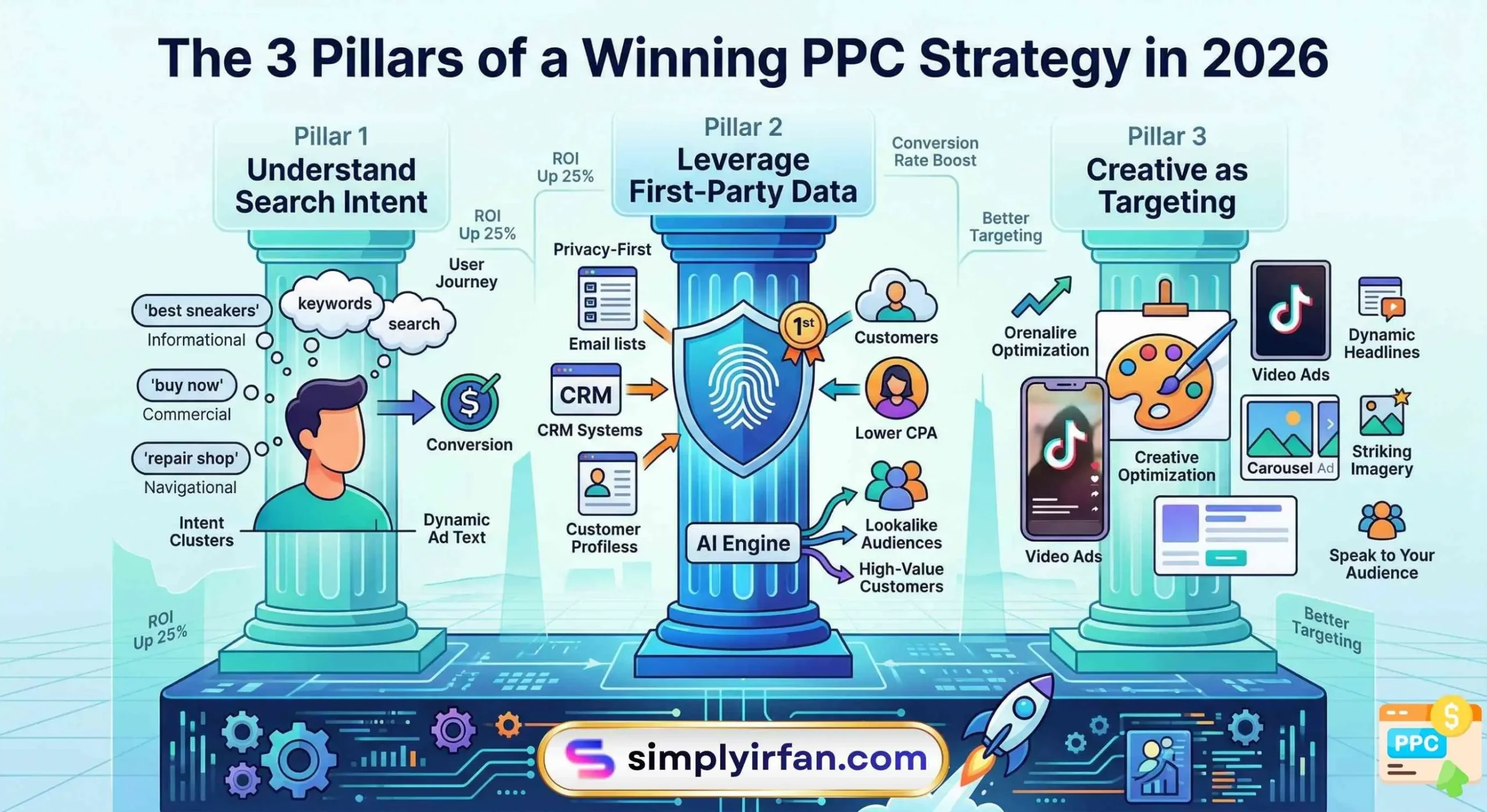
Before we dive into the “fancy” AI stuff, we need to talk about the bones of your campaign. A house built on sand will fall, no matter how many smart lightbulbs you install. In 2026, Pay Per Click success is built on three pillars: Intent, Data, and Creative.
1. Understanding Search Intent
In the past, we targeted keywords. Today, we target intent. When someone types “best sneakers,” are they looking for a review (informational) or a “buy now” button (commercial)?
Google’s AI is now so good at understanding this that “Exact Match” isn’t really exact anymore. It looks at the meaning behind the query. Your PPC strategy needs to account for this by grouping keywords by “intent clusters” rather than just similar words.
2. The Power of First-Party Data
Cookies are gone. The “Old Web” tracking is broken. If you want to reach your “best” customers, you have to tell the ad platforms who they are. By uploading your CRM lists (encrypted, of course), you allow the AI to find “lookalike” audiences that actually convert.
3. Creative as the New Targeting
In 2026, your ad copy and images do the targeting for you. If your ad speaks specifically to “Busy Moms in Austin,” the algorithm learns to show it to people who fit that profile based on how they interact with the ad.
PPC Strategy Comparison: Manual vs. Automated Bidding
Choosing the right bidding method is the most important decision you’ll make this year. Here is how they stack up in the current market:
| Feature | Manual Bidding | Smart Bidding (AI) |
| Control | Absolute control over every cent. | High-level control via targets (tCPA/tROAS). |
| Speed | Slow; requires human intervention. | Instant; bids change per auction. |
| Data Usage | Limited to what a human can track. | Analyzes millions of signals (location, time, device). |
| Best For | Brand new accounts with zero data. | Scalable growth and established accounts. |
| 2026 Performance | Often results in higher CPCs. | $2.87 average ROAS on Google Ads. |
Actionable Steps to Scale Your ROI Today
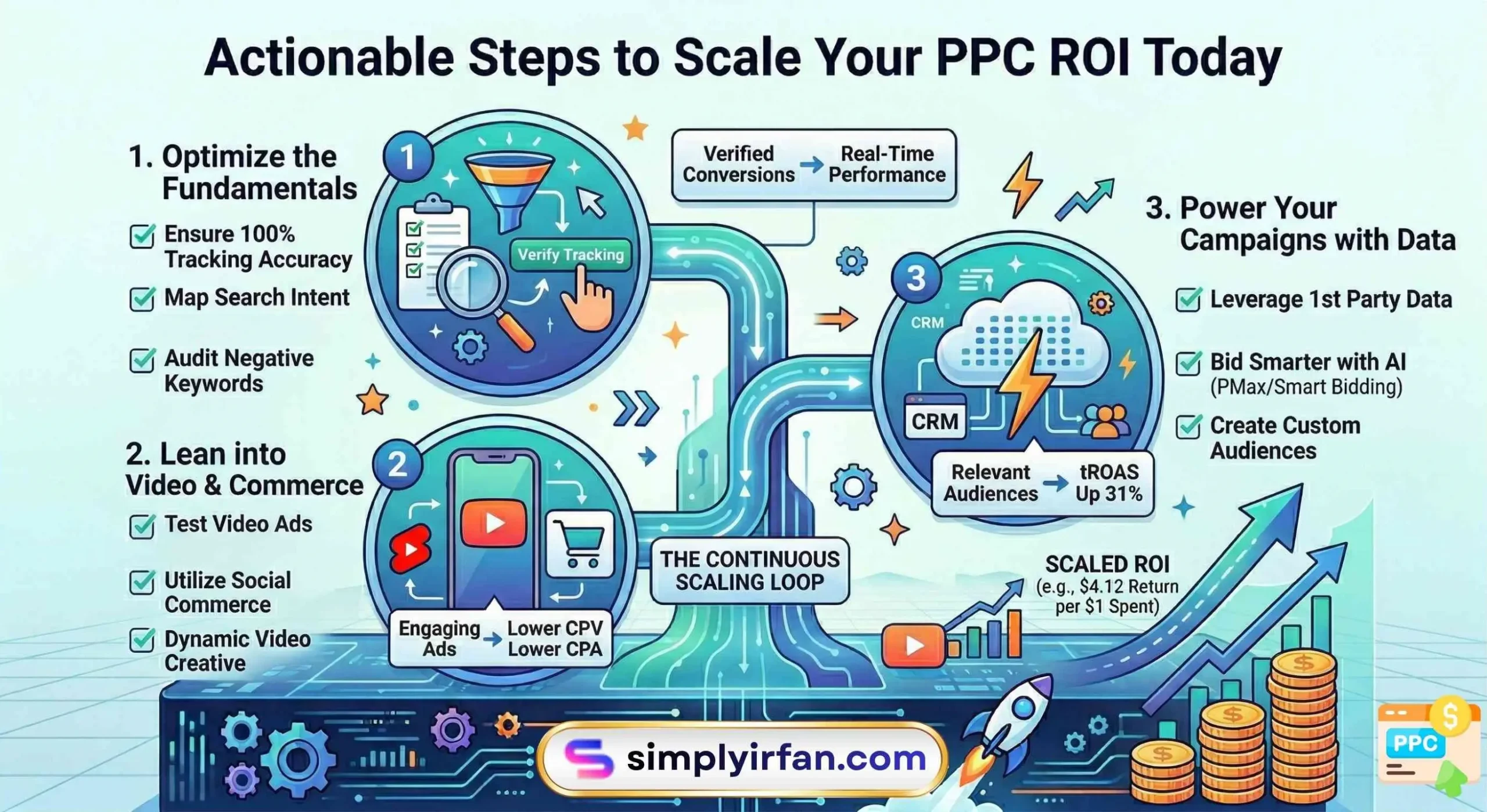
So, how do you actually build this out? Let’s get tactical. A successful PPC strategy isn’t a “set it and forget it” situation. It’s a “set it, feed it, and steer it” situation.
The “Feed the Machine” Method
Think of the AI as a very fast, very eager intern. If you give it bad instructions, it will do the wrong thing very quickly.
- Step 1: Conversion Tracking. Ensure your tracking is 100% accurate. If you tell the AI a “newsletter signup” is worth the same as a “$500 purchase,” it will spend all your money on signups.
- Step 2: Use Long Tail Keywords. While broad match is more powerful now, long tail keywords are still your secret weapon for lower costs. Instead of bidding on “Shoes,” bid on “Waterproof trail running shoes for wide feet.” These specific phrases have higher intent and usually a lower PPC cost.
- Step 3: Responsive Search Ads (RSAs). Give Google 15 headlines and 4 descriptions. Let it test the combinations. Statistics show that AI-generated responsive ads deliver a 31% lower cost-per-conversion than static ones.
The Rise of Video and Social Commerce
Don’t ignore the “new” PPC. Platforms like TikTok and YouTube have turned into direct-response powerhouses.
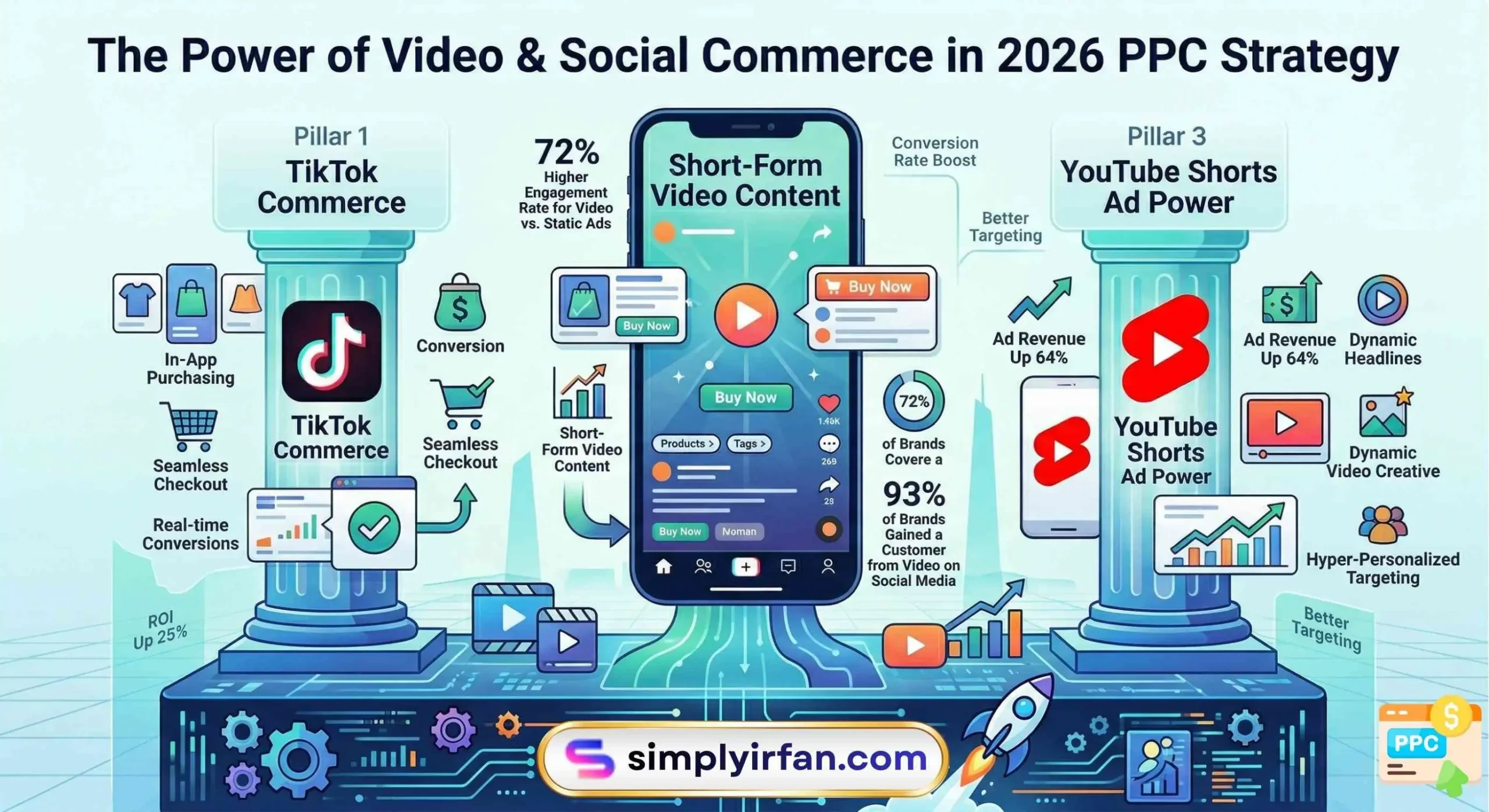
- TikTok Shop: This has completely changed the game for e-commerce. You can now run ads where the user buys the product without ever leaving the app.
- YouTube Shorts: With a 64% growth in ad revenue, these 15-second clips are the most cost-effective way to get your brand in front of a new audience right now.
In 2026, 68% of consumers say they feel positively toward a brand after seeing a well-timed, relevant ad. Relevance is more important than reach.
FAQ: Everything You Need to Know About PPC in 2026
1. What is the average CPC (Cost Per Click) in 2026?
While it varies wildly by industry, the global search ad spend has reached over $391 billion. Competition is higher, but because AI bidding is more efficient, the average revenue per $1 spent has actually risen to $2.87.
2. Is manual bidding dead?
Not entirely, but it’s on life support. Manual bidding is great for “testing the waters” or when you have a very limited budget and cannot afford any AI learning mistakes. However, for scaling, Smart Bidding is the clear winner.
3. How do long tail keywords help my PPC strategy?
Long tail keywords are more specific and less competitive. They allow you to capture users who are further down the “buying funnel.” Someone searching for “red leather office chair under $200” is much more likely to buy than someone just searching for “chairs.”
4. What is Performance Max (PMax)?
PMax is a “goal-based” campaign type that allows you to access all Google Ads inventory (Search, YouTube, Display, Gmail, Maps) from a single campaign. It relies heavily on AI to find conversions where they are cheapest.
5. How does first-party data affect my Pay Per Click ads?
Since third-party cookies are being phased out, using your own customer data (emails, purchase history) allows you to create “Customer Match” lists. This helps the platform find your ideal customers more accurately, often leading to a 52% higher conversion rate.
Conclusion: The Future is Automated, but the Strategy is Human
At the end of the day, PPC isn’t about the tech—it’s about the people. The tools have changed, and the buttons have moved, but the core of marketing remains the same: Right Message, Right Person, Right Time.
Your 2026 PPC strategy should be a partnership. Let the AI handle the math, the bidding, and the millions of micro-adjustments that would make a human’s head spin. You, the human, need to focus on the story, the offer, and the data quality.
Don’t be afraid to experiment. The most successful advertisers this year aren’t the ones with the biggest budgets; they’re the ones who are the most agile. They test new video formats, they lean into first-party data, and they treat their Pay Per Click campaigns like a living, breathing part of their business.
Ready to see what your ads can really do? Start by auditing your conversion tracking. If you don’t know exactly where your money is going, you can’t tell the AI where to send it next.
Now, go out there and win the auction.
This video provides a deep dive into the 2026 trends and how to stay ahead of the curve with AI-driven automation.
Also See: