# 10 Social Media Campaign Ideas & Tips for Facebook
- Link: https://simplyirfan.com/social-media-campaign-ideas-fb/
- Published: 2025-06-02T07:02:47-04:00
- Author: Irfan
[ Stay connected via Google News ](https://www.google.com/preferences/source?q=simplyirfan.com)
Facebook marketing works best when people have a reason to stop scrolling, pay attention,
and participate. A business can publish every day and still struggle to get meaningful
engagement if its posts feel repetitive, overly promotional, or disconnected from
what its audience actually cares about.
The solution isn’t necessarily to post more often. It’s to give people something
worth responding to.
The right Facebook Social Media Campaign Ideas can help businesses start conversations,
introduce products, collect customer feedback, build a community, and turn casual
followers into loyal customers. Whether you manage a small business, run an online
store, promote a local service, or handle social media for a larger brand, a well-
planned campaign gives your content a clear purpose.
In this guide, you’ll discover 10 practical Facebook campaign ideas, with examples,
execution tips, and metrics to measure their effectiveness. You’ll also learn how
to choose the right audience, encourage genuine participation, and improve your
campaigns based on results rather than guesswork.
## Why Facebook campaigns still matter
Facebook remains a significant platform for businesses looking to connect with customers,
share updates, promote products, and build communities.
According to DataReportal’s _Digital 2026: India_ report, Meta’s advertising resources
indicated that Facebook’s potential advertising reach in India was approximately**
403 million users in late 2025**. This represents potential advertising reach, not
a verified count of unique active users.
That audience creates opportunities for businesses across many industries. However,
a large potential audience doesn’t guarantee that a particular post will reach millions
of people or generate meaningful engagement.
Successful campaigns depend on relevance, creative quality, audience selection,
timing, and the action you want people to take.
Meta Blueprint’s training also emphasizes choosing campaign objectives that align
with business goals and understanding how to measure advertising results.
Before choosing a campaign idea, decide what success means for your business. You
might want to increase meaningful comments, encourage shares, generate qualified
leads, drive website visits, promote an event, or increase sales.
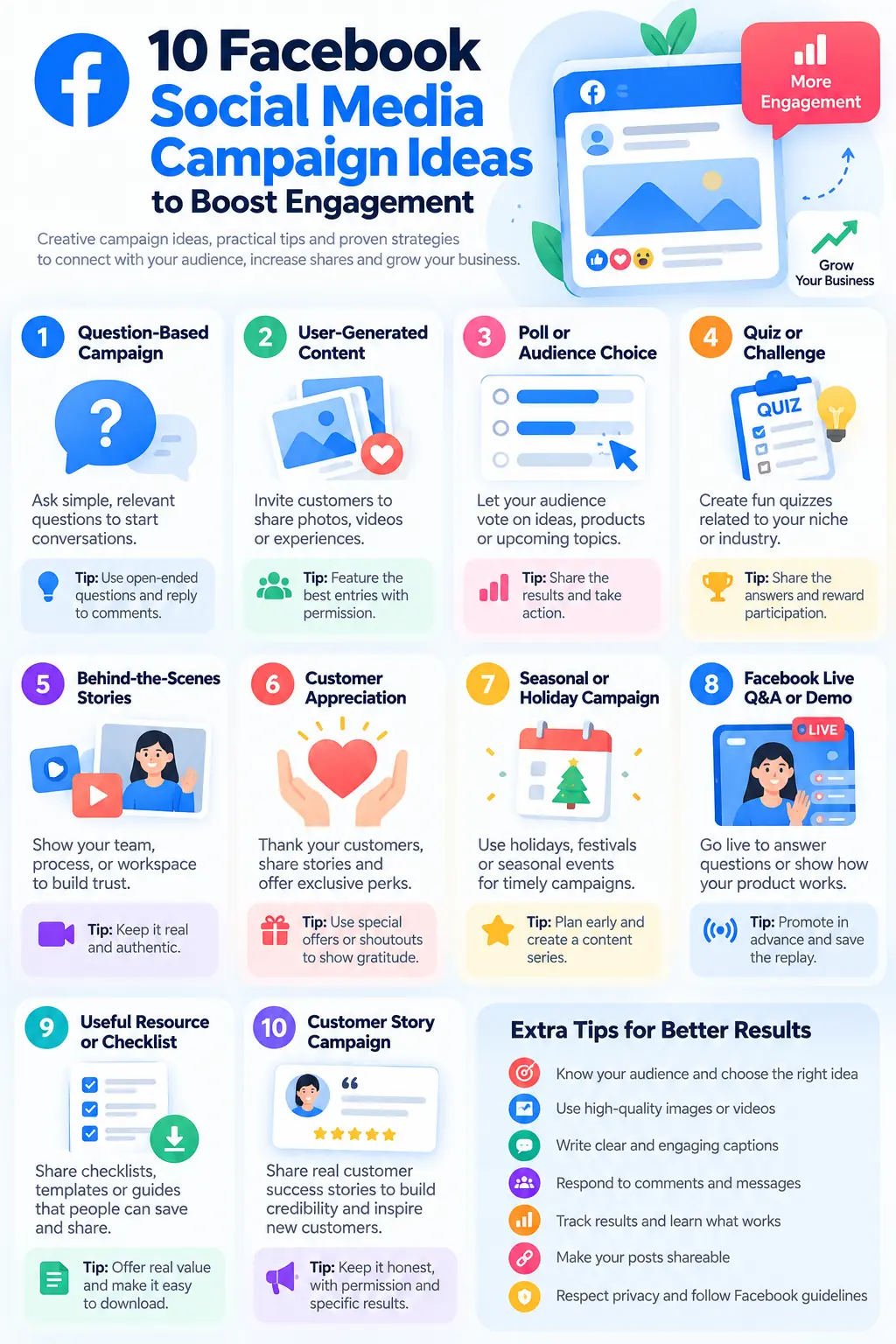
With that goal in mind, here are 10 Facebook Social Media Campaign Ideas you can
adapt to your audience.
## 1. Run a question-based engagement campaign
Best for: Community building, customer insights, and conversations
Sometimes the simplest campaign is a question people genuinely want to answer.
A question-based campaign invites followers to share their opinions, preferences,
experiences, or suggestions. It gives your audience a reason to participate while
helping your business understand what customers care about.
The key is to ask something specific and easy to answer. Broad questions such as“
What do you think about our brand?” can feel like homework. A focused question gives
people a clearer starting point.
### How to run the campaign
Choose a topic connected to your product, service, or audience’s interests. Publish
a post with a clear question and a relevant image or short video.
For example, a coffee shop might ask:
_“What’s your perfect morning coffee: a strong espresso, a creamy cappuccino, or
an iced latte?”_
A digital marketing agency might ask:
_“Which social media challenge takes up the most time in your business: creating
content, reaching customers, or measuring results?”_
Respond to comments with genuine follow-up questions. If people share useful suggestions,
acknowledge them and explain how their feedback could influence future decisions.
You can turn this into a recurring weekly feature, such as “Monday Questions” or“
Customer Choice Friday.”
### How to measure success
Track relevant comments, unique participants, replies, and the quality of feedback.
A hundred meaningful responses can be more useful than hundreds of repetitive comments.
Avoid asking people to post personal information publicly or pressuring them to
participate.
## 2. Create a user-generated content campaign
Best for: Trust, community participation, and customer stories
Customers can tell stories about your products and services that a brand’s own marketing
team cannot easily reproduce.
A user-generated content (UGC) campaign invites customers to share photographs,
videos, experiences, or creative ideas related to your business. With appropriate
permission, you can feature selected contributions on your Facebook Page.
For example, a clothing brand could invite customers to share how they style one
item in different ways. A travel business could ask customers to submit their favorite
trip memories. A software company might invite users to describe how a particular
feature helps them work more efficiently.
### How to run the campaign
Choose a clear theme and explain what participants should submit. Set a reasonable
deadline and publish straightforward rules covering eligibility, content requirements,
selection criteria, and any rewards.
Ask contributors for permission before reposting their content. Make sure your campaign
complies with applicable privacy, intellectual property, and platform requirements.
A sample campaign could read:
_“Show us how you use our product in everyday life. Share your favorite photo in
the comments or submit it through our campaign form. With your permission, we may
feature selected entries on our Page.”_
If you offer a prize, make the terms transparent. Avoid implying that Facebook sponsors
or endorses the campaign unless that is expressly authorized.
### How to measure success
Measure the number of valid submissions, participation rate, permissioned content
collected, reach, and meaningful interactions. If your objective is sales, also
track referral visits and purchases associated with the campaign.
The biggest benefit is often the customer insight you gain, not simply the number
of posts generated.
## 3. Launch a Facebook poll or audience-choice campaign
Best for: Product feedback, audience research, and interactive content
People enjoy having a say in decisions that affect them. A poll or audience-choice
campaign lets customers help select a product variation, choose an upcoming topic,
or express a preference between alternatives.
Imagine a bakery deciding which weekend special to introduce. It could ask followers
to choose between chocolate brownies and strawberry cupcakes. A digital publisher
could let readers vote on which tutorial should be published next.
This approach makes your audience part of the process rather than treating them
only as recipients of promotional messages.
### How to run the campaign
Identify a decision where customer preferences can genuinely help. Present two or
more clear options and explain when the result will be announced.
Use a Facebook poll where the feature is available and appropriate, or ask people
to comment with their choice. Avoid asking the same question repeatedly just to
inflate interaction counts.
Once the campaign ends, share the result and follow through when possible. If the
winning option cannot be implemented, explain why.
### Example campaign
_“We’re planning next month’s tutorial series. Which would help you more: Facebook
advertising for beginners or a guide to improving organic engagement? Vote below
and tell us why.”_
### How to measure success
Track votes, unique participants, useful comments, and whether the results inform
a real decision.
A poll becomes much more valuable when customers can see that their feedback made
a difference.
## 4. Organize a quiz or knowledge challenge
Best for: Education, entertainment, and brand
awareness
A quiz transforms information into an activity. Instead of simply telling people
about your product or industry, you invite them to test their knowledge.
This campaign format can work for educational businesses, technology brands, travel
companies, food businesses, publishers, and many other organizations.
A cybersecurity company could publish a “Spot the Phishing Email” challenge. A bookstore
could run a weekly literary quiz. A travel agency could ask followers to identify
destinations from photographs.
### How to run the campaign
Create a small set of questions related to your industry. Make the difficulty appropriate
for your audience, and explain the answer after the campaign closes or in a follow-
up post.
For example:
_“Quick marketing quiz: Which metric tells you how many unique accounts saw your
content—reach, impressions, or reactions?”_
You could publish one question per day for a week, then create a final post explaining
the answers.
If you offer a reward, publish clear eligibility and selection rules. Don’t make
the prize conditional on misleading claims or require people to disclose sensitive
information.
### How to measure success
Track completed answers, meaningful comments, video or post engagement where relevant,
and return participation across the series.
If the campaign is educational, evaluate whether it helps your audience understand
something useful rather than focusing only on the number of responses.
## 5. Share behind-the-scenes stories
Best for: Brand personality, credibility, and relationship building
Customers see the finished product, but they rarely see the people, decisions, and
work behind it.
A behind-the-scenes campaign reveals the process behind your business. You might
introduce your team, show how an order is prepared, explain how a product is tested,
or share the story behind a new service.
This format helps make a business feel more approachable and gives customers a better
understanding of what they are supporting.
### How to run the campaign
Choose a process that is interesting, relevant, and appropriate to share. Capture
genuine moments instead of staging every detail.
For example, a small bakery could publish a short video showing how its signature
bread is prepared. A web development company could demonstrate how a website moves
from an early design to a finished page. A local retailer could introduce the staff
members who help customers choose products.
Add a short explanation of why the process matters. If quality control is an important
part of your service, show the checks you perform and explain what customers gain
from them.
### How to measure success
Monitor video views, watch time where available, comments, shares, and questions
about your process. Also look for qualitative feedback that indicates whether people
better understand your business.
Don’t reveal customer information, confidential documents, security-sensitive processes,
or private workplace details without authorization.
## 6. Run a customer appreciation campaign
Best for: Loyalty, retention, and community recognition
Marketing often focuses on finding new customers, but existing customers also deserve
attention.
A customer appreciation campaign celebrates the people who support your business.
It could recognize a milestone, share a thank-you message, feature a customer story
with permission, or provide an exclusive benefit to eligible customers.
For example, an online store might celebrate its anniversary by thanking customers
who have supported it over the years. A local business could mark a community milestone
with a customer appreciation day.
### How to run the campaign
Start with a sincere message. Explain what you appreciate about your customers and
why their support matters.
If you feature individual customers, obtain permission before using their names,
photographs, testimonials, or purchase details. Give them the option to decline
without pressure.
You could also offer a limited-time discount or a useful resource as a thank-you.
Make the terms clear, including any expiration date or eligibility requirements.
### Example campaign
_“We’ve reached another year of serving our community, and we’d like to thank everyone
who has supported our journey. What is one thing you’d love to see us introduce
next year?”_
This combines appreciation with an opportunity to gather feedback.
### How to measure success
Measure participation, repeat purchases where relevant, customer feedback, and redemption
of any offer. Compare the results with your usual customer engagement to understand
whether the campaign made a meaningful difference.
The goal is to strengthen relationships, not make customers feel that appreciation
is simply a sales tactic.
## 7. Launch a seasonal or holiday campaign
Best for: Timely engagement, product discovery,
and seasonal sales
Seasonal campaigns give your business a natural reason to start a conversation.
Holidays, local festivals, seasonal changes, back-to-school periods, and industry
events can all provide relevant themes for Facebook content.
The key is to connect the occasion with something your audience actually cares about
instead of adding a holiday greeting to an otherwise unrelated sales message.
A home decor business might share affordable ways to refresh a room for a festival.
A restaurant could invite customers to vote for a seasonal menu item. A stationery
shop might publish a back-to-school checklist that parents can save and share.
### How to run the campaign
Plan your campaign early enough to prepare the creative assets, product availability,
landing pages, and customer support.
Consider a sequence of posts rather than a single announcement:
* **Before the event:** Publish useful tips, preparation ideas, or a question about
your audience’s plans.
* **During the event:** Share timely content, demonstrations, or relevant offers.
* **After the event:** Thank participants, share highlights, or invite feedback.
For example, a local bakery could run a week-long festival campaign featuring traditional
recipes, preparation videos, customer favorites, and a clearly explained special
offer.
### How to measure success
Track reach, shares, comments, website visits, offer redemptions, and sales where
applicable. Compare the results with previous seasonal campaigns, taking into account
differences in timing, budgets, and products.
Make sure your campaign respects the cultural context of the occasion. Avoid assuming
that every customer celebrates the same holidays or wants the same kind of promotional
message.
## 8. Host a Facebook Live Q&A or demonstration
Best for: Customer education, product demonstrations,
and direct interaction
A live session allows people to ask questions and hear answers in real time. It
can make complicated topics easier to understand and give customers a direct way
to interact with your business.
A fitness coach could demonstrate exercises and answer general training questions.
A software company could walk through a feature. A retailer could show how a product
works and answer questions about its use.
Live video is particularly useful when customers need to see a process rather than
read about it.
### How to run the campaign
Choose one clear topic and announce the session in advance. Explain what viewers
will learn, when the session will happen, and how they can submit questions.
Prepare a short outline so the discussion stays focused. Test your camera, microphone,
internet connection, lighting, and any demonstration materials before going live.
During the session, acknowledge questions and answer them honestly. If you don’t
know something, say so and follow up later rather than inventing an answer.
Afterward, share the replay if appropriate and turn useful moments into shorter
clips or a summary post.
### Example campaign
_“Ask us anything about getting started with WordPress. Join our live session this
Friday as we answer common beginner questions and demonstrate how to create your
first page.”_
### How to measure success
Look beyond the peak viewer count. Review watch time, meaningful questions, replay
views, follow-up visits, and qualified inquiries generated by the session.
A small live audience asking relevant questions may provide more business value
than a much larger audience that leaves immediately.
## 9. Create a useful resource or checklist campaign
Best for: Saves, shares, website traffic, and
lead generation
People often share content because it helps someone else solve a problem. A practical
checklist, short tutorial, template, or step-by-step guide gives your audience a
tangible reason to return to your post.
This approach works well for businesses that provide services, educational content,
software, professional advice, or products that require explanation.
A travel agency might publish a packing checklist. A digital marketing agency could
share a social media planning template. A home maintenance company might create
a seasonal maintenance checklist.
### How to run the campaign
Choose a problem your audience regularly encounters and create a resource that addresses
it clearly.
For example, a small-business marketing agency could publish:
_“Before you publish your next Facebook post, check these five things: Is the message
clear? Does the image support it? Is the link correct? Is the audience relevant?
Can you measure the result?”_
You could present the checklist directly in the post, publish a downloadable version
on your website, or create a short carousel explaining each step.
If you want to collect leads, explain what people will receive and how their information
will be used. Avoid requiring unnecessary personal data to access a simple resource.
### How to measure success
Track saves where available, shares, link clicks, downloads, qualified leads, and
subsequent conversions.
If the resource is designed to drive website traffic, make sure the landing page
delivers what the Facebook post promised. A useful campaign can lose trust quickly
when the destination is slow, confusing, or unrelated to the original message.
## 10. Run a customer story or success-story campaign
Best for: Credibility, consideration, and purchase confidence
A customer story shows how a real person or organization used a product or service
to address a specific need.
Rather than relying entirely on claims made by your business, you can explain the
customer’s original challenge, the solution they chose, and the outcome they experienced.
For example, a web design agency could share how a small business improved its booking
process. A gardening business might feature a customer’s completed garden transformation.
A software company could explain how a client simplified a repetitive workflow.
### How to run the campaign
Ask a willing customer to share their experience. Obtain permission to publish their
story, and verify any factual claims, figures, photographs, or quotations.
Structure the story around three questions:
1. What problem was the customer trying to solve?
2. Why did they choose your product or service?
3. What changed after they used it?
Keep the story specific and believable. Avoid implying that one customer’s results
are guaranteed for everyone. If a customer received compensation, a discount, or
another incentive for participating, disclose it where required.
### Example campaign
_“A local business approached us because customers found it difficult to book appointments
online. We helped simplify the booking journey, and the owner shares what changed
for the team and its customers.”_
The strongest customer stories explain the experience rather than simply declaring
that a business is excellent.
### How to measure success
Track meaningful comments, shares, visits to related service pages, inquiries, and
conversions. You can also ask prospective customers whether the story helped them
understand your service.
Customer stories work best when they are truthful, permission-based, and relevant
to the questions potential buyers actually ask.
## How to choose the right Facebook campaign idea
You don’t need to run all 10 campaigns at once. Start with the idea that fits your
current business goal, available resources, and audience.
| Your goal | Campaign ideas to try | What to measure |
| Encourage conversations | Question posts, polls, quizzes | Meaningful comments, participants, replies |
| Build customer relationships | Appreciation campaigns, customer stories | Feedback, repeat engagement, retention |
| Generate creative content | User-generated content | Valid submissions, permissions, shares |
| Explain your product | Behind-the-scenes videos, live demonstrations | Watch time, questions, qualified inquiries |
| Increase seasonal sales | Holiday campaigns | Offer redemptions, revenue, conversions |
| Attract website visitors | Checklists, educational resources | Link clicks, landing-page visits, conversions |
| Improve brand awareness | Quizzes, seasonal content, useful resources | Reach, relevant shares, audience growth |
These are starting points, not guarantees. The same campaign can perform differently
across industries, audiences, budgets, and time periods.
## How to plan a Facebook campaign step by step
A strong campaign needs more than a creative idea. It needs a clear objective, a
realistic execution plan, and a way to determine whether it worked.
### Step 1: Define one primary objective
Decide what you want people to do. Examples include participating in a discussion,
visiting a landing page, submitting an inquiry, registering for an event, or purchasing
a product.
Avoid trying to maximize every metric at once. A campaign designed to generate qualified
leads may not receive the most likes, and that doesn’t necessarily mean it has failed.
### Step 2: Understand your audience
Review the needs, interests, location, and behavior of the people you want to reach.
If your Facebook Page has sufficient audience data, use the available insights to
understand who engages with your content and which posts generate useful responses.
Our guide to [Facebook audience demographics and audience insights](https://simplyirfan.com/fb-demographics/)
can help you think about the characteristics of the people your content is intended
to reach.
Don’t assume that every follower is a potential customer. Tailor the campaign to
the people most likely to benefit from your offer or information.
### Step 3: Develop a clear creative concept
Write the main message before designing the post. Decide what the audience should
understand, feel, or do after seeing it.
Use an image, video, or text format that supports the idea. Make the opening line
clear, keep the message focused, and include a call to action that matches the objective.
### Step 4: Choose the right format
Depending on the campaign, you might use a text post, photograph, short video, carousel,
Story, poll, live session, or event.
Check the current features available to your Page and account. Facebook formats
and publishing options can change, so don’t build your entire strategy around a
feature without confirming that it is available to you.
For practical guidance, see how to [create and publish an effective Facebook Page post](https://simplyirfan.com/facebook-page-post/).
### Step 5: Decide whether paid promotion is appropriate
Organic posts can be a good starting point for testing a concept with your existing
audience. Paid promotion may help when you need to reach a larger or more specific
audience, generate leads, or drive sales.
If you advertise, select a campaign objective that aligns with the action you want
people to take. Meta Blueprint offers training on [choosing campaign objectives and measuring ad results](https://www.facebookblueprint.com/student/path/211544-ads-manager-objectives).
Set a budget you can afford, define your audience carefully, and monitor results.
Avoid assuming that boosting every post is necessary.
### Step 6: Publish, respond, and follow through
Once your campaign is live, monitor responses and answer genuine questions. If people
identify a problem or misunderstand your message, respond constructively and update
the campaign if needed.
If you promise to announce a poll result, deliver a resource, or publish a customer
story, follow through. Consistency helps build confidence in your business.
### Step 7: Review the results
After the campaign ends, compare its performance with your original objective. Record
what worked, what did not, and what you would change next time.
Don’t judge a campaign solely by its most visible metric. A post with fewer interactions
may still generate more qualified inquiries or sales than a highly popular post.
## How to increase the shareability of your Facebook campaign
Sharing can introduce your content to people who don’t already follow your Page.
But people are more likely to share something when it is genuinely useful, entertaining,
informative, or personally meaningful.
To improve the chances that people will share your campaign:
* **Provide clear value:** Share a useful tip, answer a common question, or create
a resource people may want to revisit.
* **Make the content easy to understand:** Use a clear opening, readable visuals,
and a focused message.
* **Give people a natural reason to share:** A checklist may help a colleague,
while a local event announcement may help a friend.
* **Avoid manipulative engagement bait:** Don’t pressure people to comment, tag
friends, or share posts just to inflate engagement.
* **Make the destination trustworthy:** Check links, landing pages, and privacy
practices before promoting a resource.
For more practical guidance, read [how to make a Facebook post more shareable](https://simplyirfan.com/how-to-make-a-facebook-post-shareable/).
Shareability is not fully controllable. A good campaign can still receive limited
distribution, so focus on creating useful content and learning from the response
rather than trying to force virality.
## Common Facebook campaign mistakes to avoid
Even a creative campaign can underperform when the execution is poor. Watch out
for these common mistakes.
**Posting without a goal.** If you don’t know what success looks like, you won’t
know whether the campaign worked.
**Making every post promotional.** Audiences need a reason to follow your Page beyond
repeated sales messages. Balance promotional content with education, entertainment,
useful information, and community interaction.
**Ignoring comments and messages.** A campaign invites participation, so unanswered
questions can undermine the experience.
**Using misleading headlines or exaggerated promises.** Clicks gained through confusion
or false expectations can damage trust.
**Collecting unnecessary personal information.** Request only the information you
need, explain how it will be used, and protect it appropriately.
**Copying competitors without understanding their audience.** A campaign that works
for one brand may not suit another business’s goals, resources, or customers.
**Measuring only likes.** Reactions are easy to notice, but they don’t tell the
entire story. Consider shares, meaningful comments, leads, visits, purchases, and
customer feedback where relevant.
**Ignoring privacy and permissions.** Make sure customer photographs, testimonials,
and submitted content are used appropriately.
Facebook campaigns should build relationships with people, not treat them as engagement
numbers.
For more detail, review these [Facebook privacy mistakes that users and businesses should avoid](https://simplyirfan.com/fb-privacy-mistakes/).
If you’re evaluating where else to build your online community, our overview of
[Facebook alternatives and other social platforms](https://simplyirfan.com/facebook-alternatives/)
can help you consider additional options.
## Frequently asked questions about Facebook Social Media Campaign Ideas
### What are the best Facebook Social Media Campaign Ideas for small businesses?
Question-based posts, customer stories, seasonal campaigns, polls, and behind-the-
scenes videos are practical starting points. They can often be produced with existing
resources and adapted to a local audience without a large advertising budget.
Choose a campaign that supports a specific business goal and can be managed consistently.
### How often should I run a Facebook campaign?
There is no universal schedule that works for every business. You might run a focused
campaign around a product launch, holiday, event, or customer milestone, while maintaining
regular educational and community-focused content between campaigns.
Consider your team’s capacity, audience response, and the time needed to evaluate
results before launching another campaign.
### Do Facebook campaigns need a paid advertising budget?
No. You can run many campaigns organically through your Facebook Page. Paid advertising
is an option when you need additional reach or want to optimize for a specific business
action.
If you use ads, define the objective, set a budget, and measure the outcomes that
matter to your business.
### How do I measure Facebook campaign engagement?
Start with the objective. For a discussion campaign, examine meaningful comments
and unique participants. For a resource campaign, track link clicks and downloads.
For a sales campaign, focus on conversions, revenue, and cost per acquisition where
appropriate.
Compare similar campaigns over time instead of treating one result as a universal
benchmark.
### Can Facebook campaigns help increase sales?
Yes, they can support product discovery, customer education, lead generation, and
sales. However, results depend on the offer, audience, creative, customer experience,
and other factors.
A campaign may generate interest without producing immediate purchases, so measure
the full journey where possible.
### How can I make a Facebook campaign more engaging?
Start with a topic that matters to your audience, communicate the idea clearly,
use an appropriate format, and give people a natural way to participate. Respond
to comments, learn from feedback, and improve future campaigns based on the results.
Avoid misleading claims, artificial engagement tactics, or requests for unnecessary
personal information.
## Final thoughts
The best Facebook Social Media Campaign Ideas don’t need to be complicated. A thoughtful
question, an honest customer story, a useful checklist, or a well-planned live session
can give people a meaningful reason to interact with your business.
Start with one campaign that matches your audience and objective. Prepare the content,
publish it with a clear purpose, respond to participants, and review the results
before deciding what to try next.
Remember that engagement is a means to an end, not always the end itself. The most
useful campaign is the one that helps your business build stronger relationships,
understand customers better, or achieve a measurable objective.
Experiment with these 10 ideas, adapt them to your audience, and let evidence, not
assumptions, guide your next Facebook marketing campaign.
**Helpful sources**
* [DataReportal: Digital 2026 — India](https://datareportal.com/reports/digital-2026-india)—
Facebook advertising reach estimates and digital audience context.
* [Meta Blueprint: Introduction to Campaign Objectives](https://www.facebookblueprint.com/student/path/211544-ads-manager-objectives)—
guidance on aligning advertising objectives with business goals.
* [Meta Blueprint: Engage with People and Build an Audience](https://www.facebookblueprint.com/student/page/245058-engage-with-people-and-build-an-audience)—
practical lessons on posts, Stories, messages, and audience interaction.
[ Stay connected via Google News ](https://www.google.com/preferences/source?q=simplyirfan.com)